


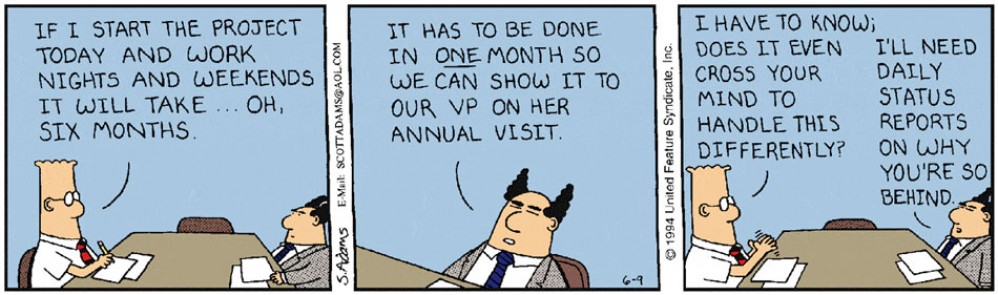
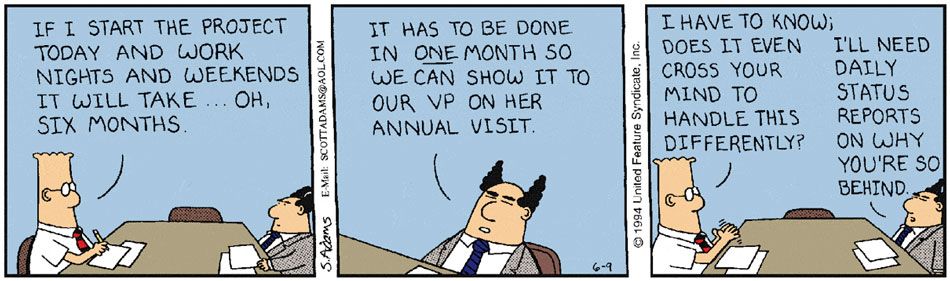
'Dilbert' (9 June 1994).
Scott Adams was an American comic artist, most famous for his long-running gag comic 'Dilbert' (1989-2025), a witty and sometimes absurd satire of office life, bureaucracy and the corporate world. 'Dilbert' was one of the first newspaper comics to increase its popularity online, as a new genre called webcomics. Since the early days of the internet, 'Dilbert' gags have been shared on bulletin boards, through e-mails and social media. Book compilations sold in such high quantities that 'Dilbert' was often the only comic book entering the Top 10 of "Current Best-Selling Books". It inspired various merchandising items, as well as an animated TV series, 'Dilbert' (1999-2000). Adams additionally wrote non-fiction books and two novels. By the 2010s, Adams' personal political-economic opinions had begun to overshadow 'Dilbert', resulting in a severe backlash from audiences and longtime fans. In 2023, after making comments that were widely criticized for being racist, 'Dilbert' was cancelled as a newspaper comic. As a webcomic, it kept running. Around the same time, Adams was also diagnosed with terminal cancer, which slowed down his production process almost entirely. Scott Adams the cartoonist should not be confused with computer programmer and video game designer Scott Adams (b. 1952).
Early life and career
Scott Raymond Adams was born in 1957 in Windham, a town in the Catskill Mountains in New York. His father was a post office clerk, who earned some extra income by painting houses. His mother worked in real estate and later on an assembly line. In her spare time, she painted landscapes. From a young age, Adams wanted to become a cartoonist. Among his graphic influences were Charles M. Schulz, Al Capp, Gary Larson, Bill Watterson and Mad Magazine. Later in life, he also expressed admiration for Tony Carrillo, Roz Chast, Scott Meyer and Stephan Pastis. At age 11, Adams applied for a junior art course at the Famous Artists School in Westport, Connecticut, but was rejected due to his young age. While they did promise him that he could come back within a year and gave him some encouraging remarks, Adams instead enrolled at Hartwick College in Oneonta, New York. However, after receiving the worst grade of all pupils, the teenager was so discouraged that he abandoned drawing in favor of economics. He graduated from Hartwick with a bachelor's degree in 1979, followed by a master in business administration (1986) from the University of Berkeley, California. Adams also took a Dale Carnegie corporate training course to improve his public speaking ability.
Between 1979 and 1986, Adams worked as a teller at Crocker National Bank in San Francisco. He then joined the Pacific Bell Telephone Company (1986-1995), where he was subsequently active as a computer programmer, financial analyst, product manager, commercial lender, budget manager, strategist, project manager and applications engineer. He was responsible for the ISDN lines, since he predicted that telecommunication was the wave of the future. In his twenties, Adams also learned to become a hypnotist. He claimed this skill gave him great insights on how to program people's brains with consistent effort. In his opinion, people are nothing more but "moist robots". In 2024, he also claimed to have taught Chat GPT to perform hypnotism on himself.
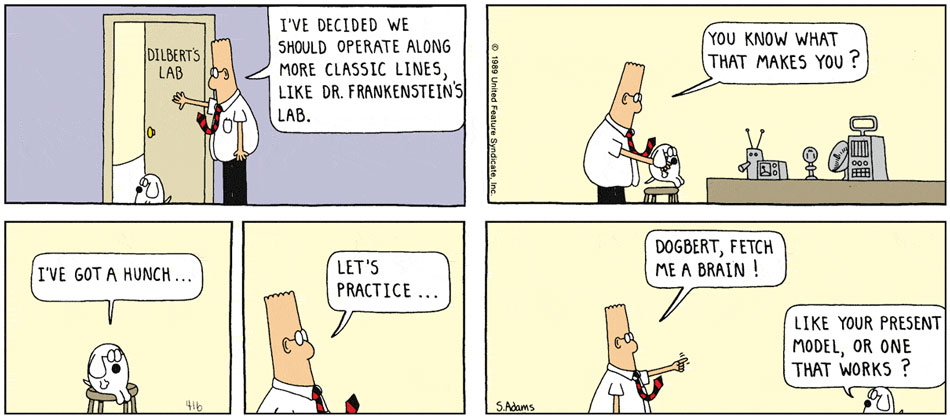
Debut episode of 'Dilbert' (16 April 1989).
Dilbert
At Pacific Bell (1986-1995), Scott Adams had a decently-paid desk job at a major hi-tech company, but still felt disillusioned. Each function appointed to him sounded far more meaningful than what it actually represented. None improved his status, salary or company input. Even when he climbed the ladder to become a manager, he was only in charge of about 7 to 15 people at best. During boring meetings, he often doodled, rediscovering his fondness for comics and cartoons. He started venting his frustrations about office life in a gag comic and considered the idea of getting it into print. One day in 1987, he was channel surfing and noticed cartoonist Jack Cassady's TV show on cartooning 'Funny Business, the Art in Cartooning'. The episode had just concluded, but Adams wrote down the creator's name from the end credits and sent him a letter, asking him for advice. Cassady told him to submit his work to various magazines. Aiming high, Adams originally wrote to The New Yorker and Hugh Hefner's Playboy, but was rejected. Discouraged, he considered he probably "wasn't good enough" and wanted to give up until Cassady sent him a follow-up letter, asking him if he was making any progress and coincidentally advising him to "not give up". The fact that Cassady believed so much in his potential that he mailed him back a second time out of curiosity, motivated Adams to try applying again. As luck would have it, United Media picked his comic up for syndication.
On 16 April 1989, the first Sunday episode of 'Dilbert' appeared in print, with the daily comic following the next day. Adams had held a contest at his workplace, asking his co-workers to come up with a good name for his protagonist. His boss, Mike Goodwin, suggested "Dilbert", which sounded perfect to Adams. Only years later, Adams discovered that Goodwin had been inspired by the World War II-era cartoon character Dilbert Groundloop, created by Capt. Austin K. Doyle. From the start, Adams' comic featured two major characters, Dilbert and Dogbert, whose design and personalities were already permanently defined. Dilbert is a geeky, bespectacled, hilariously unlucky engineer. Interviewed by Dick Donahue (Publishers Weekly, 6 October 2008), Adams revealed that his protagonist was based on "a real person, who doesn't know it. I worked with him, but didn't know him well. He just had an interesting potato-shaped body that was fun to draw. (...) Dilbert's lack of social skills is modeled on my own personality: his professional skills are a composite of engineers I have known." His pet Dogbert is such a smart dog that he bosses him around, making condescending remarks.
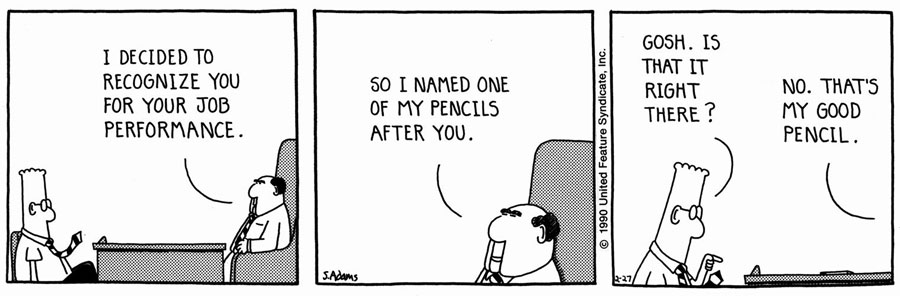
'Dilbert' (27 February 1990).
However, in those early years, the set-up was slightly different. Dilbert worked in a laboratory, where he and Dogbert did all kinds of strange experiments. A lab animal, Ratbert the Rat (introduced in 1990), and Dilbert's downright sadistic cat Catbert (1994) were derivations of Dogbert. In fact, on 17 September 1990, Dilbert was killed by a deer, but on 5 October cloned back to life by his highly intelligent garbageman. The present-day Dilbert is therefore a literal clone of the original. Adams killed off Dilbert not out of any hatred for his own creation, but merely to see how readers would react. Since his comic wasn't that popular yet, nobody did. Between 1989 and 1993, Dilbert was portrayed at home, in his lab and occasionally at work, in an office. Through readers' mail, the cartoonist learned that the office-themed gags were appreciated the most and so he made that his protagonist's permanent habitat. This decision also worked in his own creative favor, since he had first-hand experience working as an IT professional in a cubicle workspace.
For his new set-up, Adams changed Dilbert into an employee with a computer desk job in a small cubicle at an undisclosed company. He is constantly overloaded with complicated, labor-intensive and ultimately pointless tasks. His superiors expect him to work overtime and consider asking for a raise a sign of "ingratitude". None of his complaints are ever taken seriously. Dilbert's initiatives to try things differently are either misunderstood, met with indifference or get thwarted by Kafkaesque bureaucracy measures. His colleagues share the same misery, but only care about themselves. To add insult to injury, even Dogbert and Catbert have moved higher up the corporate ladder than Dilbert. Dogbert is part of the managing board, while Catbert is a human resources director. After hours, Dilbert spends most of his life online, struggling to get a date. His only steady girlfriend was Liz. Even Dilbert's mother, Dilmom, doesn't approve of him that much and spends most of her time complaining about everything he does wrong. In short, Dilbert can be described as an adult version of Charles M. Schulz' Charlie Brown, whose misery is both hilarious and, at the same time, all too recognizable.
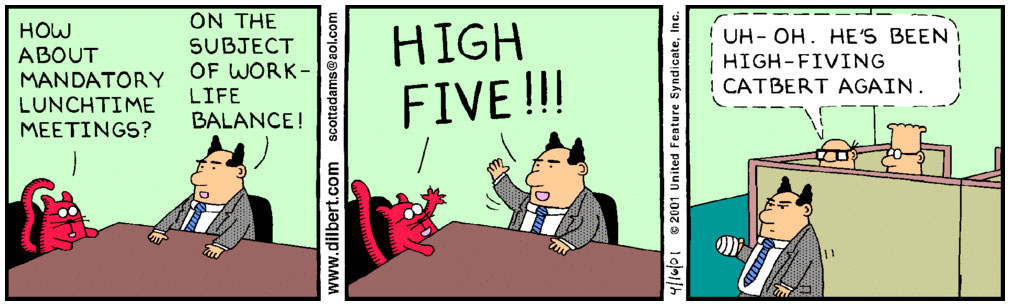
'Dilbert' (16 April 2001).
In the early years of the comic, Dilbert's co-workers were interchangeable side characters. By 1992, a genuine cast of personalities emerged. Dilbert often hangs around with the balding engineer Wally, who is rarely seen without his cup of coffee. Wally has been in the business for so long that he became an utter cynic. He no longer puts any effort in his work, doesn't care about his colleagues' well-being and accepts that company improvement is an illusion. Adams based Wally on a real-life co-worker who deliberately acted rude and sloppy at work, because he had heard that Pacific Bell's worst employees would be bought out and hoped to be part of that selection process himself. Other notable co-workers of Dilbert are Alice, Asok, Ted and Tina. Alice, whose hair resembles a triangle, is prone to temper tantrums, often using her "fist of death" on anyone who annoys or insults her. Asok is a smart Indian engineer, yet always receives tasks beyond what he is actually capable of. Ted is basically a walking running gag. He is frequently fired, has horrific accidents or is even killed, but always returns in other episodes as if nothing has happened. Tina is a tech writer and frustrated feminist, who always feels as if she has to remind others of her valuable skills.

'Dilbert'.
Dilbert's boss serves as a major antagonist. The character debuted in 1989, but only received his trademark pointy hair in 1991. Since Adams refused to give him a proper name, so that readers could imagine him representing their own supervisor, fans have nicknamed the character "the Pointy-Haired Boss". For similar reasons, Adams always kept both the name and nature of Dilbert's company vague, so more readers could imagine it to be theirs. One might even say it adds a satirical dimension, as the employees are so distracted by trivialities and suffocating bureaucracy that they no longer seem to remember what their company actually does. The Pointy-Haired Boss is utterly incompetent. His business strategies and projects are hopelessly unrealistic and fruitless. It is a mystery how he ever got his high-profile position, since he doesn't understand the inner workings of his company, or its administration in general. Apart from his questionable sales techniques, the Pointy-Haired Boss is insensitive towards his subordinates. He doesn't care about their personal problems, nor their suggestions to restructure the company. When they want a day off, or a raise, he slugs it off for superficial reasons. The Boss also has a brother, "Phil, the Prince of Insufficient Light", a not-very-subtle allusion to "the Prince of Darkness", or the Devil. Indeed, Phil is actually a demon in disguise. He punishes employees for minor mishaps, hinting that they will suffer eternal torture in a place called "Heck" (the euphemism for "Hell" used by censors). Though the threat is somewhat hollow, since even Phil admits that working in a cubicle is far worse than Hell itself. The Pointy-Haired Boss' secretary, Carol, hates her superior with such laughable venom that she tried to sabotage his career and downright murder him in increasingly convoluted fashions.
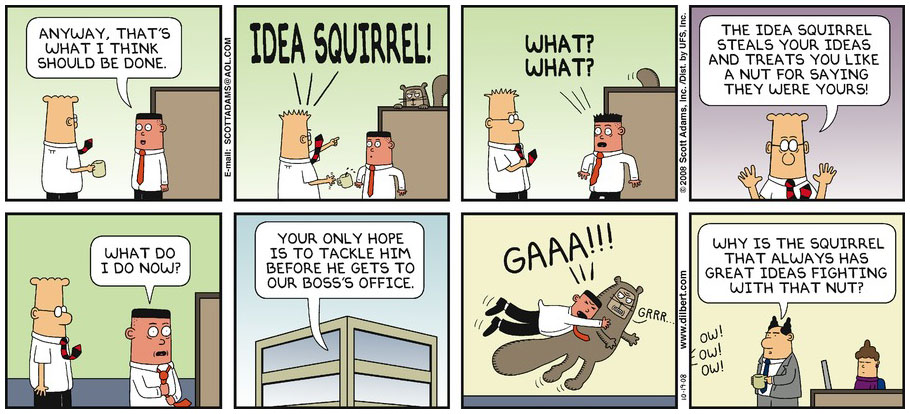
'Dilbert' (19 October 2008).
Dilbert: style
'Dilbert' is a witty, often biting satire of office life and the business world. All employees are stashed away in cubicles and regarded as disposable wheels of the "factory". Their tasks are either demeaning or senseless and they are put up against ill-conceited deadlines. Meetings feel like time-killing activities, only to make the hours pass even slower and more gruelling. Everybody feels stuck in a rut, trying to find an individual voice in a business structure that suppresses it. Nobody has any clue what they're doing. Any initiative to improve working conditions or increase profits is rejected. When catastrophe strikes, everybody refuses to take responsibility and blames it on the other. Whenever the company tries to innovate, they never get much further than trendy buzz words, impressive-sounding titles and corny team spirit-enhancing projects. Some employees are so numb that they simply punch the clock, waiting for their miserable paycheck. Others have completely given up and just laze about, since it doesn't make any difference anyway. Their only delight is doublecrossing, belittling or tormenting colleagues.
Beyond the satire of real-life corporatism, 'Dilbert' has also featured more absurd situations and characters. Several employees are anthropomorphic animals, like the previously mentioned Dogbert, Catbert and Ratbert, but also the old-fashioned employee Bob, who is a literal dinosaur. Others are fictional beings, like Phil the demon. Mordac the Preventer of Information Services is a seemingly extraterrestrial evil overlord. Dilbert's company has also been plagued by a group of accountants who are literal trolls unable to cope with changes. Even worse are the "idea squirrels", huge squirrels who overhear conversations only to take credit for good ideas and report them to the boss before anyone else can. In one gag, Dilbert had met a time traveller who is his future self. In another, Wally wishes he was a fly on the wall, so he could overhear an executive meeting and suddenly magically changes into one.
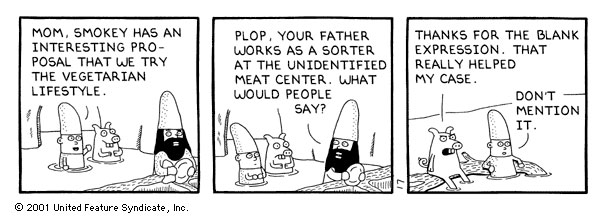
'Plop: The Hairless Elbonian' (2001).
A recurring country in the comic is Elbonia, an impoverished, Eastern European state that Dilbert's company makes business deals with. Adams created it as a stand-in for a general "foreign country", so he wouldn't offend any real-life countries in translation. During the summer of 2001, Adams created a short-lived spin-off, 'Plop: The Hairless Elbonian', about an Elbonian citizen and his pet pig. After 21 episodes, Adams decided to rename the character and the comic's title to 'Squat', since DC Comics had already created a comic magazine named Plop in the 1970s. After the terrorist attacks on the World Trade Center on 11 September 2001 and the ensuing War on Terror, Adams decided to discontinue the spin-off, since the bearded characters in their mud-filled country were too reminiscent of a Middle Eastern setting.
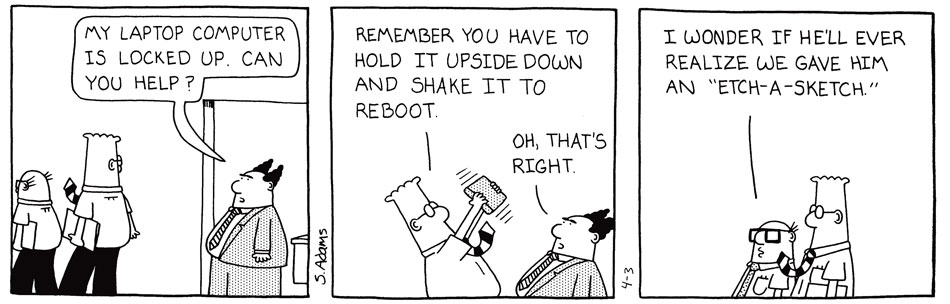
According to Scott Adams, this was the all-time most popular 'Dilbert' strip. It went on to appear on coffee mugs, mouse pads and T-shirts.
Dilbert: success
During the first six years of 'Dilbert', Scott Adams combined his comic with his day job at Pacific Bell for financial and medical benefits, but also because it provided him with constant inspiration. Every morning, he would rise at four o'clock and draw a new gag before going to work. After hours, he inked what he had drawn earlier that day. Slowly but surely, 'Dilbert' picked up a following, and by 1991, the strip was running in 100 newspapers. As one of the first cartoonists to have his own email address, Adams started adding it to each strip, so fans could write to him. Their feedback gave him the advantage to be more interactive. After learning that they liked gags set in an office the best, Adams turned 'Dilbert' into a permanent "office comedy". Characters that readers enjoyed were given larger recurring roles. Likewise, many of their personal anecdotes about office experiences found their way into 'Dilbert' gags. As the fanbase grew, Adams' editor suggested collecting all the office-themed gags into a book, which became the bestseller 'Build a Better Life Stealing Office Supplies' (Nicholas Brealey Publishing, 1994). Adams recalled that his business sense won out from his artistic integrity to just give his customers what they wanted. By the end of that year, 'Dilbert' ran in 400 newspapers.
While humor comics set in an office had existed before, 'Dilbert' still struck a nerve. Adams was lucky to debut at a turning point in history. When 'Dilbert' first appeared in print in 1989, Reaganomics and Thatcherism had been the neoconservative business model for almost a decade. Many companies were privatized. Ambitious businesspeople, nicknamed "yuppies", profited from the fact that they could market products with little government interference. Despite the 1987 Wall Street Crash, companies were lucky that in 1989 the Iron Curtain and Berlin Wall fell, leading to the dissolution of the Eastern Bloc. As Eastern Europe abandoned Communism, a whole new Capitalist market opened up. As a result, readers from all over the world could newly relate to the corporate satire in 'Dilbert'. Several situations are very recognizable to anyone stuck in a bureaucratic job. Likewise, Adams' characters often say and do things readers sometimes wish they could, except that they would be fired for it.
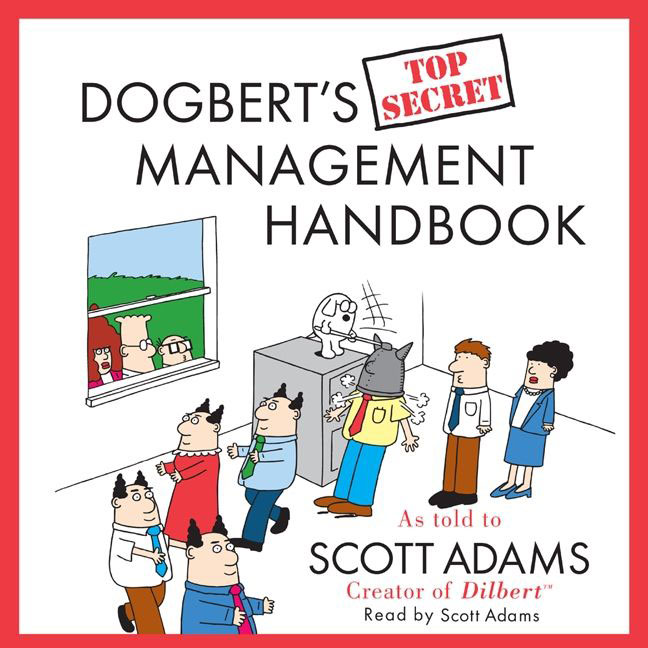
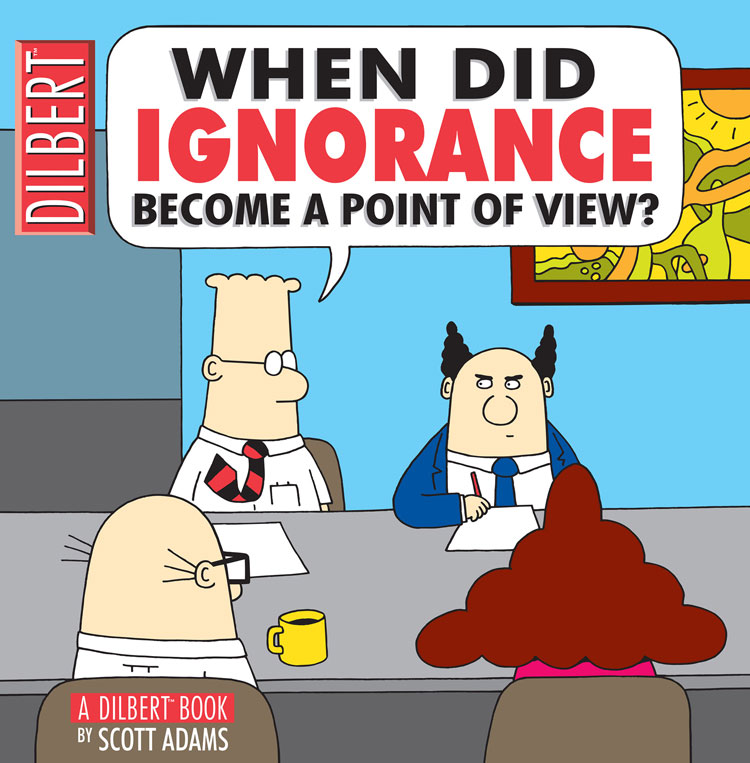
'Dilbert' book compilations.
Another historical evolution in Adams' favor was the Internet going public (1992). Thanks to his job in telecommunication, the cartoonist had already noticed that online communities were growing. He started referencing Internet jargon and other phenomena in his 'Dilbert' strips. Originally, this geeky comedy appealed mostly to people who already had access to the world wide web. But from 1995 on, when more companies launched websites and people bought Microsoft's Windows 95, 'Dilbert' only became more contemporary. That same year, Adams was the first syndicated newspaper cartoonist to make his comic strip also available online, publishing it on his own site, The Dilbert Zone. At the time, this seemed a risky move, with editors fearing that people wouldn't want to buy comics if they could read the same product online for free. But it actually increased 'Dilbert' 's fame. Adams recalled that many people asked where they could buy, or read "that office comic strip they'd read online." People visited Adams' website to catch up on gags they had missed.
'Dilbert' became the most popular newspaper comic and webcomic of the 1990s, lasting well into the 21st century. In offices all over the world, employees passed or mailed gags around or stitched them on walls, notice boards or the back of their computers. Everybody knew a manager, secretary, executive, motivational skills worker, engineer or common employee like the ones depicted in Adams' comic. Or, if they were self-employed, they saw all their reasons for not wanting to work under a boss confirmed. In some newspapers, 'Dilbert' was even deliberately not printed on the regular comics page, but in the business section. Adams sometimes took inspiration from anecdotes he remembered from his own job. Some dialogues were even exact quotes of things his superiors said to him or from company memos delivered on his desk. When, for instance, his boss wanted to have a conversation to improve their bond, he ended up bragging that he could "crush" Adams anytime he wanted. Even the most surreal situations in 'Dilbert' were often only slight exaggerations. Every time Adams thought he had come up with the most outrageous blunder a management could possibly make, there were always readers who wrote him examples that surpassed satire. In one 1998 gag, in which a woman complained about being underpaid and is told that "it appears you're not qualified for your own job, but one of your subordinates is", Adams felt obliged to add "based on a true story" to inform readers that this situation actually happened to somebody who wrote him.
In 1995, when both Bill Watterson's 'Calvin and Hobbes' and Gary Larson's 'The Far Side' ended in papers, 'Dilbert' became the logical replacement, since it was already so popular. By the end of that year, the strip ran in over 800 papers. 1995 was therefore, in many ways, Adams' "annus mirabilis". The only downside was a minor one: that same year he was laid off at Pacific Bell. But thanks to 'Dilbert', Adams no longer had to worry about money, while simultaneously not actually having to do any meaningful work at Pacific. Often, he'd made a deal with his co-workers that they would do his tasks, if he, in return, would just turn up whenever their customers wanted to meet "the famous Scott Adams" in person. Adams' boss was aware of this deal, but they had made a gentleman's agreement that if there was ever a budget concern that required somebody more needy of Adams' job to be hired, he wouldn't resist. When that day came, Adams accepted it. Still, in several later interviews, the 'Dilbert' cartoonist was often very contradictory regarding the exact reasons for his departure. He sometimes claimed he had left on his own terms, while other times that he'd been fired, or "a combination of the two." Sometimes he said that his comic strip was probably not the reason for him being laid off. In other interviews, though, Adams claimed that his boss asked him to never portray him in 'Dilbert': a promise that he broke almost instantly afterwards, proving there was still something of a grudge. In his book, 'The Early Years', Adams also wrote that after he had quoted from a direct memo by his vice president of engineering in a 'Dilbert' comic, the gag in question was brought to the man's attention. He wanted to fire Adams, but his boss said that doing this for just making jokes would be a mistake. Instead, they simply decided to give him awful assignments in the hope of making him quit. Adams only heard about this after he was already gone from the company.
Although Adams feared that no longer working in an office might change the dynamic of 'Dilbert', the comic kept growing more lucrative. It was translated into more than 19 languages and syndicated in 57 countries. Book compilations consistently held spots in the Top 10 of The New York Times' Bestseller List. 'The Dilbert Principle' (1996) spent 27 consecutive weeks on number one in this Top 10, breaking a record as the best-selling business-related book of all time. By 2000, 'Dilbert' appeared in more than 2,000 papers internationally, syndicated by United Feature. In 2010, Adams left United when it sold its licensing arm to Iconix Brand. From 2010 until 2023, 'Dilbert' was syndicated by Universal Uclick (a division of Andrews McMeel). Throughout its more than 30-year run, Adams wrote and drew 'Dilbert' almost completely on his own. On April Fool's Day 1997, all the newspaper cartoonists at Adams' syndicate drew each other's comics for a day, with Bil Keane drawing 'Dilbert' and Adams doing Keane's comic 'The Family Circus'. In 2003, Adams let seven other colleagues draw gags, namely Lynn Johnston, Darby Conley, Pat Brady, Greg Evans and Stephan Pastis. In May 2016, he took a six-week vacation during which episodes he had written were drawn by Joel Friday, John Glynn, Donna Oatney, Eric Scott, Josh Shipley, Jake Tapper and Brenna Thummler. Between 23 and 28 September 2019, Tapper again drew a week's worth of 'Dilbert' gags.
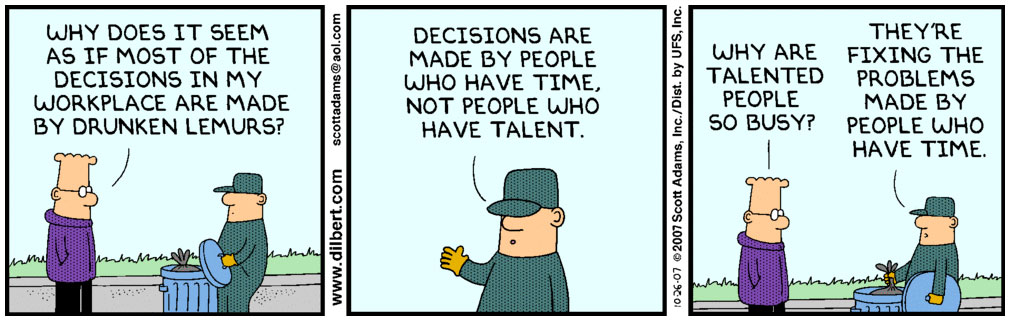
The "Lemurs" gag that got an Iowa casino worker fired (26 October 2007).
In October 2007, a man got in trouble after hanging a 'Dilbert' gag on an office bulletin at the Catfish Bend Casino in Burlington, Iowa, after being informed that the casino would close down. The gag in question compared management decisions to the actions of drunken lemurs. After identifying the perpetrator through a surveillance camera, he was fired on the spot, while the casino management tried to prevent him from receiving unemployment benefits. However, an administrative law judge ruled in December 2007 that the action was not legally justified and the man should receive his unemployment benefits. In support of this fan, Adams drew another comic strip in which Wally posts a comic strip comparing managers to drunken lemurs. Another gag in which U.S. Vice President Al Gore had a cameo, was requested by his staff: the original hung in Gore's office afterwards.
Dilbert: merchandising
Like most successful newspaper comics, 'Dilbert' inspired its fair share of merchandising, including mugs, T-shirts, calendars, card, board and video games. In 1998, Ben & Jerry's released a new flavor of their ice cream, 'Dilbert's World Totally Nuts!'. With permission of United Airlines, they set up cubicles at the La Guardia Airport in New York City, offering free samples. But it turned out to be an April Fool's joke. Adams mocked the initiative by stating: "It's the first Dilbert product that doesn't have any bitterness." Still, it seemed to give him an idea for a real food product based on his characters. In 1999, Adams launched Scott Adams Foods, Inc. The company made a vegetarian microwave burrito, named the Dilberito, but it failed to catch on. By 2003, Adams closed down this business.
The success of 'Dilbert' made the TV network FOX consider a live-action sitcom version, but Adams preferred an animated series, since it would be closer to his graphic style and have more creative possibilities. Between 25 January 1999 and 25 July 2000, an animated 'Dilbert' show, produced by Adelaide Productions, Idbox and United Media, ran for two seasons on the United Paramount Network (UPN). Adams was co-executive producer along with Larry Charles, known as scriptwriter for 'Seinfeld' and 'Mad About You'. The theme music was composed by Danny Elfman, who previously wrote the theme to Matt Groening's 'The Simpsons'. It was basically a rearrangement of music Elfman wrote for a previous film, 'The Forbidden Zone'.
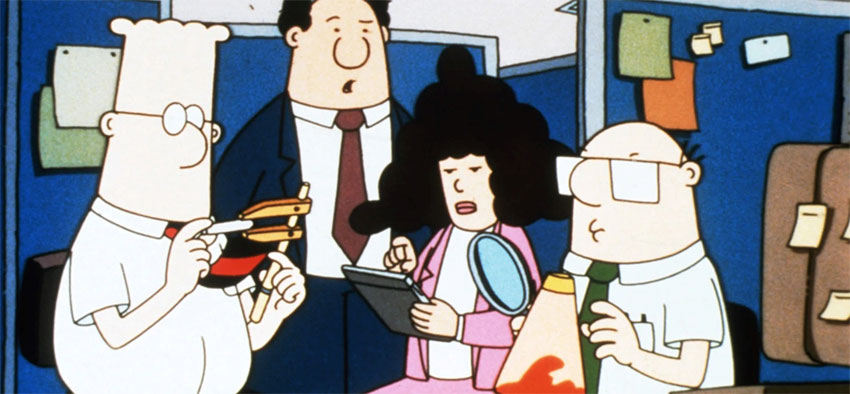
Still from the 'Dilbert' TV show.
The 'Dilbert' TV series featured Daniel Stern as the title character. Contrary to the comic strip, where Dilbert's mouth was never drawn, he had a visible mouth in the TV show whenever he spoke. Some voice actors were recognizable from other animated TV shows, like Jason Alexander (Everett Peck's 'Duckman'), Tress MacNeille (Matt Groening's 'The Simpsons'), Maurice LaMarche (Groening's 'Futurama') and Tom Kenny (Stephen Hillenburg's 'SpongeBob Squarepants'). Kathy Griffin played the role of Alice, though remained uncredited at the time, due to contractual complications of appearing on a different network. Special guest voices were provided by comedians Gilbert Gottfried, Tom Green, Christopher Guest, Jay Leno, wrestler Steve Austin and 'Seinfeld' regulars Jerry Seinfeld, Jason Alexander and Wayne Knight. Some minor characters in the comic received much larger roles in the TV show, like Asok, Dilmom, Ratbert and especially Loud Howard, whose personality trait is described in his nickname. The TV show received good reviews, though episodes quickly moved the cast beyond their office workspace, having adventures in other locations that got increasingly absurd. The trippy opening credits received a Primetime Emmy Award (1999) for "Outstanding Main Title Design". Still, since UPN was a network with low viewership, the 'Dilbert' TV show ended in 2000. Adams didn't really mind, because allegedly, he never received a dime of the show's profits.
In 2008, animated shorts based on 'Dilbert' gags, produced by Powerhouse Animation, were made available on the official Dilbert website. Despite his objections against live-action adaptations, Adams once negotiated to make a Hollywood film adaptation of 'Dilbert' with real actors. Although the project seemed to be in development, it was eventually abandoned.
Dilbert: censorship
Over the years, 'Dilbert' has occasionally been submitted to censorship, mostly because Adams tried to sneak in certain words or images that normally would be considered risqué for newspaper readers, like the word "crap". He was amazed that a joke where new company names are suggested and "Uranus-Hertz" is "the first choice" got past the censors. In 2005, he drew a comic in which Dogbert becomes a police negotiator and, flanked by an officer, shoots down a man off-screen, only to leave "an evaluation form" to "let us know how we're doing!". Adams had to redraw the shooting scene three times, since depictions of handgun violence weren't permitted in a newspaper comic. Only when he replaced the weapon with a donut being fired, it was accepted. One time, Adams actually agreed with the censors. In a specific gag, Dilbert was brought in front of a group called the "Cubicle Gestapo". Editors toned this down to the "Cubicle Police", which he felt was indeed a less offensive name that didn't hurt the joke.
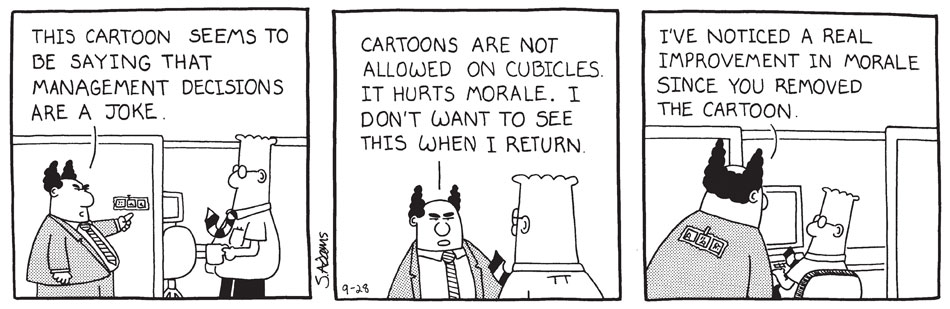
In offices, 'Dilbert' gags were regularly hung on cubicle walls. Not always to the liking of management...
Dilbert: criticism and controversies
Despite its colossal mainstream success, 'Dilbert' also drew criticism. Some newspaper cartoonists openly attacked Adams' comic for its minimalistic artwork. In 1998, Bill Griffith (of 'Zippy the Pinhead' fame) called Dilbert an "example of everything wrong about modern-day newspaper comics", since its comedy "doesn't make readers think". He criticized the fact that all panels are basically a bunch of "talking heads with shoulders" with simple dialogues: "Simplicity, even crudity, rules." Adams reacted by drawing a gag in which Dogbert creates a comic called 'Pippy the Ziphead' and says: "I'm cramming as much artwork in there as possible so no one will notice there's only one joke." Dilbert replies: "The joke is on the reader, isn't it?", to which Dogbert responds: "I'd better cram some more art in there." In a follow-up gag, Dilbert observes that the comic is "nothing but a clown with a small head saying random things", to which Dogbert replies: "I guard my artistic integrity by drawing a comic nobody will like." Griffith bit back in a 'Zippy the Pinhead' gag, where Zippy criticizes his boss "who is in a bigger hole than me". The boss concludes: "I guess the joke was delivered", whereupon Zippy says: "Yes, it was my one joke (...) now you're fired." The boss then shrugs: "I guess that's why they call it 'office depot'."
Interviewed by Jeanna Goudreau (Business Insider, 20 October 2015), Adams explained his minimalistic graphic approach with emphasis on verbal comedy: "Humor sometimes works best when one suggests what is coming without showing it. People laugh harder when they need to use their imaginations to complete the joke." Interviewed by Jenny Flippetti (Designboom, 21 September 2005), Adams added: "There is a fine line between brevity and humor. If you look at complicated business situations and describe them with the fewest words, it turns into humor." Adams has additionally frequently acknowledged that he is not a great artist. In his book 'The Dot-Com Bubble', he referred to his artwork as "being drawn by an inebriated monkey." He elaborated on this observation in many interviews, feeling that "talent is overrated" and that he achieved his success despite not being the best artist, writer or salesman.
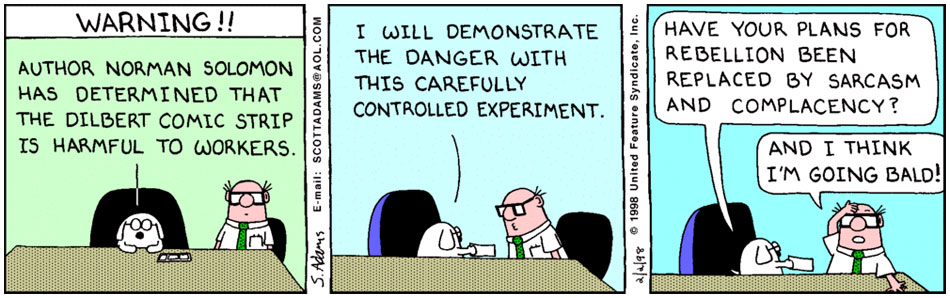
'Dilbert' comic strip lashing out at Norman Solomon's book 'The Trouble with Dilbert' (2 February 1998).
Another recurring criticism of 'Dilbert' is that the comic criticizes the corporate world, but doesn't condemn the system as a whole. Media critic Norman Solomon devoted a whole book to this subject, 'The Trouble with Dilbert' (Common Courage Press, 1997), which had a foreword by cartoonist Tom Tomorrow. Solomon argued that most of the pointed jokes in 'Dilbert' are at the expense of "lazy" workers and incompetent (middle) managers. Employees will laugh instead of taking action to change their company's policies. He called it "part of a process making people more accustomed to a stance of ironic passivity." Solomon also offered sources that confirm that Adams used 'Dilbert' to promote huge corporations like Xerox and Intel, while in an interview with Newsweek claiming to be in favor of corporate downsizing. Despite not having read Solomon's book, Adams satirized the author in a 'Dilbert' gag and included a fictional eight-page interview with him in his book 'The Joy of Work'. Adams confirmed that he believes in capitalism and much of his criticism focuses on the way companies run things. In his opinion, all its ills can be traced back to the power structure. Although companies want creative people, they are still expected to just blindly obey their boss. All promises of power are dead letters, since employees are still not allowed to do anything without the bosses' approval. Adams: "There's a constant battle. The employer is trying to get you to work more for free, and the employee is trying to do less work and get paid more." In a famous stunt, he went to the company Logitech in 1997 under a false identity and suggested a new project. He deliberately used very complex words that sounded impressive and his project was accepted. It was obvious that none of the executives really paid attention to what he was saying, nor understood his techno babble, because beyond all his fancy talk his project was just a bunch of nothingness. To Adams, this again exposed one of the major problems with the corporate world, which he elaborated on in an article printed in San Jose Mercury West Magazine (16 November 1997), for which he received a 1998 Orwell Award.
Some 'Dilbert' gags offended readers. In the early 1990s, Adams received complaints from people who didn't see the comedy in jokes he made about square dance callers, cannibalism, unicorns and televangelists. On 16 December 1993, Dogbert suggested the name "dorkage" for one of Dilbert's inventions. A real man named Dork wrote to Adams to ask for an apology, which the cartoonist granted. In another gag, Dilbert's company trademarked an ant farm. Adams received mail from a representative of Uncle Milton Industries, Inc., who wrote that his client actually owned this trademark and demanded a correction in a subsequent strip. After ignoring him twice and receiving follow-up letters, Adams eventually gave in and apologized, though not without having Dilbert ask: "What should we call a habitat for worthless and disgusting little creatures?", to which Dogbert replies: "Law school." In September 1997, Dilbert's boss said he survived an air crash with 100 nuns aboard, which had the bad luck to coincide with news reports about Mother Teresa's passing. Many people wrote furious letters. Religion proved to be the comic's greatest controversy. In 1998, Adams drew a few gags in which an employee is introduced named Jesus. Although he only shares his name with the founder of Christianity and every episode clarified: "it is pronounced Hay-soos", the character did perform miracles, assembled 12 disciples and was "betrayed" by a co-worker by being downsized, though "did come back afterwards." The jokes were blasphemous enough to start with, but Adams hadn't foreseen that they would be serialized around Easter. Many angry letters came in.
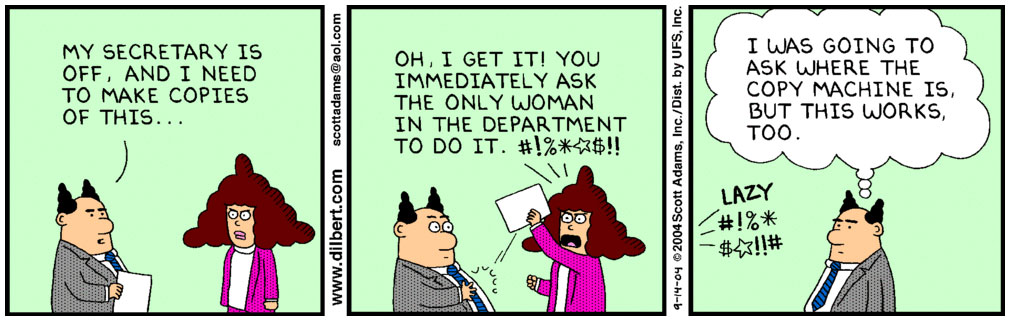
'Dilbert' (14 September 2004).
Scott Adams: criticism and controversies
In the 2010s, Adams became more visible in mainstream media as a political-social commentator. He described himself as a libertarian and sometimes as an "undecided voter". Earlier in his career, he admitted voting for Bill Clinton and Barack Obama. In 2016, he predicted that Donald Trump would win the US presidential elections. While Adams was originally vague about whether he supported Trump or not, it ultimately became clear that he did. He made paranoid claims that if Hilary Clinton, and later Joe Biden were elected President, "he and other Republicans would be hunted down." In 2017, he devoted an entire book to Trump: 'Win Bigly: Persuasion in a World Where Facts Don't Matter', in which he described him as a "masterful persuader of the masses".
In some interviews Adams expressed viewpoints that some people criticized for being sexist, even cold and misantropic. Interviewed by Laura Hudson (25 March 2011), Adams felt that women who ask for equal payment are comparable to "children demanding candy". On 27 March 2011, he wrote on his blog about "the widespread suppression of men's rights (...) women are treated differently by society for exactly the same reason that children and the mentally handicapped are treated differently. It's just easier this way for everyone (...) It's called a strategy. Sometimes you sacrifice a pawn to nail the queen." After many critical comments, Adams deleted this blog post. After separating from his wife in 2013 and finalizing their divorce a year later, he vented his frustrations about marriage and feminism in various posts. In October 2014, he advised women in New York complaining about sexual harassment in the street to "move somewhere better, you idiot (...) stop making it my problem!!!".
On 6 July 2022, a lunatic started shooting at a crowd in Hyland Park, Illinois, murdering seven people. Adams reacted to the tragedy on the social media platform Twitter: "The Highland shooting and every Fentanyl overdose death among the young are teaching us the same lesson, and we refuse to learn it. (...) When a young male (let's say 14 to 19) is a danger to himself and others, society gives the supporting family two options: 1. Watch people die. 2. Kill your own son. Those are your only options. I chose nr. 1 and watched my stepson die. I was relieved he took no one else with him. (...) If you think there is a third choice, in which your wisdom and tough love, along with government services, 'fixes' that broken young man, you are living in a delusion. (...) You have to either murder your own son or watch him die and maybe kill others." After a flood of offended and outraged reactions, Adams later rephrased his statement by saying that the topic was "very emotional" for him, since his own 18-year old stepson also died from a drug overdose.
Adams' public image took a serious nose dive in the 2020s, when he made comments widely condemned for being anti-black. On 28 June 2020, he claimed that his 'Dilbert' animated series had been cancelled because he was white and the channel wanted to focus on an African-American audience. He also added that it had been "the third time" that he had been laid off for "being white". According to him, he lost his jobs in 1986 and 1995 for the exact same reason, namely that his company wanted to make more room for "diversity", and not "white males". In September 2022, he introduced a black character called Dave in 'Dilbert', who nevertheless "identifies as white", while his managers ask him whether he could "also identify as gay". Within a week, several newspapers cancelled his comic. On 22 February 2023, during an episode of his vlog 'Real Coffee with Scott Adams', Adams characterized "black people" as a "hate group" and said: "The best advice I would give to white people is to get the hell away from black people: just get the fuck away." Many people criticized these comments for being racist. Countless papers instantly cancelled 'Dilbert' and even his own syndicate and publisher broke all ties with him. Adams tried to defend himself that the "context" of what he commented on had been ignored. He had been responding to a poll by Rasmussen Reports in which people were asked what they thought about the statement "It's okay to be white", with a majority of black people agreeing, but still a minority disagreeing, or not being sure. Two prominent right-wing celebrities defended Adams, namely businessman Elon Musk and pundit Charlie Kirk.
On 25 January 2022, political cartoonist Ben Garrison (himself also often accused of taking ultra-conservative, racist viewpoints) mocked Scott Adams in a parody of 'Dilbert', titled 'Illbert'. It depicted Adams being hypnotized to get vaccinated, only to get angry when finding out that "you anti-vaxxers were right accidentally", with Dogbert in the final panel saying: "Take the 'L', dummy". The strange cartoon baffled many readers, as it referred to a live stream lecture posted on Adams' YouTube account (on 11 January of that year) that didn't receive any media coverage. In the final two minutes of this video, Adams reacted to a comment from a female antivaxxer who accused him of "being duped by COVID, because you friends scared you into trying to save the world" and insisted that he should apologize. Adams started hurling a bunch of profanities, closing off that his rant might get him monetized by YouTube, but added "it was worth it." After seeing Garrison's cartoon, Adams commented on social media that it totally misrepresented him and his views, since he had been vaccinated twice and didn't regret it. He even considered his intentions to take legal action for "defamation". A year later, when Adams got cancelled over remarks perceived as racist, Garrison drew another cartoon, this time showing Adams pulling away Dilbert from a group of black people with whom he tries to be friends.
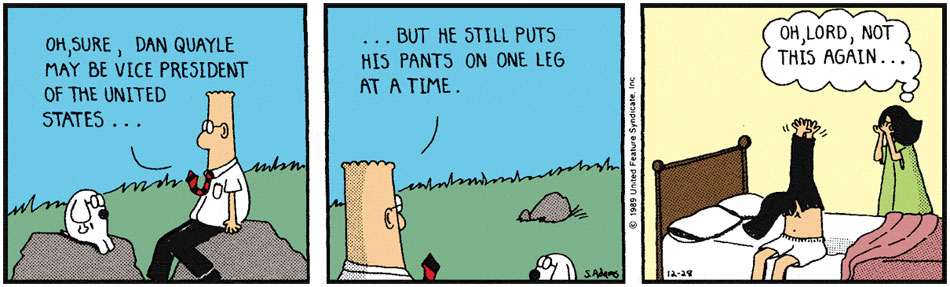
'Dilbert' comic poking fun at Vice President Dan Quayle (28 December 1989).
Dilbert Reborn
In the early years of 'Dilbert', Adams had occasionally made jokes about current events and politicians, like the US President George Bush Sr., Vice President Dan Quayle and even Donald Trump (back when he was a businessman). He later abandoned them because they tended to date episodes very fast. Yet from the mid-2010s on, 'Dilbert' became more political again, albeit more in storylines and gags that attacked political correctness. Some longtime fans felt Adams was basically shoehorning his own opinions into his comic. A storyline with an African-American employee who nevertheless "identifies as white" was deemed too offensive for some newspapers, who didn't print these episodes or canceled the entire comic altogether.
Adams rebooted his comic on 13 March 2023 under the title 'Dilbert Reborn', made available on his website Locals.com and the right-wing conservative online platform Rumble. Earlier, Adams already stated that since newspapers print fewer and fewer comics, it is bound to become the future of his series. While both Adams and many media outlets hinted that this reboot would be "spicier than the original", in reality many gags don't differ that much from the standard humorous situations in 'Dilbert'.
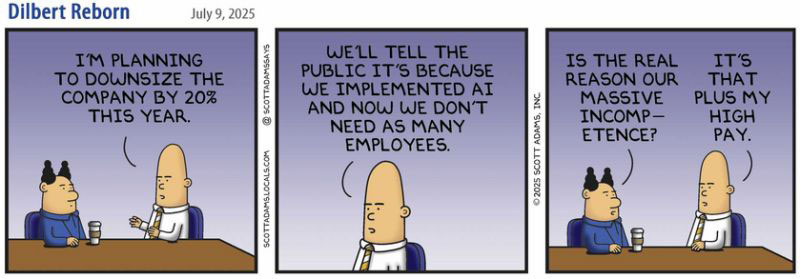
'Dilbert Reborn' (9 July 2025).
Author
Outside of his comics career, Scott Adams has also been a productive writer. Over the years, he published several motivational or self-help guides. Many have used Dilbert on their cover, or reprinted gags to liven up the pages, like 'The Dilbert Principle' (Harperbusiness, 1996). Adams also published a version for young readers, advocating use and understanding of computers. 'The Joy of Work' (HarperCollins, 1998) is, despite the title, a tongue-in-cheek reflection on how to keep one's spirits up at your job by doing nothing of actual substance, ranging from playing pranks, writing jokes and having fun with your co-workers. More serious in its messages were his follow-up books. 'How to Fail at Almost Everything and Still Win Big: Kind of the Story of My Life' (Portfolio, 2013), is the closest he ever came to writing an autobiography. The work reflects on his own long struggle for success and the importance of persistence and learning through trial and error. He wrote two additional self-help books in the same vein, 'Loserthink: How Untrained Brains Are Ruining America' (Portfolio, 2019) and 'Reframe Your Brain: The User Interface for Happiness and Success' (Penguin, 2023).
On his blog, Adams expressed his viewpoints about a wide variety of topics, from personal anecdotes and slice-of-life comedy to political commentary. In 2007, he released a book compilation of his blog posts: 'Stick to Drawing Comics, Monkey Brain!: Cartoonist Ignores Helpful Advice' (Portfolio, 2007). In 2015, the cartoonist also launched a daily vlog, 'Real Coffee with Scott Adams', hosted on his own website and on YouTube, where he has mostly discussed politics, current events and motivational tips. In 2017, he released 'Win Bigly: Persuasion in a World Where Facts Don't Matter', a more contested book in which he praised then-recent president-elect Donald Trump and analyzed his success in playing to crowds. The book particularly drew attention through its depiction of Dogbert with a hairstyle and orange skin color that resemble Trump's.
With his duology, 'God's Debris: A Thought Experiment' (2001) and 'The Religion War' (2004), both published by Andrews McMeel, Adams wrote two novels criticizing religion. Initially published as an e-book, due to concerns that readers wouldn't buy anything by Adams non-Dilbert-related, it was eventually also given a hard-cover book release too. In some interviews, Adams said he regarded these two novels as his true legacy.
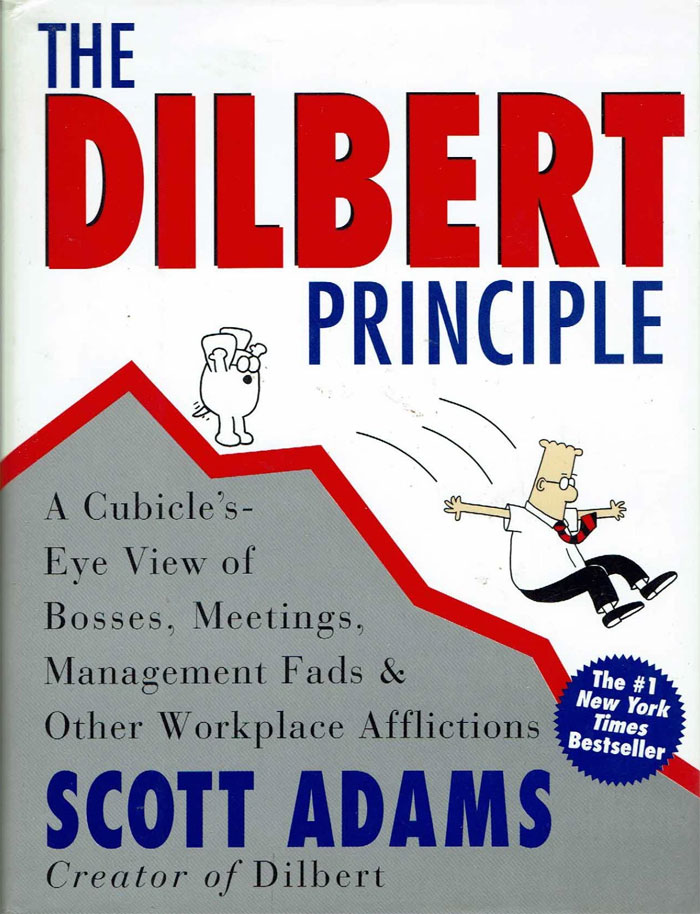
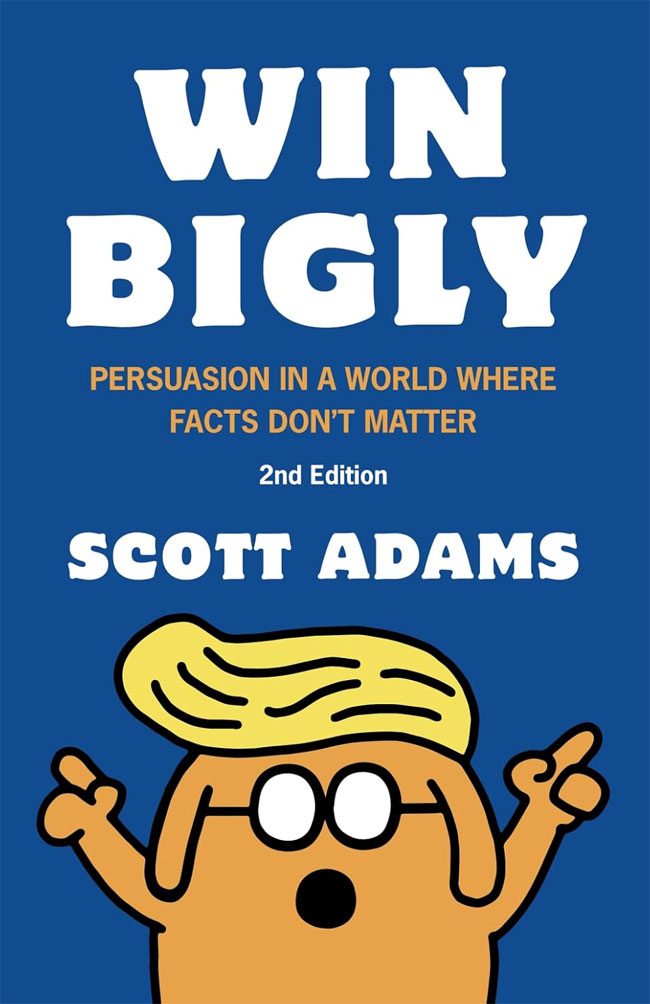
'The Dilbert Principle' and 'Win Bigly'.
Graphic and written contributions and media appearances
Adams had a guest role in the episode 'Moments of Transition' in the SF series 'Babylon 5' and in 'Review', an episode of the TV series NewsRadio. He also appeared in the documentaries 'Silenced' (2016) and 'Hoaxed' (2019) by Mike Cernovich. In 2017, he provided a foreword to Jack Cassady's 'Animal Tales from Jack Cassady's Monday Funnies' (Xlibris, 2017).
Recognition
In 1997, Adams won the Reuben Award for "Outstanding Cartoonist" and "Best Newspaper Comic", while also receiving the Harvey Award for "Best Syndicated Comic Strip". That same year, the Soujourner Mars rover inspected various rocks on the planet Mars, and four of them were named after Dilbert, Dogbert, Ratbert and the Pointy-Haired Boss. Adams also received an Orwell Award (1998) for his infamous impersonation trick at Logitech. In 1998, 'Dilbert' received a Max & Moritz Award for "Best International Comic Strip".
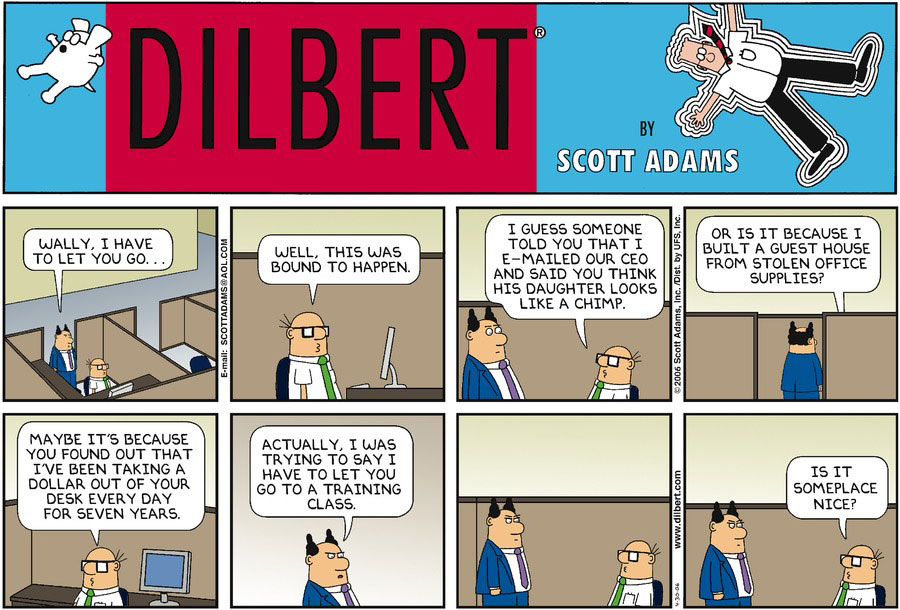
'Dilbert' (30 April 2006).
Later years
In 2004, Adams was diagnosed with focal dystonia in his right hand's pinky. This rare neurological disorder made his pinky have spasms, making it difficult to draw. His doctor advised him to quit cartooning, but Adams developed his own cure. He'd grip his pen and hold it down on a piece of paper, waiting until the spasms started. Just before they did, he pulled the pen away and started over. Each time, his pinky grew steadier and after a year, the twinges stopped. Still, by 2005 he started using the computer to draw, since it didn't trigger the spasm and actually "cut my workload by about 50 percent." Between 2005 and 2008, Adams also had spasmodic dysphonia, leaving him unable to talk loud and clearly. Again he tried to cure himself, but for a long while nothing seemed to help. One day, he read a homework assignment by his stepson out loud and noticed that he suddenly spoke in normal speech again. Adams had no explanation of what had happened. He eventually suggested that he had possibly "remapped" his brain, allowing to express his thoughts again in combination with his vocal cords. Yet when he caught a cold some time afterwards, the spasmodic dysphonia returned. After trying out several techniques, he eventually underwent a successful larynx surgery.
By 2025, however, Adams' health took a turn for the worse. On 19 May of that year, he announced that he was diagnosed with prostate cancer, which had already spread to his bones. The pain forced him to use a walker and a wheelchair and by June he planned euthanasia. Again, luck was at his side, since he suddenly discovered that testosterone blocker pills magically eased his suffering, allowing him to cancel his euthanasia plans. But by November Adams was paralyzed below the waist and wrote an open letter to U.S. President Donald Trump to help him get access to the cancer drug Pluvicto. U.S. Secretary of Health Robert F. Kennedy, Jr., replied in Trump's name, saying that they wanted to help him. In early January 2026, it was reported that Adams was at death's door. Despite being a lifelong atheist, he announced he would convert to Christianity. On 13 January 2026, Scott Adams died in Pleasanton, California, at the age of 68.
On the official White House account, president Trump wrote a short commemoration for Adams, describing him as "the Great Influencer" and "a fantastic guy who liked and respected me when it wasn't fashionable to do so." He shared a photo of Adams visiting him in the Oval Office. Later, a second "in memoriam'" was shared on Trump's account, combined with an A.I.-generated drawing of Dilbert and cartoony renditions of Trump and Vice President J.D. Vance. This bizarre tribute received criticism for several reasons. Some critics wondered why a second tribute was necessary if the first was sufficient enough, especially since it was the official White House account, normally reserved for messages of national importance. Others criticized the decision of not using actual artwork by Adams, but instead a rather insulting artificial intelligence rendition that gave Dilbert a smile he never had in the actual comics, with Trump and Vance placed very prominently in the foreground in a manner that came across more self-serving than honoring a deceased person.
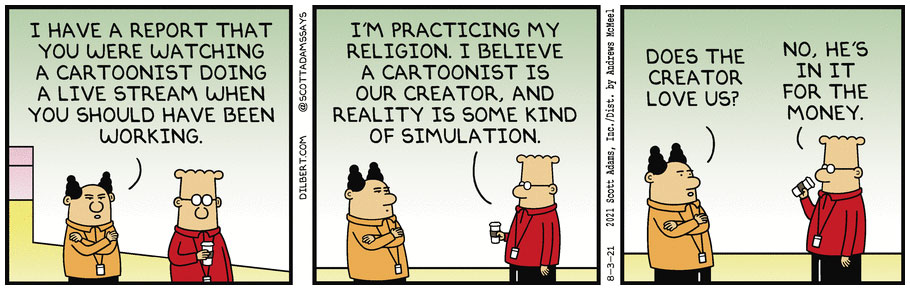
'Dilbert' (3 August 2021).
Legacy and influence
Scott Adams' 'Dilbert' was easily the most popular newspaper comic of the 1990s and 2000s, as well as the first big hit of the Internet Age. It had a huge influence on webcomics, particularly the way they are marketed online. Many traditional newspaper cartoonists were motivated to also make their archives available on websites or online platforms. The comic had a considerable impact on the English language. In a gag printed on 5 February 1995, Dogbert said: "leadership is nature's way of removing morons from the productive flow." The same year, Adams developed this joke into an economical principle, nicknamed "the Dilbert Principle", which states that the least qualified people are often named managers, since they will do the least harm bossing others around. His theory, a parody of Laurence J. Peter's "Peter Principle", reached a wider audience in a 1995 essay by Adams, printed in the Wall Street Journal. Adams also used it as the title for his business book, 'The Dilbert Principle' (1996). Some other economic neologisms by Adams also found their way into the English language. "Elbonia" is a synonym for "offshore work", and "confusopoly" refers to businesses that survive by misleading their customers. In U.S. slang, people who work in cubicles were sometimes nicknamed "Dilberts" or referred to as "getting Dilberted".
However, both Adams and 'Dilbert' have experienced a fall of grace not seen since the downfall of that other satirical newspaper cartoonist who once was both a hit with general audiences and critics, Al Capp (of 'Li'l Abner' fame). Just like Capp, Adams' personal opinions started to seep through more and more into his comics, resulting in punchlines that seemed more bitter than witty. In the wake of all the scandals that effectively killed his career, fans have re-read his comics with different eyes. The cynicism about office life in 'Dilbert' seems more motivated by personal frustrations over never breaking through in telecommunication business, which he blamed on political correctness and favoring minorities over "white men" like him. Some critics have wondered whether Adams even deliberately sabotaged his own comics career. Others have made a connection with his rapidly declining health. However, interviewed on VladTV in 2016, Adams said that he often went to social media and started discussions about controversy just to feel the anger and frustration again that inspired him in the early years when he was a poor cartoonist but that he "lost" since becoming a millionaire.
'Dilbert' has frequently been parodied. Karl Hörnell drew a mashup comic strip, 'The Savage Dragonbert and Hitler's Brainbert', spoofing both 'Dilbert' and Erik Larsen's 'The Savage Dragon'. In the 1990s and 2000s, 'Dilbert' was a favorite satirical target in Mad Magazine. John Caldwell, for instance, drew 'What if 'Dilbert' Had Different Jobs?' (Mad #376, December 1998). In 2002, Peter Bagge and Johnny Ryan drew a vicious and lewd underground comic, 'Dildobert Joins the Al-Qaeda', in which Dilbert contemplates suicide after Teena is promoted to manager, but is recruited by the terrorist organisation Al-Qaeda afterwards. In 2023, after 'Dilbert' was cancelled over Adams' racist remarks, Rich Powell drew a 'Dilbert' spoof comic in which none of the regular cast members are seen, except for one single black man whose delightful comment is: "Well, this is refreshing." Darrin Bell also reacted in his comic 'Candorville', while Ruben Bolling drew Dilbert with a MAGA hat in an episode of 'Tom the Dancing Bug', spewing real-life racist quotes by Adams.
Scott Adams' 'Dilbert' has received praise from veteran cartoonists George Booth, Guy Gilchrist, Larry Gonick and Matt Groening. Younger artists influenced by him are Mattie Lubchansky and Stephan Pastis.
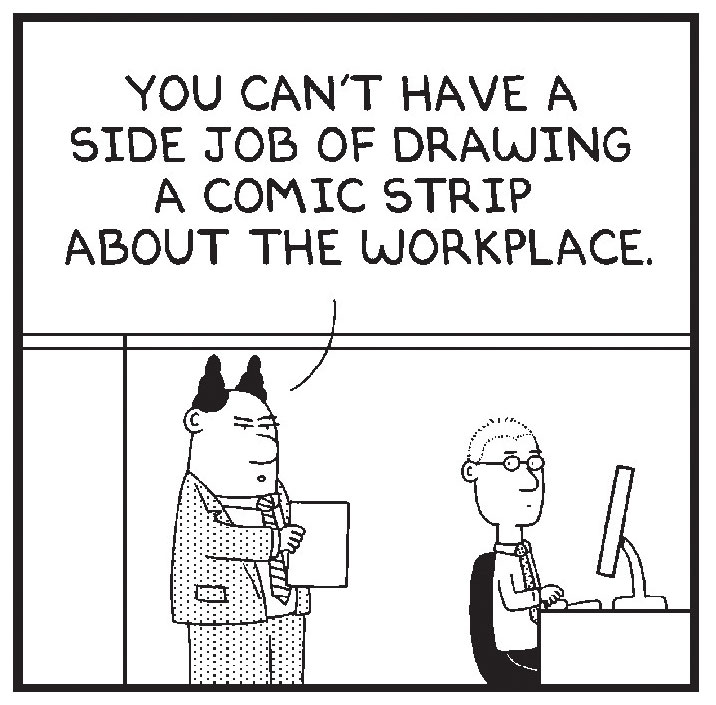
On occasion, Scott Adams featured himself in his 'Dilbert' strip (4 May 2007).