


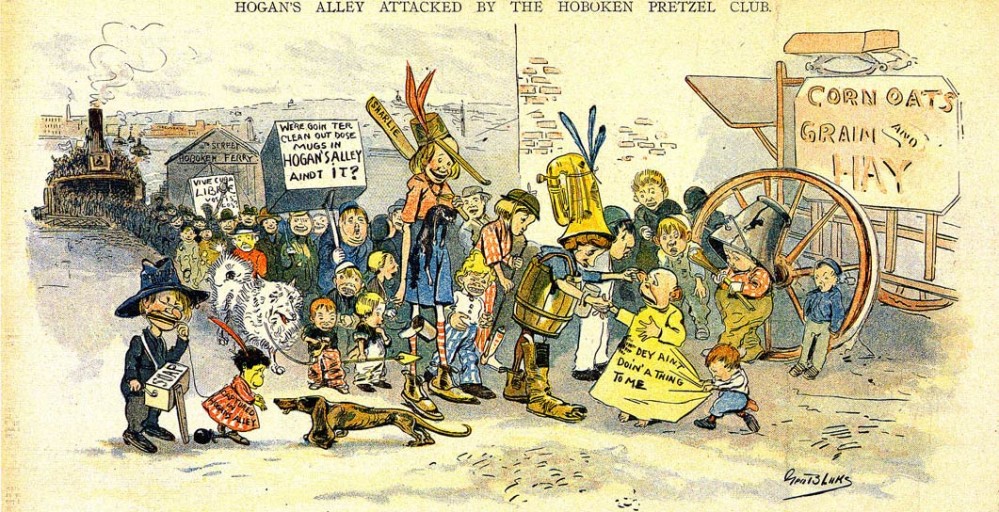

'Hogan's Alley' (31 May 1896).
George Luks was a late 19th-century, early 20th-century American painter, best known for his realistic paintings of New York City life. In addition, he was also a comic artist for a while, continuing the cartoon feature 'Hogan's Alley' (better known as 'The Yellow Kid', 1896-1897) in The New York World after its original creator Richard F. Outcault had joined the rival newspaper The New York Journal. This event marked the first instance in comic history of two newspapers battling over one comic strip. Luks' other short-lived newspaper gag comics and cartoons were 'The Nipper Twins' (1897-1898), 'The Kalsomine Family' (1897) and 'Mose the Trained Chicken' (AKA 'Incubator Mose', 1897-1898).
Early life and career
George Benjamin Luks was born in 1867 in Williamsport, Pennsylvania, as the son of a physician/apothecary. He inherited his artistic gift from his mother, who was a painter and musician. In 1872, the family moved to Shenandoah, in the south of the state. Originally, Luks was interested in vaudeville, so he and his younger brother actively performed as stage actors in their teens. In 1882, they performed with their stage act 'Buzzey & Anstock' throughout their state, and also performed it as far as New Jersey. Eventually Luks enjoyed painting more and went to study at the Pennsylvania Academy of Fine Arts. Luks only stayed for about a month, though, and decided to fine tune his craft through self-study. The college dropout moved to Europe where he attended the Düsseldorf School of Art in Germany. Among his graphic influences were Diego Velazquez, Francisco Goya, Frans Hals and Edouard Manet.
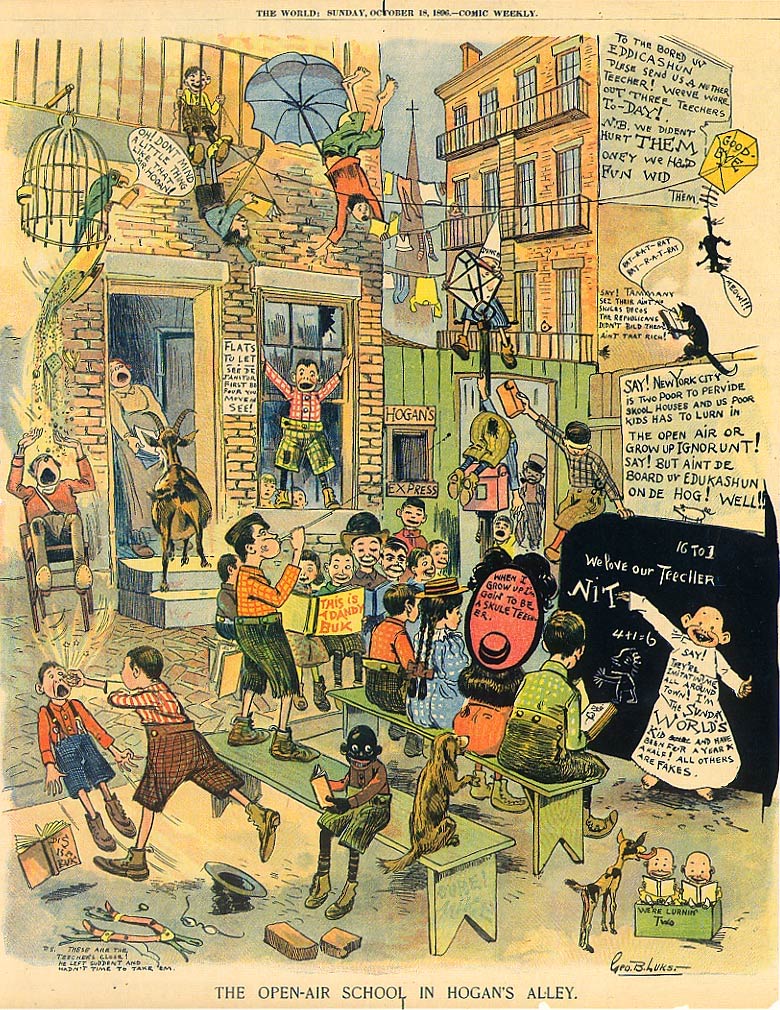
'Hogan's Alley', 18 October 1896. The first episode completely drawn by George Luks. The Nipper Twins appear on the bottom right.
Early graphic career
In 1891, George Luks returned to the United States, where he created illustrations for magazines like Puck, Truth, The Verdict, Music and Drama. In 1893, he became an illustrator for the Philadelphia Press. In 1896, during the Spanish-American conflict, he also traveled to Cuba as a war correspondent. Afterwards, Luks moved to New York City, where he joined Joseph Pulitzer's newspaper The New York World.
The Yellow Kid
On 10 and 31 May 1896, The New York World ran the first two 'Hogan's Alley' cartoons drawn by George Luks. The artist would become the feature's regular artist a few months later. In the previous year, in May 1895, The New York World had launched this popular cartoon feature, drawn by Richard F. Outcault, which was also referred to as 'The Yellow Kid' after its breakout character. Although readers enjoyed the feature, Outcault was bought away in 1896 by the rival publisher William Randolph Hearst to star in his The New York Journal instead. Outcault's final 'Yellow Kid' episode ran in The New York World on 4 October 1896. To fill up the void left behind, Luks was commissioned to continue 'The Yellow Kid' in The New York World. It has often been claimed that this spawned the first court case over the publishing rights of a comic strip. In reality, there was never a court case, only a legal decision issued on 15 April 1897 on behalf of the Treasury Department and advised by the Librarian of Congress to inform the New York Journal that only the comic strip's title was copyrighted, not the character itself. Still, 'The Yellow Kid' was indeed the first example in history of a comic strip being so popular that newspapers actually tried to outbid one another to have an exclusivity contract over it. In The New York Journal, Outcault's series was retitled to 'McFadden's Row of Flats', although it was still legally able to use the original characters. In The New York World, it was the opposite situation: the paper could still use the title 'The Yellow Kid', but Luks had to create new protagonists.
On 11 October 1896, the first episode of Luks' version of 'The Yellow Kid' was printed in The New York World, signed under the name "Geo B. Luks". The artist redesigned the Yellow Kid with more floppy ears and gave him a sidekick, Baldy Sours. Other recurring characters were the twin toddlers Alex and George, nicknamed "The Little Nippers". The duo looked exactly like The Yellow Kid, down to their clothing and naughty streak, but it was never made clear whether they were related to him. Between 12 September 1897 and 15 May 1898, 'The Little Nippers' appeared in a spin-off Sunday comic.
As often happens, a copy is never quite as popular as the original, and Luks' 'Hogan's Alley' didn't catch on. However, Outcault's 'McFadden's Row of Flats' in The New York Journal wasn't a hit with readers either. On 30 May 1897, it was discontinued for several months, without an explanation. In August of that same year, Luks' 'Hogan's Alley' also vanished in the same mysterious manner. On 25 September, Outcault's comic suddenly made a comeback, which prompted a return of Luks' 'The Yellow Kid' a week later. Yet in both cases it was only a death gasp. Luks' final episode appeared on 5 December 1897, and Outcault's version only lasted a month longer, until 23 January 1898. The most self-evident explanation for both comics' loss of popularity was the title confusion among general audiences.
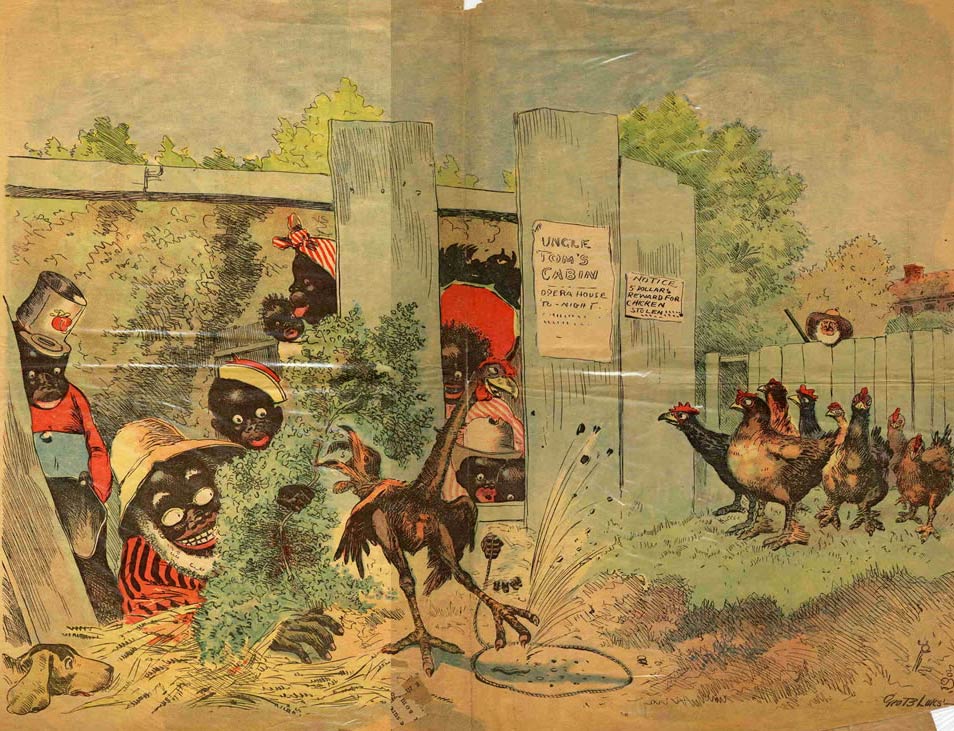
'Mose the Trained Chicken'. The panel depicts African-Americans as stereotypical chicken thieves. Also note the sign on the fence, promoting a theatrical performance of Harriet Beecher Stowe's 'Uncle Tom's Cabin'.
Other comics ('The Kalsomine Family', 'Mose the Trained Chicken')
During his career, Luks made only a handful of other comic strips. Between 25 July and 5 September 1897, the New York World also printed his Sunday panel 'The Kalsomine Family'. A comic with a bit more durability, 'Mose the Trained Chicken', also known as 'Mose's Incubator' (1897-1898), revolved around a strange, large chicken named Mose, who looked more like a miniature ostrich.
Final years and death
From 1898 on, Luks left the field of cartooning and became far more celebrated as a painter. He made brutally realistic portrayals of urban life, particularly among the working class people. Among his best-known paintings are 'The Spielers' (1905) and 'The Wrestlers' (1905). Luks was additionally a teacher at the Arts Students League in Manhattan and later established a school of his own, the George Luks School of Painting in Manhattan. During his lifetime, he enjoyed several exhibitions of his work, for instance at the Armory Show.
Sadly, Luks suffered from alcoholism. On 29 October 1933, he was critically injured in a drunken bar room brawl and left behind on a doorway. The police discovered his corpse in the early morning. George Luks was 66 years old.

'The Spielers'.