


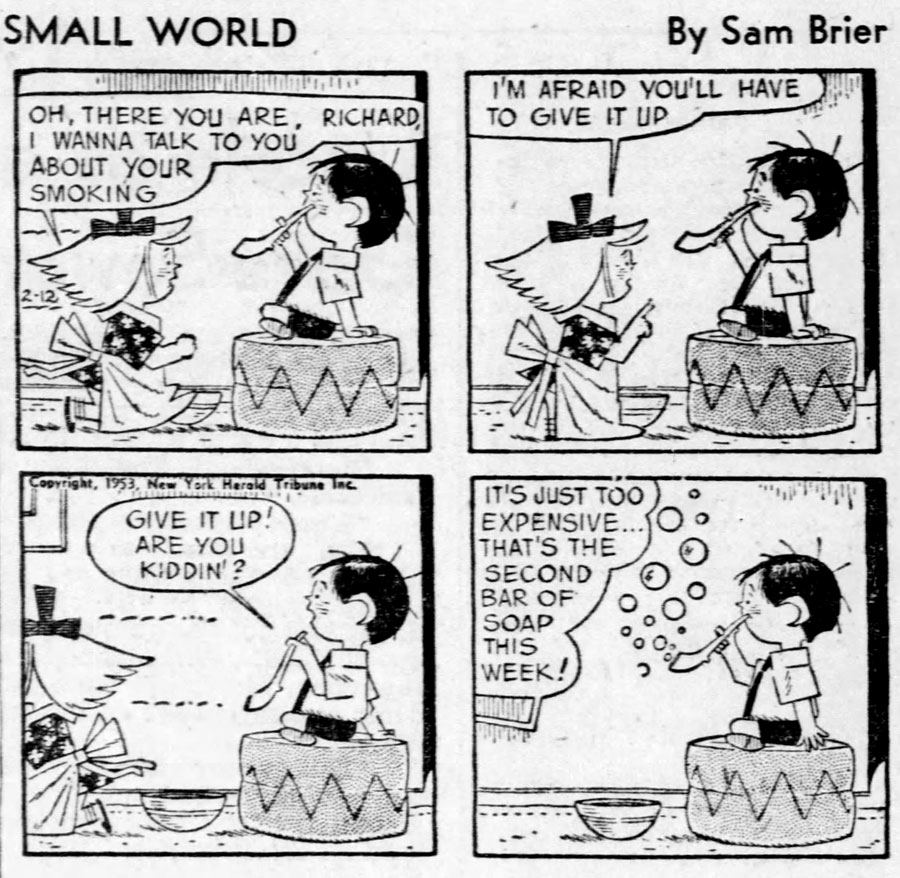
'Small World' (The Philadelphia Inquirer, 12 February 1953).
S.B. Stevens, better known as Sam Brier, was a Canadian comic artist, and the creator of gag-a-day newspaper features 'General Mischief' (1947-1949), 'Stevie' (1951-1952) and 'Small World' (1952-1956). All three featured little kids dressed up in adult clothing re-enacting scenes from adult lives.
Early life and career
Sam B. Stevens was born in 1923 in Montréal, but later moved to Brooklyn, where he graduated from Franklin K. Lane High School. Early in his career, he was active as a band and night club singer and then, between 1950 and 1952, worked as a children's toy designer. In the meantime, he was building on a career as a cartoonist, selling his first cartoon to Judge magazine at age 16. His work subsequently appeared in the pages of Saturday Evening Post, Collier's and The New Yorker. These mostly titleless cartoons were often signed with the initials "S.B.S".
Mop O'Hare
Between 30 July 1945 and 25 January 1947, Stevens drew the one-panel cartoon series 'Mop O' Hare' (1945-1947) for the New York Post Syndicate. The title character was a young bratty boy, whose hair always hangs over his face. Non-English speakers might not spot the pun hidden in his name ("mop o(f) hair"). While the gag cartoon only ran for two years, it was the first of many cartoon features by Stevens about children. However, he signed 'Mop O'Hare' under the pseudonym "Ken Stevens".

'Mop O'Hare'.
General Mischief
Another regular strip/cartoon feature by Brier was 'General Mischief' (1947-1949), which he signed with his real name. Much like 'Mop O'Hare', it featured children as protagonists, in this case a boy imagining himself to be a US general. 'General Mischief' ran in The American Legion Magazine, the house organ of the U.S. war veterans' organization. 'General Mischief' was later syndicated to newspapers by the McNaught Syndicate. Brier later re-used the concept of children acting like adults for his longer-running gag comic 'Small World' (1952-1956).
Many readers have observed the similarities with Charles M. Schulz' 'Peanuts', which also features big-headed children in suburban neighborhoods conversing about situations one would associate more with the adult world. However, the 'General Mischief' strip predated 'Peanuts' (1950-2000) by three years. Also, as 'Peanuts' only became a cultural phenomenon by the end of the 1950s, Brier possibly was unaware of Schulz' comic.
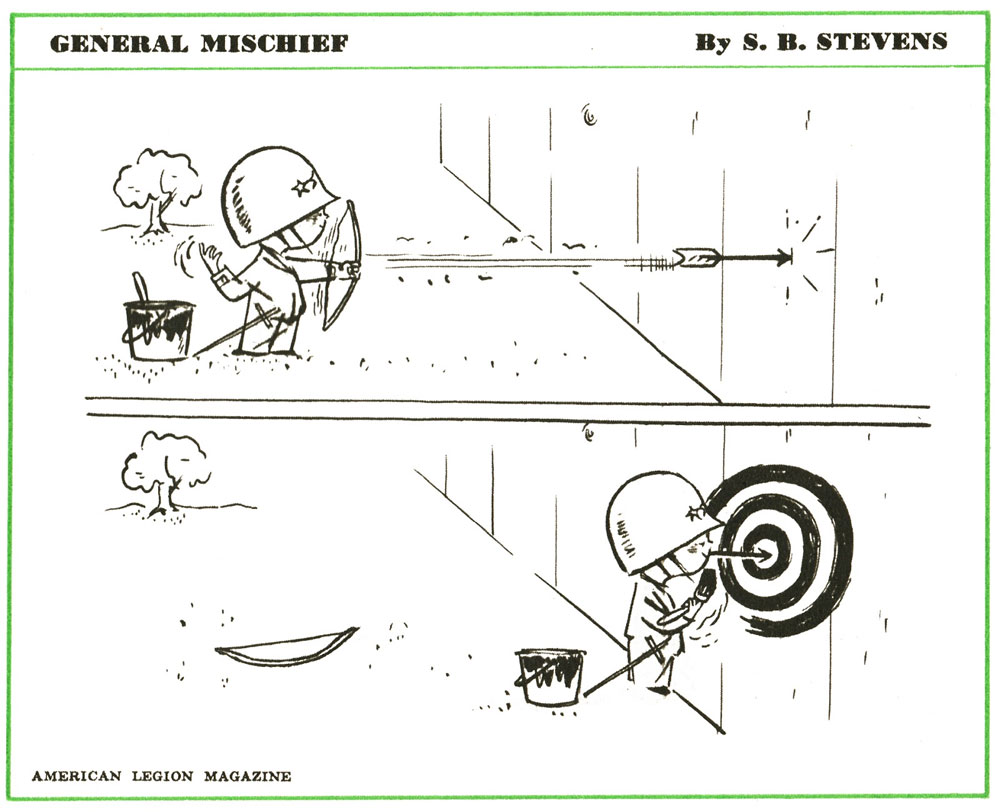
'General Mischief' (June 1949).
Stevie
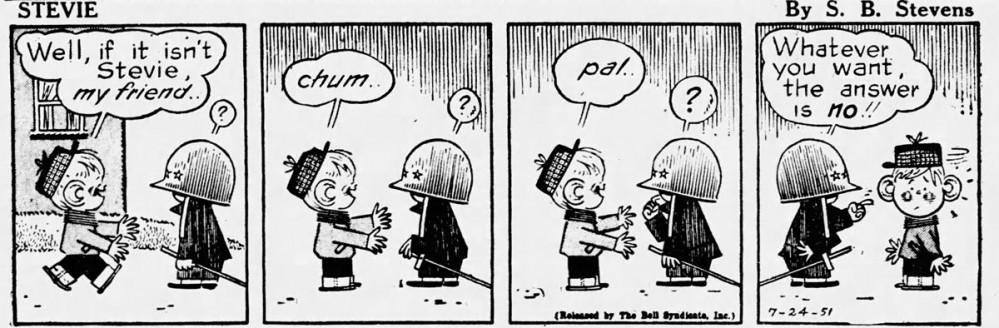
Stevens subsequently made a gag-a-day comic named 'Stevie' (1951-1952), again about a little boy dressed up as an adult. Most of the time he wore a soldier's helmet and carried a wooden sword around, much like 'General Mischief'. The comic appeared in Judge and was syndicated through the Bell Syndicate between 2 April 1951 and 1 May 1952. 'Stevie' gags were additionally reprinted in early 1950s comic books by National Comics (the current DC Comics), such as 'A Date With Judy', 'Buzzy', 'Here's Howie Comics' and 'Leave It To Binky'.
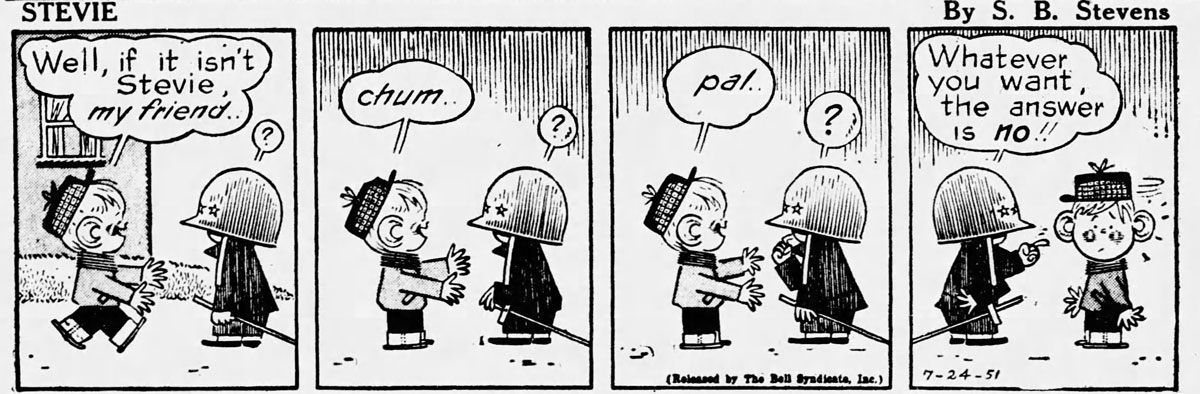
'Stevie' (The Boston Globe, 24 July 1951).
Small World
Brier's best-known and longest-running creation is 'Small World' (9 August 1952-1956), syndicated in The New York Herald Tribune and collected in book format by Hanover House from 1954 on. 'Small World' centers on a boy, Richard, and a girl, Kathi, acting like adults. They have mature conversations and even wear clothes that are too big. Brier based Richard on his younger son, while Kathi was modelled after his wife. In 2012, 'Small World' was re-released in a reprint by comic writer and expert Nat Gertler, through his About Comics imprint.
Legacy
In an article about 'Small World', published in The Indianapolis News on 3 July 1954, Brier gave insight why he was so interested in child characters as protagonists for his comics and cartoons: "When children play house, they mimic their elders with an innocent wit that goes right to the heart of the matter. They're the best comedians since the silent movies."
It is unknown when Sam Brier passed away.
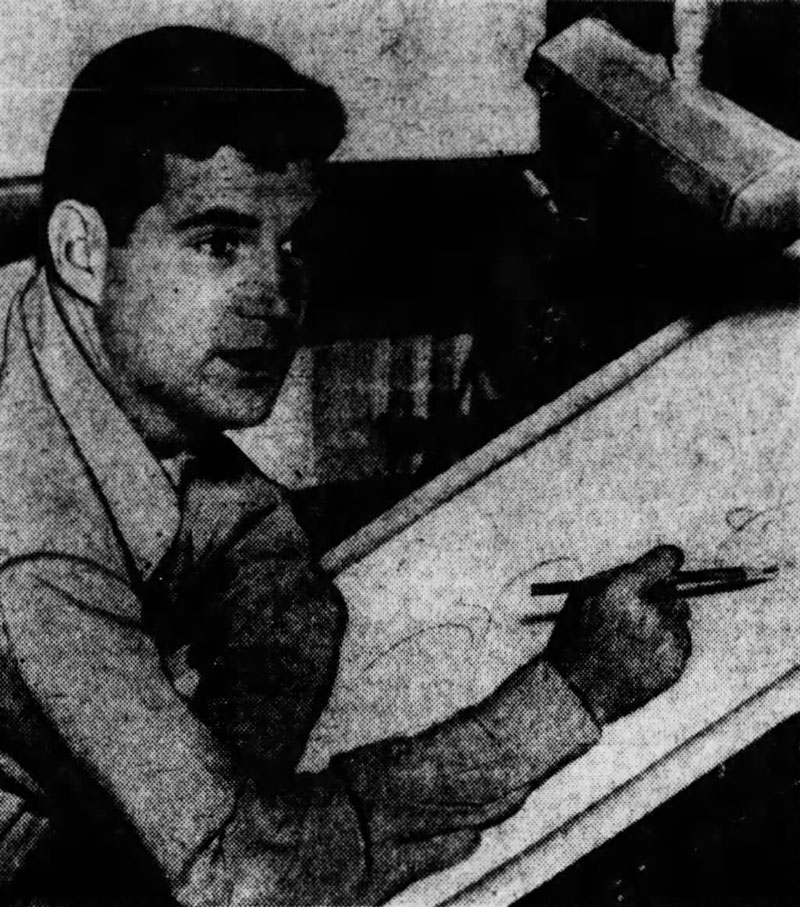
Sam Brier, The Indianapolis News, 3 July 1954.