


'Het Mannetje Bagatel' (1946).
Eppo Doeve was a mid-20th century Dutch-Indonesian illustrator and cartoonist. After spending his youth in the Dutch Indies, he came to The Netherlands for agricultural studies, but eventually switched to a career in graphic arts. One of the foremost illustrators of his time, his artwork appeared in books, magazines and advertisements, as well as murals and stage sets. His cover drawings for the Penta Pocket books in particular have become collector's items, and his 1950s posters for Heineken and the Artis Zoo have become iconic. Doeve's political cartoons appeared in De Groene Amsterdammer and Vrij Nederland, and he was a longtime contributor for the radio and TV guides of broadcasting corporation AVRO. As a comic artist, he created two text comics with novelist Bertus Aafjes as scriptwriter: 'Het Mannetje Bagatel' (1946) and 'Kleine Isar, de Vierde Koning' (1962).
Early life
Joseph Ferdinand Doeve was born in 1907 in Bandung in the province of West Java, Indonesia, at the time still a Dutch colony. He was the son of civil servant Justin Theodorus Doeve and Helena Rosina Kepel - both were of mixed European and Indian blood - and had four younger sisters. As a primary school student, Eppo attended the Catholic School run by the Ursuline Sisters. After his secondary education, Doeve made some trips through the Dutch East Indies, while developing a special interest in plants and flowers, a passion he shared with his parents. Even at a young age, Doeve showed artistic promise. At school, he created illustrations for stories told by teachers and classmates. At age sixteen, he made murals for a movie theater in Bandung. Yet he didn't consider his graphic talent all that exceptional and instead dreamt of becoming a tea planter, which made him decide to go to the Netherlands to study Agronomy, the science of using plants by agriculture for food, fuel, fibre, chemicals or land conservation. In 1927, he enrolled at the Landbouwhoogeschool ("Agricultural science college") in Wageningen, where he was also involved in the almanacs and monthly magazine for the student society (Wageningsche Studentencorps) and the student jazz band.

Advertisement for the "Milk brigade" by Eppo Doeve. Drawn to promote drinking more milk the illustration mostly features Dutch sport champions and a few other media celebrities. In the top right we see Marten Toonder and Joop Geesink (1960).
Commercial artist
However, the 1929 Wall Street stock market crash had caused a global economic crisis, with the Indian tea market collapsing as a result. With his future plans thwarted, Doeve decided to stay in The Netherlands and embark upon a career in graphics instead. As a student, he had already earned some extra income at the Amsterdam advertising bureau DelaMar and by 1932, he was a regular illustrator for them. Well-known advertising campaigns illustrated by Doeve from that period included "Leave the Road Free!" (1935) and the "Dirt Devil" campaign for MobilOil. For decades, Doeve continued to use his graphic skills for commercial art, frequently contributing to calendars, brochures, and anniversary books. Especially in the 1950s, Doeve created dozens of advertising posters for several companies, of which several became icons of Dutch advertising. Among the most famous were a waiter carrying a plate with Heineken beer and a group of penguins promoting the Artis Zoo in Amsterdam.

Cartoon for Elseviers Weekblad (1978).
Magazine cartoonist
His career start at DelaMar quickly landed Eppo Doeve other jobs. In 1933, he became a political cartoonist for the weekly opinion magazine De Groene Amsterdammer. After three years, he moved to Haagsche Post as a freelance artist. Starting in 1935, his illustrations also appeared in De Radiobode, the official magazine of the Dutch radio broadcaster AVRO. One of his colleagues there was Eelco ten Harmsen van der Beek, who taught him several valuable skills. In the following decades, Doeve continued to contribute to the subsequent AVRO magazines AVRObode and Televizier. During the 1950s, he was an illustrator for the magazine's 'Paul van Vlaanderen' serials, alternating with fellow artists Henk Gijsbers and Henk Albers. Doeve's graphic work additionally appeared in the newspapers Het Handelsblad and De Telegraaf, and after World War II also in the news magazine Vrij Nederland. His longest association was with Elseviers Weekblad (later Elseviers Magazine), for which he made cartoons from 1946 until his death in 1983.
Notable about Eppo Doeve's work as a political cartoonist was that the thousands of cartoons he made didn't necessarily reflect his own opinions. Recurring themes in his work were harsh criticism of taxes and the decolonization of the Dutch East Indies, but on a personal level, his views were more nuanced. For Doeve, cartooning was simply one of the most important disciplines for a journalistic illustrator, especially since photography had replaced other forms of journalistic illustration.
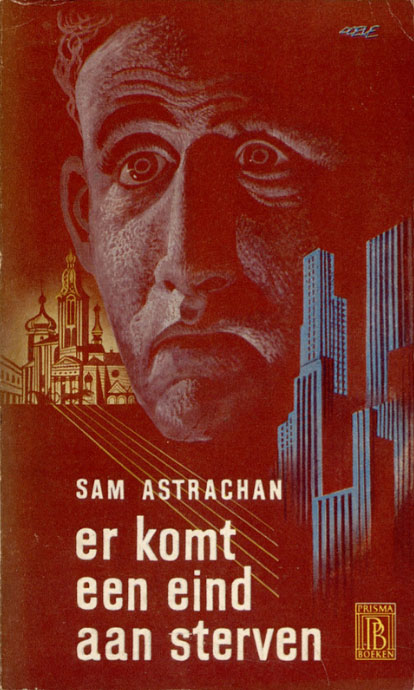
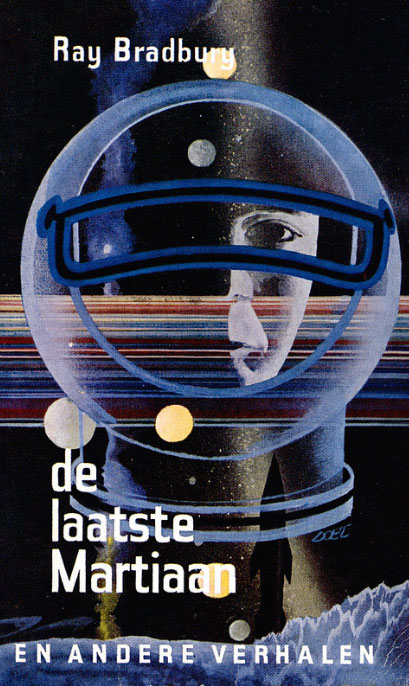
Cover artwork for Prisma pockets #296 and #940.
Illustrator
As an illustrator, Eppo Doeve was an artist dedicated to working in the service of others. Above all, he strived to serve the story, believing his drawings should complement the text, not the other way around. When he began drawing professionally in 1932, his first regular commission was illustrating the advertising magazine Meer Baet. In the following decades, he continued to illustrate for magazines, for instance making portraits for interviews, drawings for short stories, and even going on reportage. Until the 1970s, Doeve's drawings livened up the covers of many of the Prisma pocket novels published by Het Spectrum. Again he showed great versatility, varying in styles from highly realistic to abstract, and providing artwork for literature, historical novels, detective stories, sci-fi and even cookbooks.

'Het Mannetje Bagatel' (1946).
Comics
Doeve ventured in comics too, illustrating two narratives by the famous Dutch novelist and poet Bertus Aafjes. Between 4 June and 7 October 1946, their fairy tale comic strip 'Het Mannetje Bagatel' ran in the newspaper De Volkskrant as a temporary replacement for 'Pa Pinkelman en Tante Pollewop' by Godfried Bomans and Carol Voges. After 17 September 1946, the Aafjes-Doeve strip appeared under the title 'Bagatel's Kinder-cabaret'. It wasn't until sixteen years later before Eppo Doeve and Bertus Aafjes returned to the comics medium with 'Kleine Isar, de Vierde Koning' (1962) in Elseviers Weekblad. 'Kleine Isar' was a Christmas comic revolving around Isar, the fourth king never mentioned in the story about The Three Kings. While Balthazar, Melchior and Caspar are in time to find the newborn baby Jesus, "Little Isar" always arrives too late at each important event, much to his frustration. Book publications of 'Kleine Isar' appeared in 1963 and 1979. The was also reprinted in the Belgian comic magazine Ohee (issues #36-37, 1963) and ran in its French-language counterpart Samedi Jeunesse under the title 'Isar - Le Petit Roi Mage' (1964).
Doeve was not the only comic artist for whom Bert Aafjes wrote scripts. In 1948, Aafjes collaborated with Piet Worm on 'De Vrolijke Vaderlandse Geschiedenis', also published in De Volkskrant.

'Kleine Isar'.
Other media
Besides print media, Eppo Doeve designed murals, stamps, portraits, paintings, costumes and sculptures. Even in his illustration work, he enjoyed working on a large format. His original illustrations can be up to a meter wide, but only take up a few centimeters in print. However, Doeve could express his love for scale in his monumental works, some of which were as wide as forty-five meters. Until the 1970s, Doeve, aided by assistants, continued to create large-scale paintings for companies, foundations and government agencies. In addition, he has been active in the theater, designing sets and costumes. Between 1951 to 1965, he worked primarily with Johan de Meester, director of theater companies like De Nederlandse Comedie and De Nederlandse Opera. He occasionally worked for other clients, ranging from the 'Snip & Snap Revue' shows to the Russian director Peter Scharoff. Famous actors like Henk van Ulsen, Mary Dresselhuys and Ko van Dijk have worn his costumes.
In the 1950s, Eppo Doeve was also notable for designing a new set of paper bills. Each bank note sported the head of a famous person from Dutch history, like jurist Hugo De Groot (10 guilders), chemist/botanist Herman Boerhaave (20 guilders), astronomer/inventor Christiaan Huygens (25 guilders), writer Desiderius Erasmus (100 guilders), and painter Rembrandt van Rijn (1000 guilders). Later in life, Doeve even made parodies of these bills, depicting the heads of soccer icon Johan Cruyff or Dutch folklore character Zwarte Piet. Even though he had never been to Art Academy, Eppo Doeve was widely recognized as an outstanding graphic talent. He was ambidextrous and, if necessary, could even draw upside down. Doeve received so many assignments that he never had to worry about money. The only downside was that he mostly worked for other people, instead of creating something personal, out of his own free will.
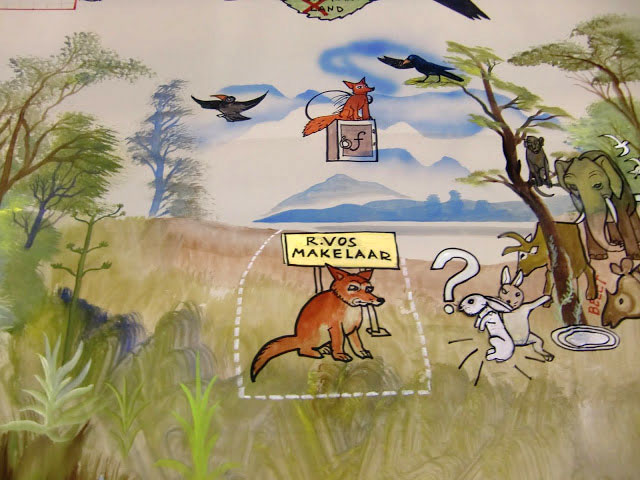
Part of the Fable of the Fox and the Raven, broadcast on 'Hier en Nu' on 12 March 1977.
Media appearances
By appearing on radio, television and in printed media, Eppo Doeve was one of the more recognizable graphic artists to the general Dutch public of his time. He was frequently invited to make drawings during live broadcasts of TV game shows like 'Telemimiek', 'Eén van de Acht' and 'Sterallures'. Together with writer Alexander Pola (part of the team of the satirical comedy show 'Farce Majeure'), Doeve appeared in episodes of the NCRV news shows 'Attentie' (1961-1962 ) and 'Hier en Nu' (1976-1977), with Pola telling a "political fable" related to one of the news items and Doeve illustrating his narrative on rolls of paper of 3 meters wide and up to 10 meters long.
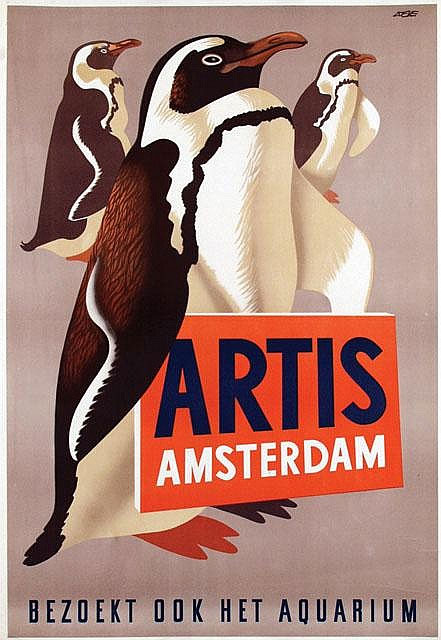
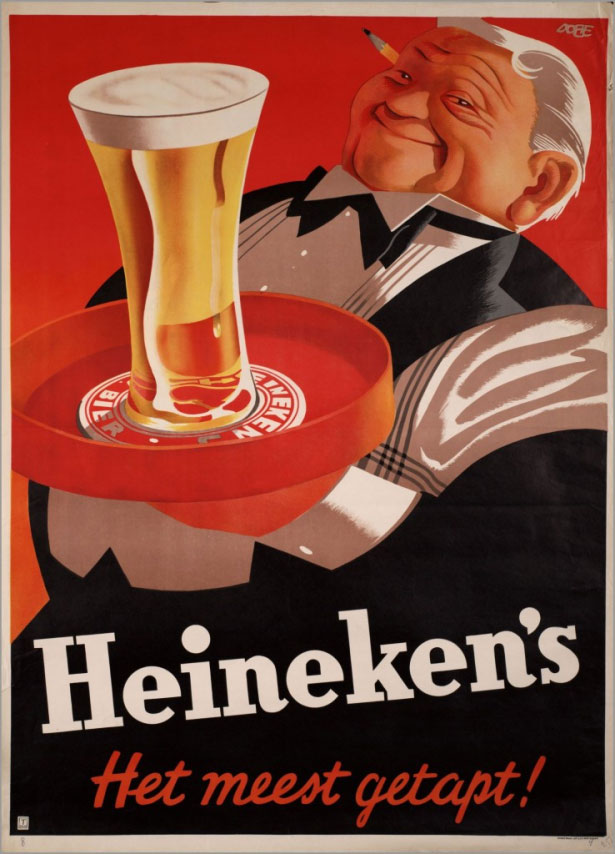
Advertising posters for Artis and Heineken (1950s).
Legacy and influence
Eppo Doeve won several awards for his work. In 1955, he received the National Outdoor Advertising Award and in April 1973 he was knighted in the Order of Orange-Nassau. Doeve passed away in 1981 at the age of 73. He was highly respected among fellow artists and a strong influence on people like Marten Toonder, Rudy van Giffen, Jan Kruis, Martin Lodewijk, Peter van Straaten and Fiep Westendorp. As his colleague Alexander Pola remembered him: "He could do everything he wanted, and wanted everything he could".
In 1988, art historian Marysa Otto wrote a book about Eppo Doeve's wall, ceiling and monumental paintings, 'Doeve Monumentaal'. Eppo Doeve's personal archives are in the collection of the Dutch Press Museum, which in June-July 2013 organized a large overview exhibition at Arti et Amicitiae. Its curator Jop Euwijk explored the artist's background and legacy, and authored the accompanying book 'Ter Herinnering Eppo Doeve' (1907-1981)' (Elsevier, 2013).

Eppo Doeve.