


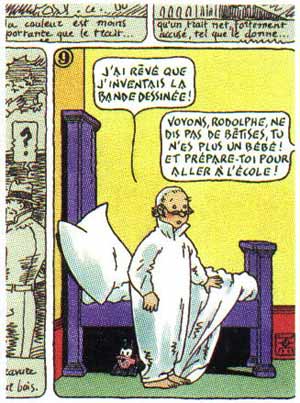
Comic art by Exem, starring Rodolphe Töpffer "inventing the comic strip", paying homage to Winsor McCay's 'Little Nemo in Slumberland'. Underneath his bed we can spot George Herriman's Krazy Kat.
Emmanuel Excoffier, also known as Exem, made his debut in 1983 with several posters. His work is characterized by its sense of composition and its Clear Line style, which is similar to the work of Joost Swarte. Most of his posters and cartoons have been printed in 'Affiches BD, 25 Ans de Création Genevoise', a book compiled by Ariel Herbez and published by Slatkine in cooperation with the Cultural Centre of Saint-Gervais. In 1984 and 1985 he created 'Le Jumeau Maléfique' and 'Zinzin Maître du Monde', two mini-albums parodying the 'Tintin' series by Hergé, published by Éditions Tchang. Exem became known as a miniaturist, and made several commercial books for Belvédaire ('Pas d'Escalade pour le Duc', 'Viva la Musica'), the Red Cross in Geneva ('Le Secret du Pyrophone') and Éditions Minerve ('Rendez-Vous Avec La Dune').
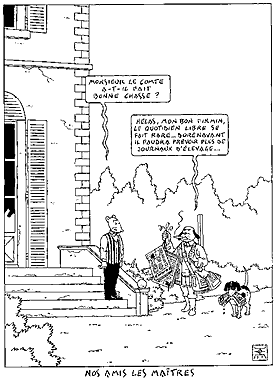
Comic art by Exem.
While pursuing a productive career as an illustrator, Exem has made comics for Tout va bien-Hebdo, Lémaniques and several collective albums. In 1998, he wrote the script for 'Les Héritiers de Sonderbund', a comic drawn by Enrico Marini and published by Suzanne Hurter on the occasion of the 150th anniversary of the federal state of Switzerland. He has also published a couple of books at Drozophile, such as 'Éclats d'Âme' (with Lawrence Suhner).
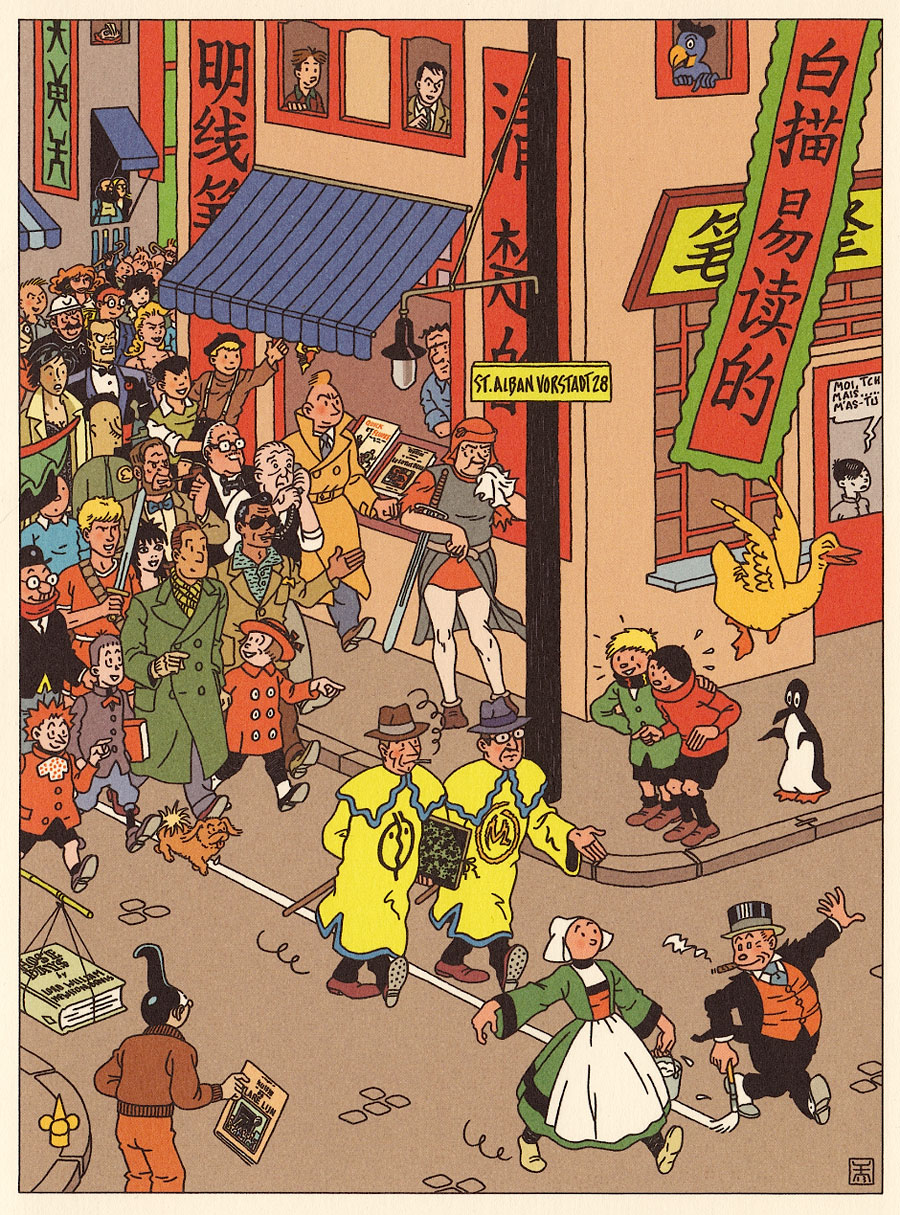
Poster for the Cartoon Museum in Basel , Switzerland (2013), regarding an exhibition about the 'Ligne Claire’ (‘Clear Line’) art style, invented by Hergé, spoofing a panel from Hergé’s 'Tintin’ story 'The Blue Lotus’. Tchang Tchong-Yen from this story can be seen as a poster on a door, while Exem portrayed himself as the store owner looking through the window. The illustration brings several characters and key artists together who were significant in the development of the 'Clear Line’. Up front, we see Émile-Joseph Pinchon’s Bécassine, George McManus’ Jiggs and Benjamin Rabier’s Gédéon the duck flying in the air, who were the predecessors. In Chinese costume, Hergé and Edgar P. Jacobs follow the 'Clear' Line as streamliners of the style. On the left side of the street, we spot Joost Swarte’s Jopo de Pojo and on the right, Hergé’s Quick and Flupke, with Alfred the penguin from Alain Saint-Ogan’s 'Zig et Puce’ behind the little rascals. Behind Hergé and Jacobs follow Alain Saint-Ogan’s Zig et Puce, Didier Savard’s Dick Hérisson, Ted Benoit's Ray Banana, Martin Branner's Winnie Winkle and Willy Vandersteen’s Lambik. Behind them Bob de Moor's Meester Mus (Monsieur Tric), Jacques Martin’s Alix, E.P. Jacobs’ Mortimer, Theo van den Boogaard’s Sjef van Oekel, Chris Ware’s Jimmy Corrigan and Yves Chaland’s Freddy Lombard. In the crowd behind them, Hergé’s Tintin, a typical character by Ever Meulen, Peter van Dongen’s boys from 'Muizentheater’, Philippe Wurm and Jean Dufaux' Lady Elza, Hergé’s Agent 15, Henk Kuijpers’ Franka, Maurice Tillieux’ Félix, Daniel Torres’ Opium, Émile Bravo’s Jules, E.P. Jacobs’ Olrik, Jijé's Jojo and Danker Jan Oreel's Helena. In the window in the upper right corner we also spot Robert Lips' Globi the toucan.