


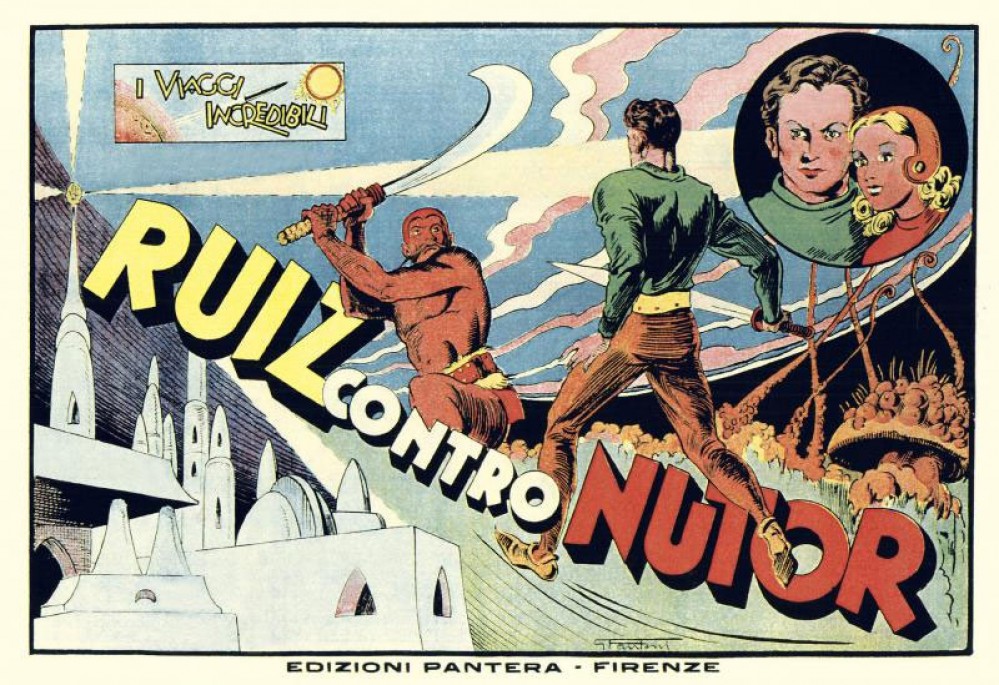
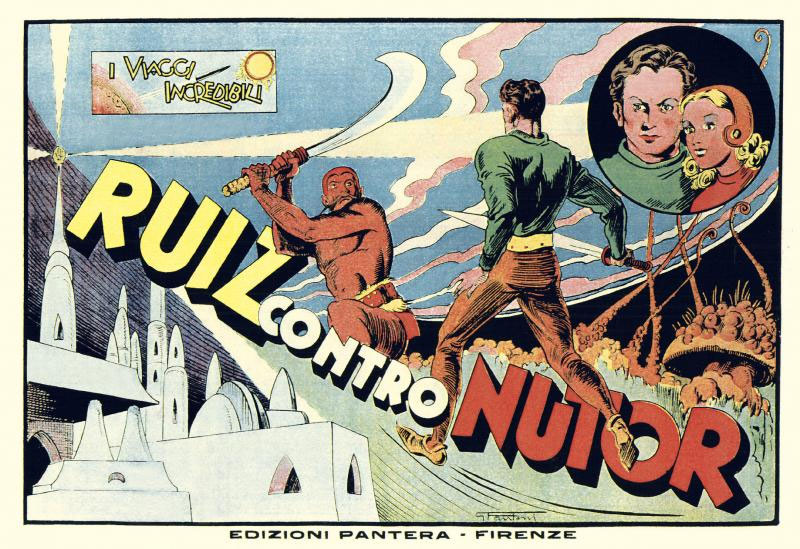
'Ruiz contro Nutor' for the collection 'I Viaggi Incredibili' (1946).
Guido Fantoni was an Italian artist, who was active in the field of comics from the 1930s through the 1950s. In the first leg of his comics career, he was a productive artist for the Florence-based publisher Mario Nerbini. In the Nerbini titles Giungla!, Il Giornale di Cino e Franco and L'Avventuroso, he drew a great many stand-alone adventure serials, as well as stories with heroes like 'Ku-Ty-Pao' and 'Vittorio Bottego'. He also worked on Italian episodes with American newspaper comic characters like 'Flash Gordon', 'Brick Bradford', 'The Phantom' and 'Mandrake the Magician'. After World War II, he worked for several other publishers, such as Editoriale Universo, Edizioni Pantera and Corrado Tedeschi. By the 1950s, he had established a creative partnership with his son and daughter, with whom he worked on the comic book series about aviator 'Capitan Walter' (1953-1957). Guido Fantoni the comic artist should not be confused with the Italian heavyweight wrestler Guido Fantoni (1919-1974).
Early life
Besides being born in 1892, not much is known about Guido Fantoni's early life. When he began working in the Italian comic industry in the second half of the 1930s, he was already in his mid-forties. It seems likely that by then he was already working as an illustrator. Since he mostly worked for Florence-based publishers, Fantoni was possibly from this region.
Casa Editrice Nerbini
Around 1937, Fantoni presumably began his collaboration with the publishing house of Mario Nerbini. In October of that year, his story 'Nella Tana Della Belva' appeared in Giungla!, the monthly adventure and crime fiction supplement of Nerbini's comic magazine L'Avventuroso. When in the following year that title merged with Il Giornale di Cino e Franco into Giungla!-Il Giornale di Cino e Franco, Fantoni created the comical feature 'Cartouche l'Allegro Furfante Parigino' ("Cartouche the Cheerful Parisian Rascal", 1938-1939) in collaboration with Paolo Lorenzini. In addition, Fantoni contributed the one-shot serials 'Sugriva il Fachiro' (1938), 'Il Valore Italiano in Tutti i Tempi' (1938-1939), 'La Regina di Borneo' (1939) and 'Hara Sahib il Fachiro del Mistero' (1939, again with Paolo Lorenzini). When in October 1939, Il Giornale di Cino e Franco was discontinued, the latter two serials were continued in L'Avventuroso.

'Flash Gordon' by Guido Fantoni.
Flash Gordon
Initially, the Nerbini magazines were largely filled with translated American newspaper comics - the title comic of Il Giornale di Cino e Franco was in fact Lyman Young's 'Tim Tyler's Luck', and important features in the parent magazine L'Avventuroso were Alex Raymond's 'Flash Gordon', William Ritt and Clarence Gray's 'Brick Bradford' ('Marco Spada'), Lee Falk's 'Mandrake the Magician' and 'The Phantom' and Eddie Sullivan and Charlie Schmidt's 'Radio Patrol' ('La Radio Pattuglia'). Among the early domestic contributors were Fantoni, Giorgio Scudellari and Ferdinando Vichi. When in 1938 Mussolini banned the import of all US comics, Nerbini started bootleg story productions for several of these features with his own artists and writers. For a long time, it was believed that the Italian stories with Alex Raymond's 'Flash Gordon' were drawn by Giove Toppi and written by the future filmmaker Federico Fellini. However, fumetti expert Leonardo Gori cast doubt over this often-repeated story, claiming that the Italian versions of 'Flash Gordon' were in fact drawn by Guido Fantoni. During this period, Italian stories with 'The Phantom' were drawn by Roberto Lemmi.

'Vittorio Bottego'.
L'Avventuroso
Between 1937 until the title's cancellation in May 1943, Fantoni remained a prominent artist in the pages of L'Avventuroso. Often in collaboration with his regular writer Lorenzini, he contributed several stand-alone serials, often in the western genre or jungle adventures. These stories included 'Pionieri Italiani sui Sentieri di Guerra del Grand-Ovest' (February-May 1937), 'Il Cavaliere Misterioso' (July-December 1937), 'Gaor, Il Conquistatore del Fuoco' (July-October 1938), 'La Regina di Cipro' (November 1938-July 1939), 'Il Fiore Della Jungla' (September 1940-July 1941, with writer B. D'Aloja) and 'Passaggio a Sud-Ovest' (March-October 1941). In the meantime, he continued his earlier serials from Giungla!-Il Giornale di Cino e Franco in L'Avventuroso: 'Hara-Sahib il Fakiro del Mistero' (October 1939-September 1940) and 'La Regina del Borneo' (October-December 1939, July-November 1940).
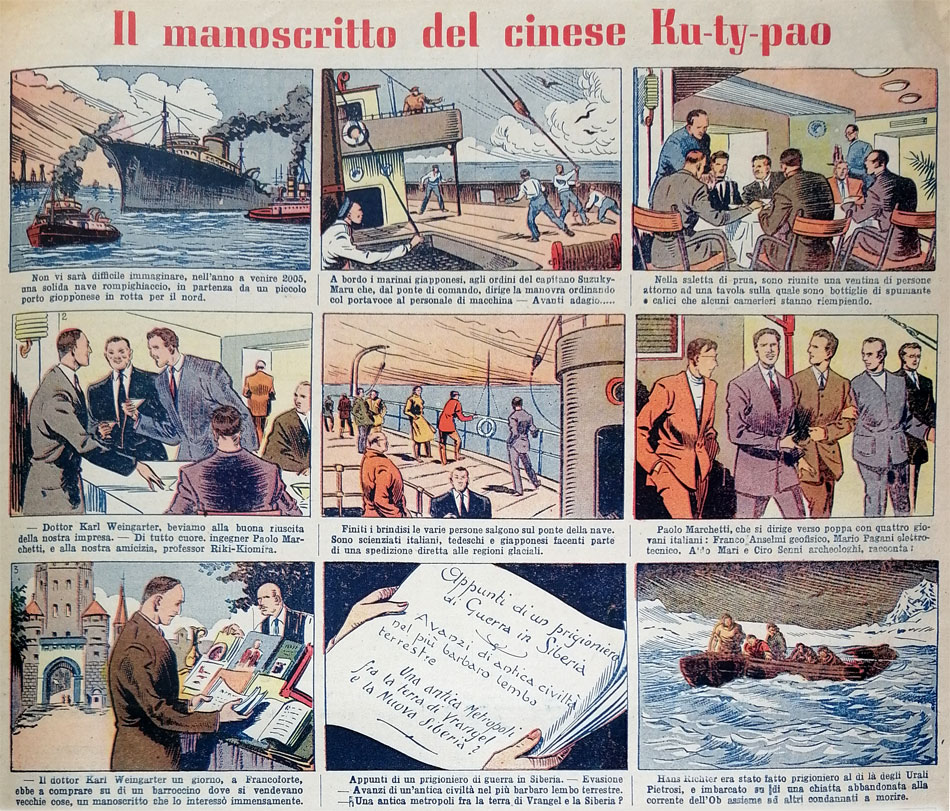
'Il Manoscritto del Cinese Ku-Ty-Pao'.
In L'Avventoroso, Fantoni also made adventure comics with recurring characters, starting with another Lorenzini co-creation, 'Ku-Ty-Pao', who appeared in the stories 'Il Manoscritto del Cinese Ku-Ty-Pao' ("The Manuscript of the Chinese Ku-Ty-Pao", April-June 1942) and 'Le Città Sovrapposte' ("The Överlapping Cities", June-September 1942). In 1942 and 1943, he made three serials based on Vittorio Bottego, the Italian army officer who led two expeditions in the Horn of Africa. The subsequent stories were 'Sui Sentieri del Giuba' (September-November 1942), 'Fiamme su Uelmal' (January-February 1943) and 'La Battaglia di Lokita' (starting February 1943). Several of Fantoni's stories for L'Avventuroso were also reprinted in the comic book collection 'Albi Grandi Avventure'.
In April 1943, Fantoni and writer Roberto De Luca also began a new Italian serial with 'Brick Bradford', titled 'Sul Trono di Titania'. When in May 1943 L'Avventuroso was absorbed by Mondadori's Topolino magazine, their story continued in this magazine until December of that year.
Editoriale Universo
While the largest part of his production was for Nerbini, Fantoni also worked for other publishers. As early as 1940, his story 'I Contrabbandieri d'Oppio' ("The Opium Smugglers") appeared as issue #87 in the collection Albi dell'Intrepido of Editoriale Universo. In Universo's Intrepido magazine, Fantoni and writer F. Macciò created the swashbuckling adventures of 'Capitan Sparviero', a series originally drawn by Vittorio Cossio and written by Elia Cavernelli. Under the title 'Le Capitaine Épervier', these stories also appeared in the French comic book L'Audaciaux by Éditions Mondiales (1942).

Cover illustration for the collection Avventurosi.
Post-World War II comics
In the post-World War II period, Guido Fantoni's collaborations expanded. In Mondadori's Topolino, Fantoni drew a comic adaptation of Pina Ballario's novel 'L'Isola dei Pinguini' (December 1945-September 1946). At Edizioni Pantera in Florence, he provided the illustrations for the prose pulp novel series starring the policeman 'Adamo Rey, Poliziotto' (1945-1946), written by Enzo Gemignani. While five titles were advertised, only the first two are known to have actually appeared. Also for Edizioni Pantera, Fantoni drew three issues of the space opera comic book 'I Viaggi Incredibili' (1946), which was a mix between a prose narrative with sequentially illustrated panels.
Between 1948 and 1953, Fantoni was a cover artist for Albi Colibri/Albi Avventurosi, a series of landscape-format comic booklets with mostly American newspaper strips, published by another Florence publisher, Corrado Tedeschi. For this series, Fantoni also drew the issues about 'Il Piccolo Indiano', a Native American boy reminiscent of Walt Disney's 'Little Hiawatha' (designed by Charles Thorson). For the occasion, the artist's name was Americanized to "Bobby Phantom".

'Mandrake the Magician' by Guido Fantoni.
Between 1946 and 1949, Guido Fantoni, along with his son and daughter, drew Italian stories with Lee Falk's 'The Phantom' ('Il Fantasma Mascherato'), first for the Tedeschi collection Albi Nuove Avventure (1946-1948), then for Nerbini's Albi Economici Nerbini (1949). For this latter series of landscape-format comic booklets, the team also worked on stories with another Lee Falk creation, 'Mandrake the Magician'. In addition to the Lee Falk comics, Guido Fantoni's later work for Nerbini included the volumes 'Il Mistero della Casa nel Parco' ("The Mystery of the House in the Park", #15) and 'Il Tesoro in Fondo al Mare' ("The Treasure at the Bottom of the Sea", #16) in the series Albi Economici Mistero (1949).
Family studio
After World War II, Guido Fantoni began a steady collaboration with his children, the illustrators Liliana Fantoni and Mario Fantoni. The family worked together on the 'Phantom' stories for publisher Tedeschi, and then created the comic book series about the aviator (and later journalist) 'Capitan Walter' for the Catholic publisher Anonima Veritas Editrice in Rome (227 issues between 1953 and 1957). The stories were written by Mario Basari and Renata Gelardini De Barba. For the same publisher, the team created the stories 'Calcio in Costume' and 'Il Figlio del Gangster' in the magazine Il Vittorioso. In Belgium, the 'Capitan Walter' stories appeared in Fernand Cheneval's Héroïc-Albums comic book (1955-1956).
During the 1950s, artwork by Guido Fantoni appeared in magazines like Il Corriere dei Piccoli. In 1953, he notably switched to a cartoony drawing style for the comic book 'Bertoldino' by Casa Editrice Dardo. For this 18-volume series, Fantoni (or one of his offspring) drew the title comic with the young Bertoldino, as well as the back-up feature 'Chiribù'.
In their collaboration, Guido Fantoni drew the general story with help from Mario, while Liliana did the lettering and drew the female characters. On occasion, Liliana's future husband, the sculptor Giuseppe Madonia, helped out with some translations from English, if necessary. After the death of father Guido Fantoni at age 64 in 1957, the 'Capitan Walter' series came to an end. However, brother and sister Fantoni continued their collaboration until the 1960s in the pages of Il Vittorioso and the book collection 'Jolly'.

'Bertoldini'.