


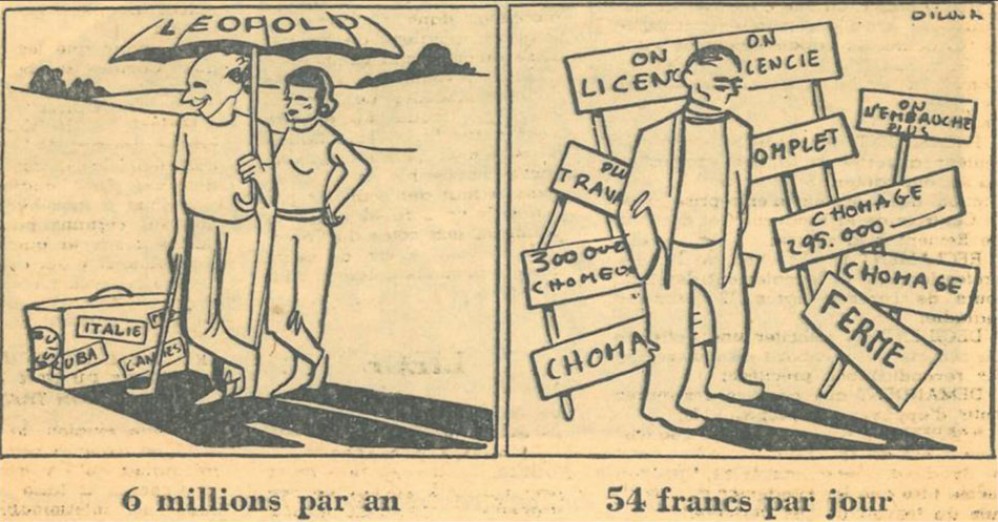
Cartoon criticizing former Belgian king and Nazi collaborator Leopold III and his second wife Lilian Baels for spending 6 million Belgian francs a year to go on a holiday, while the common unemployed man has to live on 54 francs a day.
Didier Geluck, who signed with the pseudonym Diluck, was a Belgian editorial cartoonist who primarily worked for Pourquoi Pas? magazine and the Communist weekly Le Drapeau Rouge. Later in his career, he headed Progrés Films, a company that imported and distributed foreign films, mostly from Eastern Europe. He is additionally notable as the father of Philippe Geluck, creator of 'Le Chat'.
Cartooning career
Didier Geluck was born in 1924 in Brussels, where he also studied at the Academy of Fine Arts. In October 1944, Geluck published his first editorial cartoon in the daily newspaper La Dernière Heure. Between 1946 and 1954, he was a political cartoonist in weekly magazines such as Pourquoi Pas?, and also livened up the pages of the official federal magazine Moniteur Belge/Belgisch Staatsblad. Between 1950 and 1954, his weekly cartoons ran in the communist weekly Le Drapeau Rouge. As one could expect in a far-left publication, Geluck's cartoons were critical of capitalism, the Church and royalty, while praising the virtues of the common worker. Geluck signed his work with a contraction of his first and last name, "Diluck".
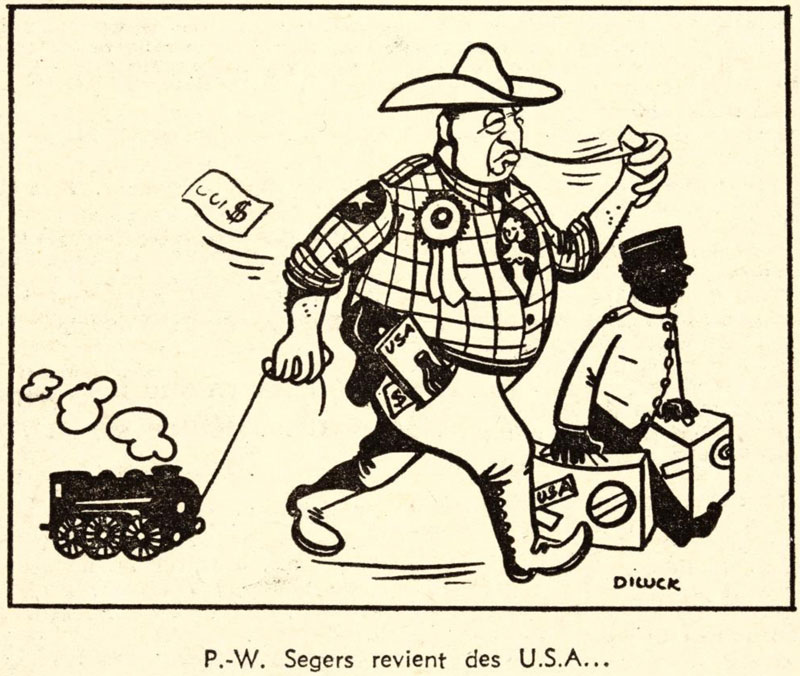
Cartoon depicting Belgian Prime Minister P. W. Segers returning from the U.S. in all his decadence (Le Drapeau Rouge, 13 January 1952).
Progrès Films
In 1950, the Belgian Communist Party founded Progrès Films, a film company intended to import and distribute Soviet and other Eastern-European films, including fiction films, animated films and documentaries. In 1955, Geluck quit his cartooning career and became head of this firm. He had an eye for new talent and brought in many films of future cinematic legends such as Roman Polanski, Andrzej Wajda, Milòs Forman and Andrej Tarkovsky. During his career, he met many of these directors in person too. While Progrès Films focused mostly on productions from behind the Iron Curtain, the company also bought pictures from other parts of the world, which they played in their own Brussels theater and sold to other movie theaters and festivals in the country. In 1989, the Berlin Wall fell and two years later the USSR was dissolved. These developments gave a serious blow to communism worldwide. Progrès Films saw much of its Eastern-European imports dry out, since they were no longer backed by Moscow. In addition, ticket sales plummeted because more people rented films from video stores. Progrès Films managed to survive long enough to celebrate its 50th anniversary in 2000, but the company went bankrupt in 2002.
Death and legacy
In 2011, Didier Geluck passed away. His cartooning career is nowadays forgotten and overshadowed by his far more famous son Philippe Geluck (b. 1954). His other son is the painter and graphic artist Jean-Christophe Geluck (b. 1947).
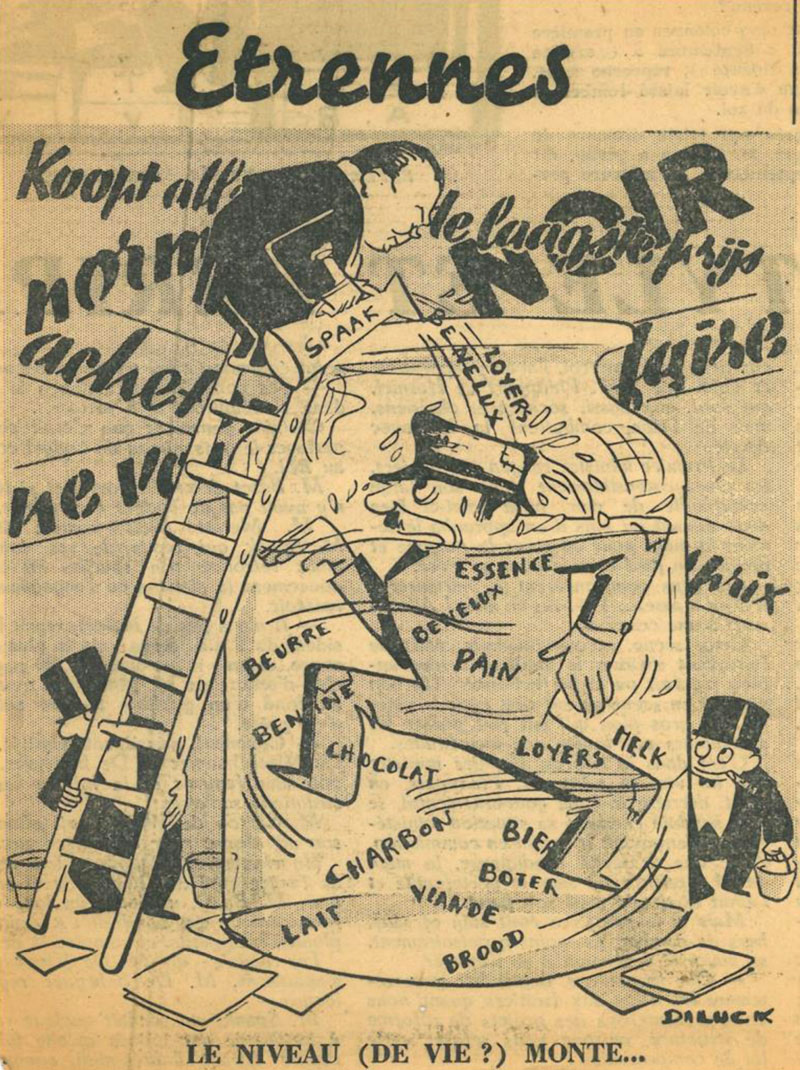
Cartoon criticizing socialist Prime Minister Paul-Henri Spaak's economic policy, which inundates the common man, while "the living standards are rising."