


'Piccolo Bello'.
Wim Haazen is a Belgian animator and comic artist, active in the field during the 1970s and 1980s. Beginning his career working at animation studios and as an assistant of Jef Nys on the 'Jommeke' comic, Haazen had a short-lived solo career with the humor comics 'Zeezus' in Kuifje/Tintin ('L'Eaulita' in the French-language version, 1980-1981) and 'Piccolo Bello' in Robbedoes/Spirou ('Attention: Groom Méchant' in the French-language version, 1983). Wim Haazen the comic artist should not be confused with the Belgian poet Wim Haazen (b. 1945).
Early life
Wim Haazen was born in 1953 in the Antwerp district of Wilrijk. While he had the ambition to enroll at the Art Academy, his parents envisioned another career path for him, so instead he studied to become a bookkeeper. After graduation, he worked at a book club, until an advertisement for the Belvision animation studios lured him away.
Animation
At Belvision, the animation studio of comic book publisher Le Lombard (known for Tintin magazine) Haazen participated in the production of the film 'Gulliver's Travels' (released in 1977), which mixed live-action with animation. After a couple of months, Haazen already left the studios, and found employment with TVA Dupuis, the audiovisual department of the competing publishing company Dupuis (known for Spirou magazine). Under supervision of Ray Goossens, he was one of the animators for the animated TV series 'Boule et Bill' (1975), based on Jean Roba's popular children's comic of the same name.
Switch to comics
After the TVA Dupuis studio closed down two years later, Haazen became a publicity officer for a family business in equipment for dismantling car tires, followed by a similar stint as a representative for creative applications. Simultaneously, in his spare time, he spent a year working as an assistant for Jef Nys on the classic Flemish comic series 'Jommeke'. He co-wrote the script for the album 'De Kleine Professor' (1978), in which professor Gobelijn turns into a baby. He also contributed as a character artist to about five albums in the series until creative differences with Nys ended this collaboration, and Haazen set out to launch a solo comics career.

'Zeezus'.
Zeezus
Together with the Belgian comic expert Kris De Saeger, Haazen developed the pantomime gag strip 'Zeezus', about a female castaway waiting on a deserted island for either salvation or true love. Her name is a pun on the Dutch spelling of Jesus, the word "zee" ("ocean") and "zus" ("sister"). Graphically, Haazen applied a style strongly reminiscent of the Dutch humorist Peter de Smet. Created under the pseudonym "Scrunch", the 'Zeezus' strip won the first prize in a contest organized by the Ministry of French Culture, and landed a spot in the comic magazine Tintin. Between 1980 and 1981, about 80 gags appeared in both the French-language edition (under the title 'L'Eaulita') and the Dutch-language version, Kuifje (under the title 'Zeezus'). The character's French name is also a pun, referring to the female name 'Lolita' and the word "l'eau" ("water"). Between 2017 and 2018, Haazen digitized and recolored the strips and published them on his Facebook page, this time using the title 'Zee, Zus & Zo'.

'Piccolo Bello'.
Piccolo Bello
In 1983, Haazen appeared in the comic magazine Spirou/Robbedoes, this time working with writer Marck Meul on the slapstick humor feature 'Piccolo Bello' (1983, French title: 'Attention: Groom Méchant'). Just like the magazine mascot Spirou, Haazen and Meul's creation was a bellboy, only far less heroic and dressed in a green instead of red costume. Utterly clumsy and naive, Piccolo Bello's behavior constantly causes havoc at the hotel, driving his manager to madness. Unfortunately, the comic didn't really catch on with Spirou's readership, allegedly because it shared too many similarities with their other anti-hero, André Franquin's office worker 'Gaston Lagaffe'.
Post-comics career
For the rest of his career, Wim Haazen worked in the graphic industry. In his spare time, he worked on an occasional comic project, but none for serialization. Later in life, during the 2020s, Haazen returned to animation as a hobby, experimenting with AI techniques.
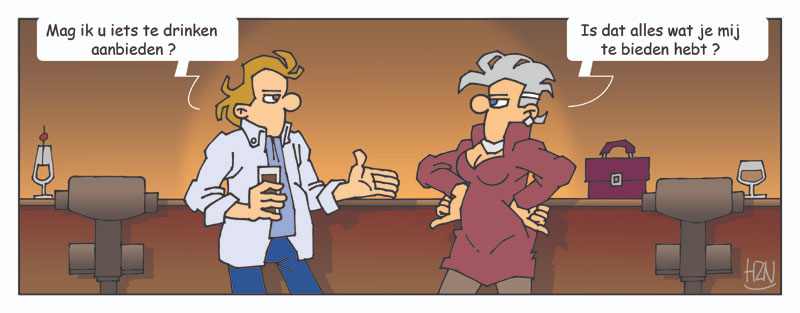
'Mannen & Madammen', a later comic project published on the artist's website. Translation: "Can I offer you something to drink?" - "Is that all you've got to offer me?".