


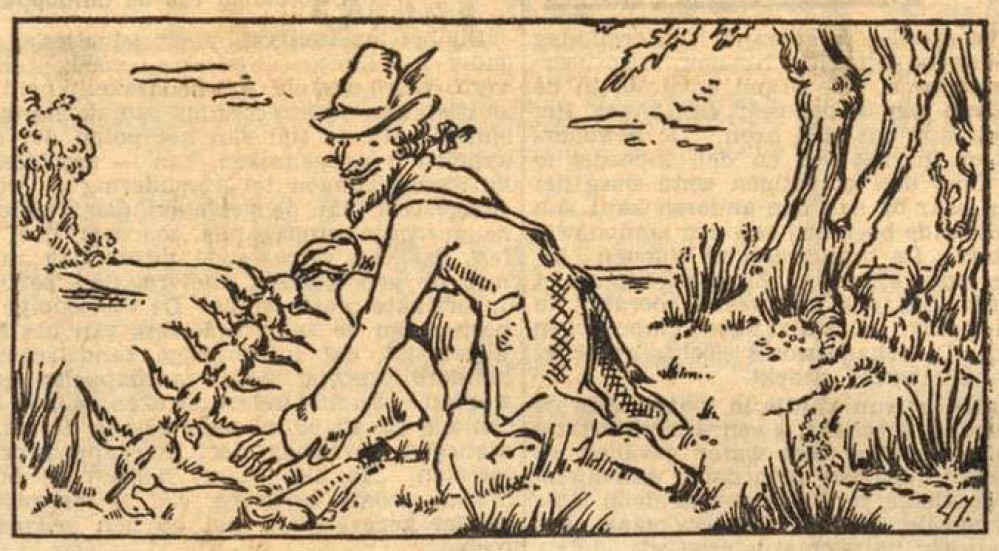
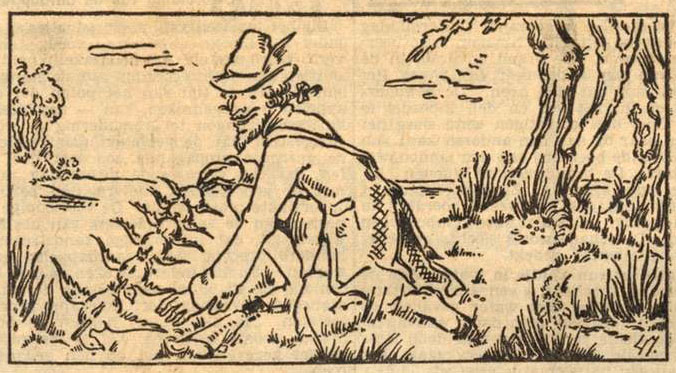
'Avonturen van Baron van Munchhausen', 11 April 1941.
Toby Nieuwstadt, whose last name is sometimes spelled as "Nieuwstad", was a Dutch painter and illustrator. She was the creator of the 1930s picture book 'Het Sprookje van Uta-Daja en Uta-Nebo', and of a 1941 text comic adaptation of 'The Adventures of Baron Munchausen', which was published in a few Dutch regional newspapers. As a fine artist, she is generally known under her married name, Carina Maesser.
Life and career
Catharina Nieuwstadt, nicknamed "Carina" or "Toby", was born in 1920 in Utrecht. Many sources spell her last name as "Nieuwstad", but her official documents certify that her name was "Nieuwstadt". Nieuwstadt was active as a painter of still lifes, particularly flower arrangements and landscapes. She got her education at the Academy of Fine Arts and Crafts in Arnhem. Among her teachers were Gerard van Lerven and Jos. Rovers.
An ad in the Arnhemsche Courant of 24 December 1941 announced her engagement in Arnhem to Johannes Franciscus Maesser, born 28 October 1908. The same paper mentions their marriage on 3 June 1942. In 1947, the couple moved to Amsterdam. Nieuwstadt was also a member of the Amsterdam Fine Artists collective De Brug, a group taking the example of the German collective Die Brücke in introducing the New Objectivity movement into painting. Maesser passed away on 3 January 2002 at age 93, and his wife followed on 23 October 2010, at age 90.
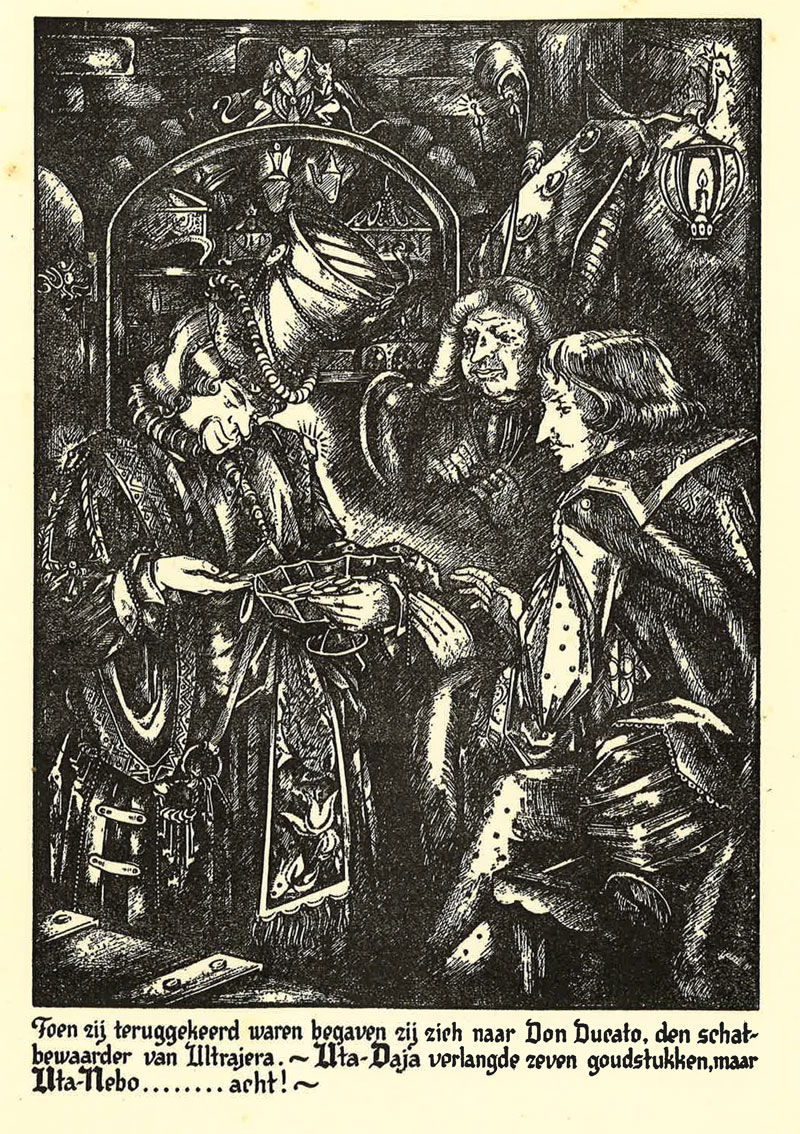
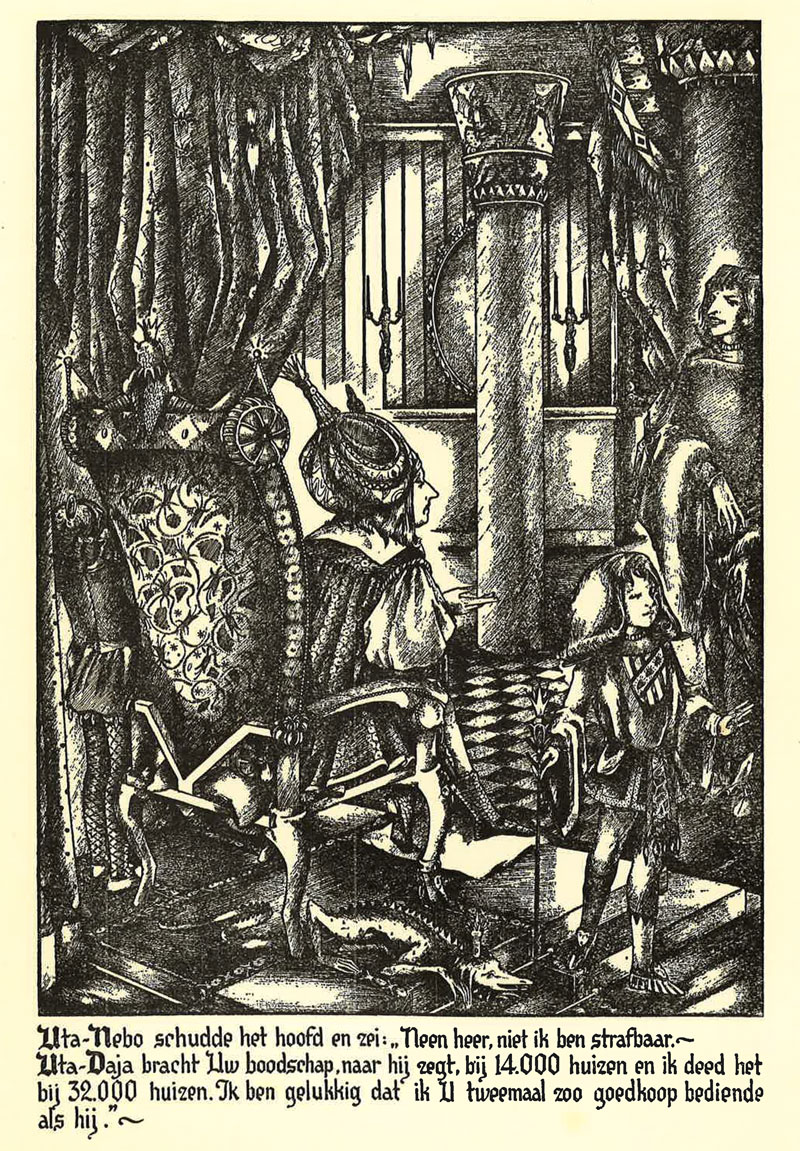
'Het Sprookje van Uta-Daja en Uta-Nebo' (1930s).
Het Sprookje van Uta-Daja en Uta-Nebo
During the late 1930s, Toby Nieuwstadt wrote and illustrated the picture story fairy tale 'Het Sprookje van Uta-Daja en Uta-Nebo', published by Utrechts Nieuwsblad. It told the story of the emperor of Ultrajera, who orders his two messengers Uta-Daja and Uta-Nebo to inform the people of the country that he will reduce taxes by one ducat. After their job is done, the two messengers head to the royal treasurer, where Uta-Daja demands seven pieces of gold for his services, and Uta-Nebo eight. Sent back to the emperor, Uta-Daja claimed he helped his ruler the best, by asking for the smallest reward money. Uta-Nebo on the other hand remarks that he had visited 32,000 houses, and his colleague only 14,000. A quick calculation indeed revealed that the latter had offered the most lucrative service, by delivering 4,000 messages for one gold coin, while his colleague delivered only 2,000 messages for one coin. As a result, Uta-Nebo is promoted to Ultrajera's first messenger. The publication was a promotional booklet by the regional newspaper Utrechts Nieuwsblad, aimed at potential advertisers. The paper calculated that they delivered their advertiser's messages to 32,000 Utrecht households against the lowest advertising rates.
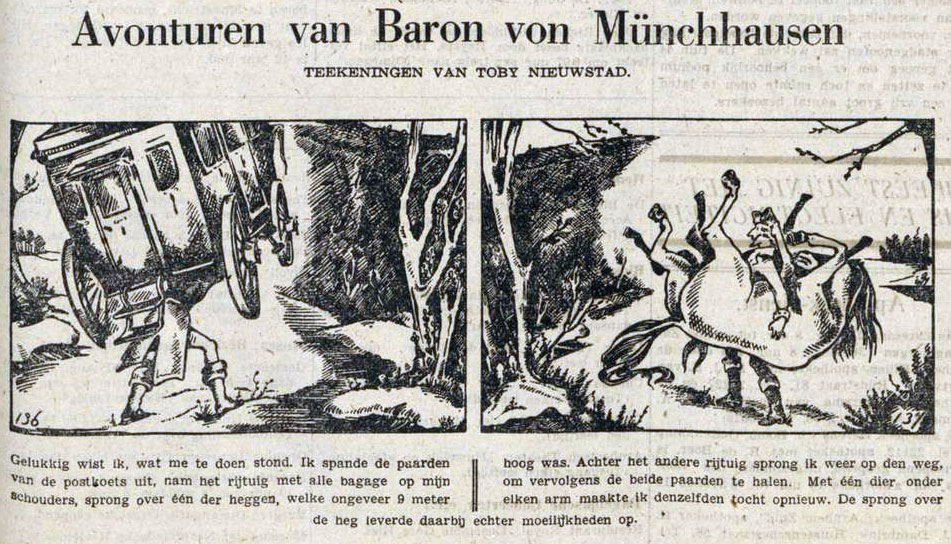
'Avonturen van Baron van Munchhausen', 27 August 1941.
Baron von Munchausen
In 1941, shortly before her marriage, Toby Nieuwstadt drew a newspaper comic serial based on Rudolph Raspe's humorous 18th-century novel 'The Adventures of Baron Munchausen' ('Avonturen van Baron van Munchausen' in Dutch). Starting on 7 March 1941 and running until early 1942, the tall tales about the self-grandizing baron were printed in a text comic format, with narration underneath the images. The comic ran in the regional newspapers Gooi en Eemlander, Utrechts Nieuwsblad and Arnhemse Courant. Contrary to most Dutch newspaper text comics, Nieuwstadt's comic wasn't published with one or two strips per episode, but usually just one or two panels. It's possible that this was a direct result of the supply scarcity during the war years, which forced editors to keep their publications economical.
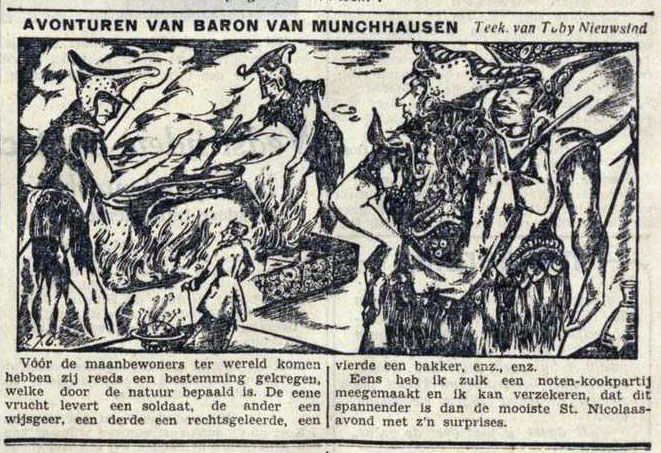
'Avonturen van Baron van Munchhausen', 23 January 1942.
Nieuwstadt wasn't the first Dutch artist to make a comic strip adaptation of 'Baron Munchausen': in 1928 Sam van Vleuten, Jr. already released a picture story based on the infamous baron. In addition, the German film studio Universum Film A.G. (Ufa) released a film adaptation of 'Baron Munchausen' in 1943, directed by Josef von Báky.
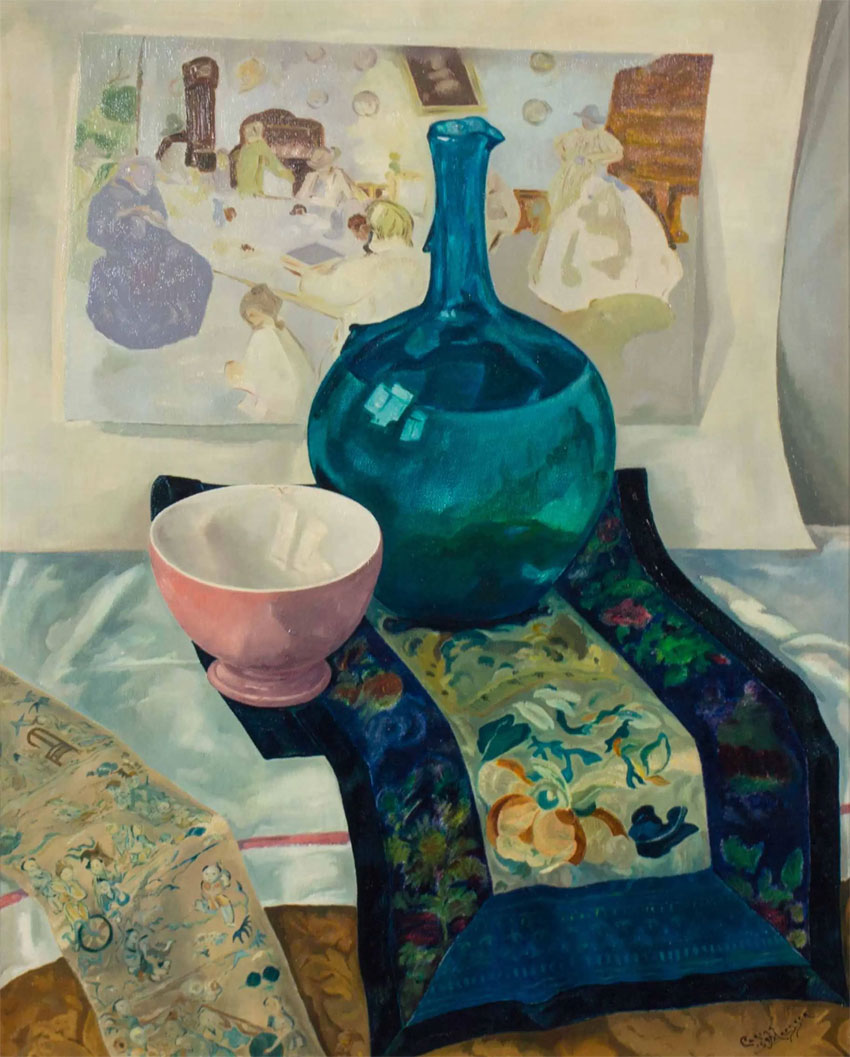
"Still life bowl and vase" by Carina Maesser (oil on canvas).