


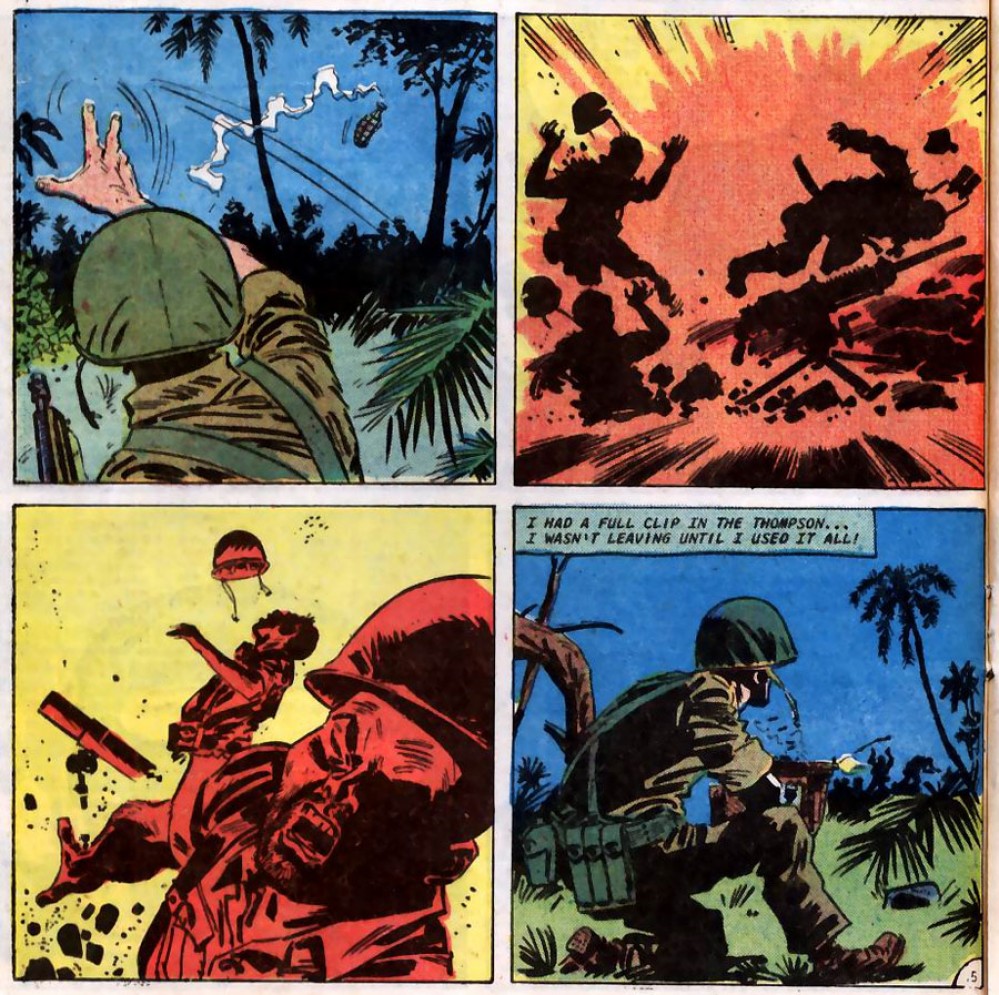
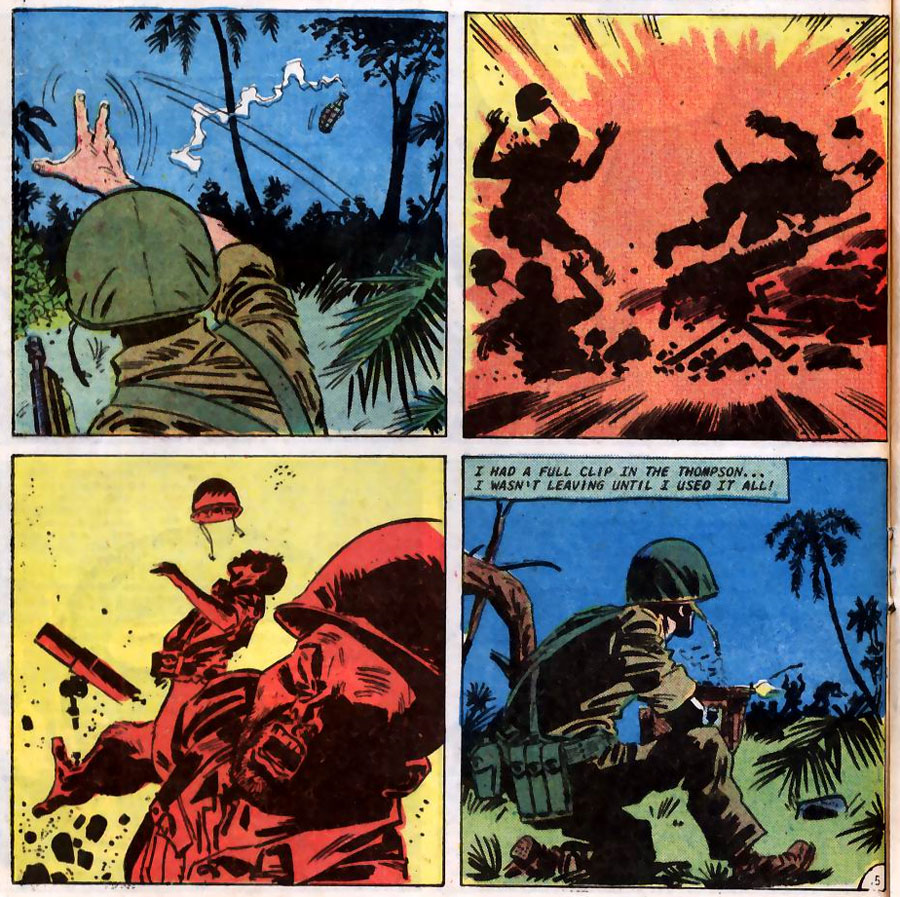
'Banzai! Banzai!' (Fightin' Marines #74, May 1967), signed "Al Caruso".
Alberto Caruso is an Argentinian comic artist and art teacher, with an extensive career in drawing war comics. In his home country, he appeared in magazines by Editorial Frontera and a host of smaller publishers, before beginning a long association with Editorial Columba. From the 1960s through the 1980s, he crafted a great many war stories for magazines like D'Artagnan and Intervalo, and subsequently produced the naval adventure series 'MAN' (1988-1996) for El Tony. Simultaneously, Caruso had a productive career as an agency artist, notably working for publishers like Fleetway in the UK and Eura Editoriale in Italy.
Early life and career
Alberto Luis Caruso was born in 1941 in Buenos Aires. In the city's Villa Pueyrredón neighborhood, the family rented a front part of a house owned by the Zanotto family, who had just moved from Italy. As luck would have it, their son was the future comic artist Juan Zanotto. Even though Juan was six years Alberto's senior, the two boys became close friends as they shared a passion for drawing. They later started their careers in comics almost simultaneously. Caruso studied at the Pan-American School of Art, where his teachers were the comic creator Alberto Breccia and the illustrator Ángel Borisoff. In the early stages of his career, Caruso took inspiration from many cartoonists, picking out elements which he liked from each one. Important influences were his former teacher, Alberto Breccia, as well as Hugo Pratt, Harold Foster and especially the Italian artist Gino D'Antonio.
In 1959, Caruso began his professional career, working for small publishing houses like Nómina and Carlos Clemen's Cleda. The first was responsible for the magazines Bala de Plata and X-9, the second for Comanche magazine. On 17 May 1960, one of the first known Caruso strips appeared in issue #4 of Comanche, the western story 'No Hay Que Prisarse' ("Don't Rush", 1960), scripted by Pedro Mazzino.
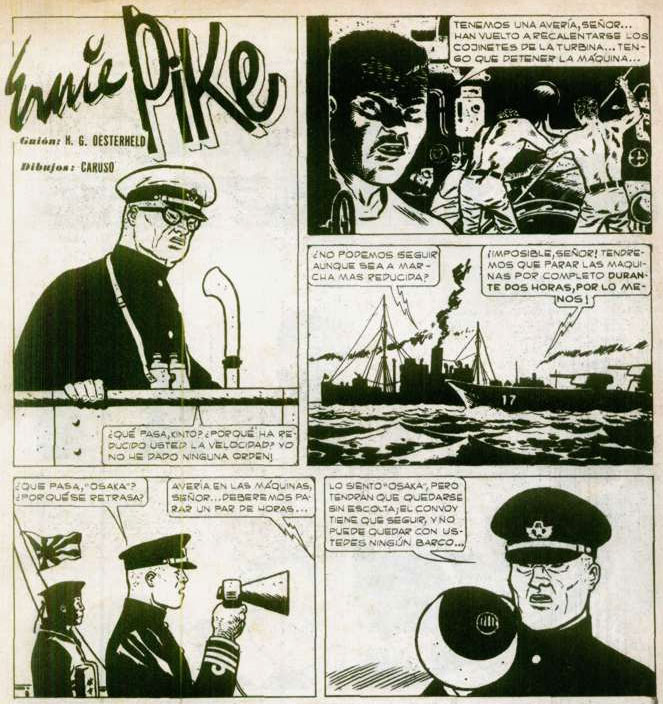
'Ernie Pike' art by Alberto Caruso.
Caruso continued his career at Editorial Frontera. Starting in 1961, he contributed to Hora Cero Extra and Frontera Extra, drawing episodes with Héctor Germán Oesterheld and Hugo Pratt's war reporter 'Ernie Pike', and also installments of its spin-off 'Del Cuaderno Rojo de Ernie Pike' ("From Ernie Pike's Red Notebook"). By 1963, he appeared in Fuego!, a similar war title published by EDMAL (Editorial Manuel Láinez), where he drew 'Arenas Infernales' ("Infernal Sands"). In the following year, Caruso drew comics like 'El Inspector Fuentes' and 'Arenas en Llamas' ("Burning Sands"), published in Editorial Abril's Misterix as well as the evening newspaper El Siglo by Editorial Haynes.
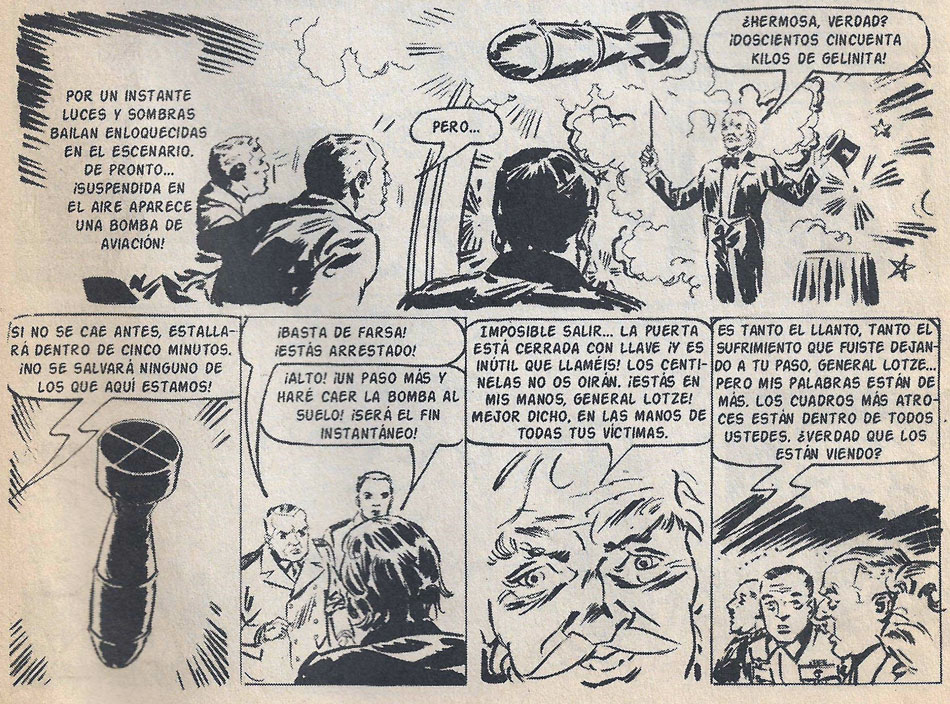
'El Magia Suprema' (D'Artagnan, May 1972).
Editorial Columba
Still in 1964, Caruso began his enduring association with Editorial Columba, which lasted, despite some interruptions, for over thirty years. By then, the publisher was one of the few companies that survived the 1960s media crisis, and effectively monopolized the Argentinian comic industry. Continuing his work in the war genre in the anthology magazine D'Artagnan, he started out with drawing stories like 'Extraño Parecido' ("Strange Resemblance" 1965) and 'Morir en Sicilia' ("To Die in Sicily", 1966). Working with writers like Pedro Mazzino, Robin Wood, Héctor Germán Oesterheld, Noel McLeod, Hernán Ferret and José Luis Arévalo, he continued to create dozens of short stories for the Columba magazines D'Artagnan, Fantasía and Intervalo in the next couple of decades. One notable contribution to D'Artagnan was 'La Magia Suprema' ("Supreme Magic", May 1972), a poetic World War II story by Oesterheld about a single man whose action can keep the German army from its final and decisive victory at Stalingrad.
Between 1988 and 1996, Caruso worked with writer Theo Lacruz (Eugenio Zappietro) on 27 episodes of the naval adventure series 'MAN', about a man who traveled by ship through Asia fighting pirates. It was published in El Tony Todo Color and its annuals. Also for El Tony, he drew episodes of the war feature 'Brigada Madeleine' from scripts by Guillermo Fernández Morán. Originally created by Héctor Germán Oesterheld and Gómez Sierra, additional artists for the comic were Néstor Olivera, Merel and Navarro.
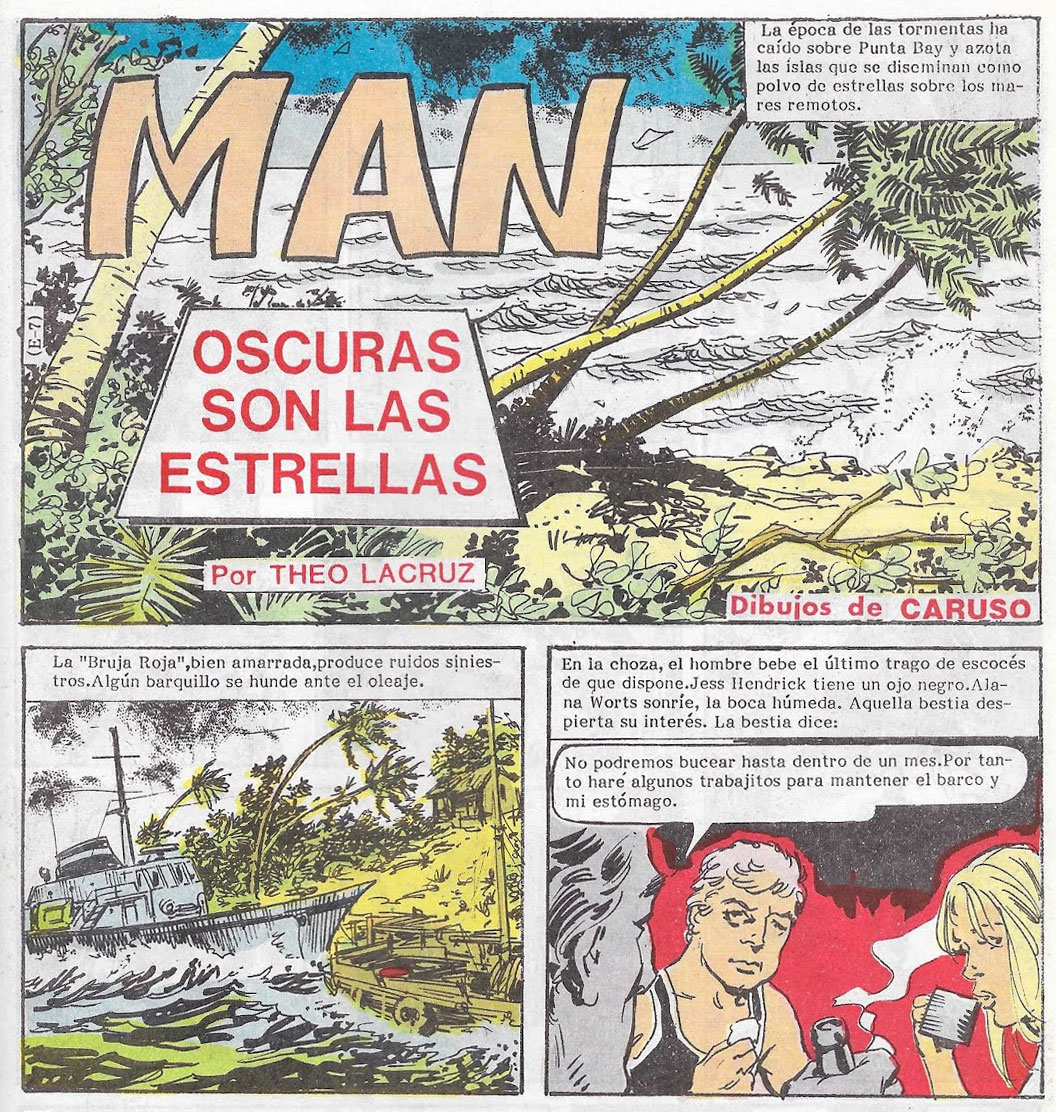
MAN - 'Oscuras son las Estrellas' (El Tony Super Anual #32, 9 May 1989).
International work
Like many of his contemporaries, Caruso was active as an agency artist for international publishers from the UK, USA, Italy and Germany. Between 1959 and 1961, he assisted his good friend Juan Zanotto on the 'Air Ace' series for Fleetway in England. With the decline of the Argentinian comic book market, his international workload intensified later in the 1960s. Through Union Studio, he produced war stories for the North-American market, for instance for the Fightin' Marines comic book by Charlton Comics (1967). Between 1967 and 1969, Caruso was drawing episodes of 'Top Sergeant Ironside' for the Fleetway Super Library and the Battle Picture Library of the British publisher Fleetway.
In 1974, Caruso began drawing comic stories for magazines like Pif-Paf and Skorpio by Editorial Record in Argentina, which were simultaneously published by Eura Editoriale in the Italian magazines Skorpio and Lanciostory. While he mostly worked on war stories, he also tackled crime and romance. Between 1999 and 2001, Caruso drew erotic comics for Sex-Humor.
Teacher
In the 1980s, Alberto Caruso taught drawing classes through the Asociación de Dibujantes de la Argentina. A professor at the Association for the Promotion of Fine Arts (AEBA) in Buenos Aires since 1995, he has been in charge of the comics, basic drawing and illustration courses.
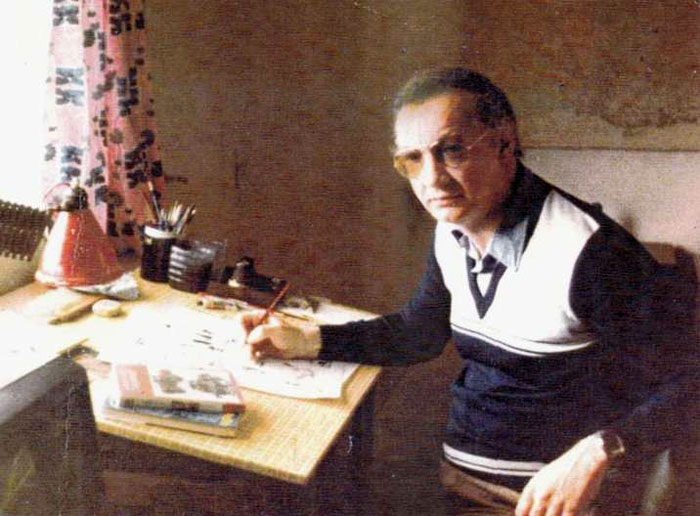
Albert Caruso.