


Génial Olivier - 'Le Passé Recomposé' (1977).
Jacques Devos was a Belgian comic artist, who worked for the magazine Spirou throughout his career. His two signature series are the humorous spy comic 'Victor Sébastopol' (1962-1988, co-created with Hubuc) and the equally funny 'Génial Olivier' (1963-1988), about a child prodigy. Devos went on a science fiction route with 'Les Chroniques d'Extra-Terrestres' (1976-1984), a series of short stories in which two extraterrestrials unwillingly shape history and mythology. Passionate about machinery, particularly weaponry, he also wrote and illustrated various educational features for Spirou about the history of firearms and warfare.
Early life and career
Jacques Devos was born in 1924 in Brussels. As a child, he avidly read the pre-war comic magazines Le Petit Vingtième, Les Petits Belges, La Semaine de Suzette, Les Belles Histoires Illustrées, Le Journal de Mickey, Robinson, Hop-là! and L'Aventureux. After the war, he became fascinated by the comic magazines Spirou and Héroïc-Albums. Showing an early talent for drawing, Devos' ambition was to become a comic artist. At age 19, he worked on the full-color comic story 'Aventures Mirobolantes de Scottie' (1943), but it remained unfinished. Decades later, in 2011, the story was discovered in the artist's childhood sketchbooks and released posthumously by Éditions Bague-Á-Tel.
Instead of turning to fulltime cartooning, Devos initially followed in his father's footsteps. After obtaining his mechanic's degree, he went to work in the family's bicycle repair shop. Devos worked in this profession for twenty years, while doing occasional art assignments on the side. In 1951, two illustrated articles by him about the history of tanks were published in Tintin magazine. He then spent two years illustrating the memoirs of a healer, who then disappeared with his original drawings. In ink wash, Devos made an illustrated history of the African war, which he submitted to the magazine Le Moustique. In 1960, he also illustrated a short story in Bayard magazine.


'Schwartzbrot' and 'SuperHerman', Dutch-language version, respectively from Spirou/ Robbedoes issues #1280 (25 October 1962) and #1357 (16 April 1964).
Spirou
At age 37, in 1961, Devos quit his day job to focus on his cartooning work, as he began his enduring association with the publishing house Dupuis and its comic magazine Spirou. His first contributions appeared in the magazine's fold-in mini books section, generally the try-out spot for new creators. In these so-called "mini-récits", Devos wrote western-themed comic booklets with characters like 'Tim et Tom' (1962-1965) for Louis Salverius, and drew his own mini-books starring characters like 'Schwartzbrot' (1962-1963), 'SuperHerman' (1963-1965) and 'Génial Olivier' (1963-1966). The latter three were early showcases of the artist's slapstick humor, often accompanied by absurd fantasy elements. Soon afterwards, Devos also appeared as a writer in Spirou's regular pages, co-creating the adventures of the Native Americans 'Whamoka et Whikilowat' (1963-1968) with Salvérius and the genie-in-a-bottle 'Djinn' with Kiko (1964-1966). In Spirou, Devos also wrote 'Dans le Sillage des Argonautes' (1965), the second serial starring the artist Hubuc's Ancient Greeks 'Alertogas et Saxophon'.

'Victor Sebastopol in Spirou issue #2107 (31 August 1978).
Victor Sébastopol
With fellow artist Hubuc, Devos created the memoirs of the German spy 'Victor Sébastopol', debuting in the 1288th issue of Spirou (20 December 1962). The series is set at the start of the 20th century and presented as Sébastopol's chronicles of his brilliant strategies, clever schemes, successful assignments and amazing inventions. Although the text praises Sébastopol's achievements, the drawings show what actually happened, which was quite the opposite of what the narcissistic spy claims. While most comics in Spirou had word balloons, 'Victor Sébastopol' was a text comic, with captions above the images, giving it the impression of an actual journal. In the beginning, the series was drawn by Hubuc, but from 1964 onwards, Devos continued the feature on his own. 'Victor Sébastopol: Les Mémoires d'un Agent Secret' appeared with long intervals in Spirou throughout the 1960s, 1970s and 1980s. Michel Deligne published one black-and-white book collection in 1977.
Steve Pops #2 - 'Operation Éclair' (1967).
Steve Pops
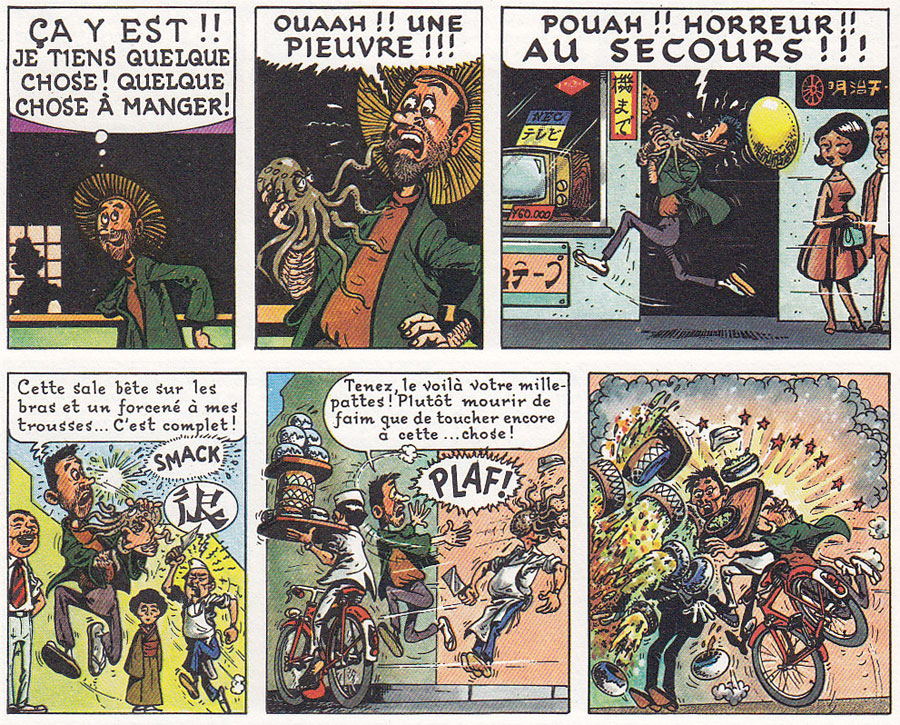
In addition to his work for Dupuis, Devos created two albums of the spy parody 'Steve Pops' (1966-1967) for Casterman. Steve Pops is the secret agent H2O of Na2S, a British counter-espionage service. A master of disguise, hand-to-hand combat and firearms, he is known for his clothes, his cakes, and his impressive beard, which grows rapidly throughout his adventures. The Steve Pops adventures were parodies of the James Bond films starring Sean Connery - the first book was called 'Steve Contre Dr. Yes' - while incorporating elements from other famous spy series such as 'The Man from U.N.C.L.E'. In 2015, the Coffre à BD imprint re-released the two albums.
In 1968, Devos had finished a third installment of the series, when the original artwork disappeared before publication. Devastated by this event, he instantly canceled the series, leaving also the fourth book unfinished, which existed in synopsis format. Forty years later, the original pages of the third 'Steve Pops' story resurfaced at an auction. Fans of the series, like Gilles Doumerc, began monitoring these sales and acquiring either the original artwork or high-resolution scans. With the help of the additional documents owned by the artist's son, Devos, a major restoration project was undertaken, which resulted in 2015 in the release of 'Steve Contre les Soucoupes Volantes' at La Coffre à BD. The illustrated script of the fourth story 'Steve Pops: L'Affaire Citrolls-Roynault' was released by the same imprint as volume #4 in the series.

'La Porte aux Illusions' (Spirou #1670, 16 April 1970).
Génial Olivier
Between 1969 and 1972, Devos produced several humorous and often absurd comics for Spirou, which appeared under the title 'Farfeluosités de Devos'. The stories featured a wide range of imaginative creatures and surreal settings, while the artist also toyed with perspective and anatomy. A book collection appeared in 1984, in the 'Carte Blanche' collection of the publishing house Dupuis. These experimental stories can be considered forerunners of Devos's best-known creation, 'Génial Olivier'. The genius boy had already starred in three mini books during the 1960s; the first was included in the 1321th issue of Spirou on 8 August 1963. Prior to his debut in Spirou's regular pages, 'Génial Olivier' additionally appeared in the 97th issue of the monthly Samedi-Jeunesse in November 1965 in a special 18-page story.
In the first regular 'Génial Olivier' gag page in Spirou #1627 (19 June 1969), a group of Martians arrive on Earth, but nobody understands them. A bespectacled boy figures out that they are lost and searching for the planet Venus. Since the Martian language is binary, he was able to communicate with them through the use of his pocket calculator. As a punchline, it turned out Olivier had to go home afterwards "because he failed irregular verbs earlier that morning".

'Génial Olivier'. Dutch-language version.
'Génial Olivier' ("Oliver the Genius") is the nickname of the extremely gifted boy Olivier Delabranche. Together with his best friend and accomplice Flafla, he invents all kinds of crafty potions, formulas, machines, robots and vehicles. Some are intended to impress his sweetheart, Betty. Others merely to get a good grade in school, or, even more often, to act revenge on the bully Absalon, the teacher Mr. Rectitude or other school authorities. Sometimes Olivier succeeds, but usually his inventions have unforeseen side effects, creating a lot of humorous havoc. Much to the school principal's frustration, this always happens when the superintendent pays a visit. The groundskeeper, on the other hand, is irritated because he has to clean up the mess afterwards. Even though the teacher Mr. Rectitude often panics because he falls behind on his teaching schedule, he sometimes has the last laugh when he manages to outsmart Olivier or the inventions backfire on Olivier and Flafla.
'Génial Olivier' is a fun series for any reader who suffered from bullying or boring, nasty teachers. The wacky inventions allowed for a lot of imaginative storylines. Given that Devos himself was a technological whiz, much of Olivier's expertise came from the heart. One could wonder why a kid like Olivier, the winner of several Nobel Prizes and an expert in cybernetics, chemistry and technology, needs to go to school in the first place.
'Génial Olivier' consisted mainly of gags and short stories, but also featured a couple of longer serials, such as 'Le Passé Recomposé' ("The Past Recomposed", 1977) and 'L'Électron et le Blason' ("The Electron and the Coat of Arms", 1979). Under the series title 'M. Rectitude et Génial Olivier', the comic was collected by Dupuis in 17 albums. The series was also translated into Dutch as 'Geniale Olivier', sometimes adding Mr. Rectitude in the full title as 'Mr. Kweeniewa en Geniale Olivier'. Devos drew the series until his retirement in 1988.

From: 'L'Encyclo-B.D. des Armes'. Dutch-language version.
L'Encyclo-B.D. des Armes
His background as a mechanic left Devos with a passion for technology, resulting not only in inventive fictional gadgets in his comic pages, but also in well-documented depictions of existing machinery. From his grandfather - a World War I veteran - he inherited a keen interest in weaponry, although only the machinery and not the warfare. During the first half of the 1970s, Devos made two half-page educational features for Spirou dealing with the history of firearms and other weaponry: 'La Petite Histoire des Armes à Feu' (1970-1972) and 'Armes Secrètes, Armes Farfelues' (1972-1974). These comics installments were collected in two books by Rossel in 1974, and in one volume by Dupuis under the title 'L'Encyclo-B.D. des Armes' in 1985. This project earned Devos the 1973 Prix Saint-Michel comic prize in the "Research" category.

Extra-terrestres - 'Opération Kamikaze' (Spirou #1975, 19 February 1976).
Les Chroniques d'Extra-terrestres
By 1976, Devos turned to a highly realistic drawing style for a series of science fiction stories about extraterrestrials, called 'Les Chroniques d'Extra-terrestres'. Showing them in different time periods and dimensions, while interacting with various living creatures, Devos "proved" these aliens were the source of several legends, like the story of Icarus. Between 1974 and 1981, Devos made about a dozen short stories, followed in 1984 by a final longer serial 'L'Étoile Verte' ("The Green Star"). In 1981, an album was published in the Dupuis collection 'Les Meilleurs Récits du Journal de Spirou'.

A later episode of 'M. Rectitude et Génial Olivier' in a psychedelic setting (Spirou #2574, 1987).
Graphic contributions
Devos was one of several artists to make a graphic contribution to 'Pepperland' (1980), a collective comic book celebrating the 10th anniversary of the Pepperland comic store. To celebrate the 50th anniversary of Hergé's 'Tintin', Devos drew a homage, printed in issue #184 of Tintin (20 March 1979).
Death and legacy
With his oddball comic stories that mixed slapstick humor with semi-realistic drawings, Jacques Devos was a remarkable artist in the pages of Spirou. His style deviated from the magazine's "round" house style, and at times even had an underground comix vibe, with psychedelic excursions. He continued to appear regularly in the magazine's pages until his retirement in 1988. Only four years later, in January 1992, Jacques Devos died at the age of 67.
The artist's son Jean-Jacques Devos (b. 10 December 1949) studied Decorative Arts and later specialized in interior architecture and painting. Earlier in his life, Jean-Jacques had helped his father with some of his scripts, or coming up with funny puns. After his father's death, he dedicated himself to keep the legacy of Jacques Devos alive, releasing several of his father's works with imprints like Bague à Tel and La Coffre à BD. Besides reprints, these have included a 2007 portfolio with tribute drawings by some of his former colleagues, additional books with previously unpublished material of 'Génial Olivier' (2008), 'Les Extraterrestres' (2011) and 'Steve Pops' (2015), as well as a 2017 collection of archival drawings (Le Dernier Tiroir de Jacques Devos, 2017). A previously unused story for a children's book - probably intended for the Collection du Carrousel of Dupuis - was drawn in 2011 by Bruno Gilson. 'Wichita le petit Navajo' told the adventures of a Native American boy, and was published by Bagatelle in its "Du Manège" collection.

Jacques Devos, drawn by Jamic.