


'Zuzanka a jeji svet' (1947) by Bohumil Konecny and Jaroslav Pribik.
Bohumil Konečný, also known as "Bimba", was an accomplished Czech painter and illustrator, praised for his dynamic artwork for popular adventure stories and his advertising posters with pin-up girls during the 1940s. His excursions into comics were limited, with his most popular serial being the romance comic 'Zuzanka a Její Svět' ("Zuzanka and Her World", 1947-1948) in Květen magazine. However, the comic that he became best-known for was also the one that he probably regretted the most. Together with writer Petr Sadecký, Konečný created a series of adventure comics starring the warrior princess Amazona. When the writer left the country, he tried to market these comics in Western Europe as the anti-Soviet superheroine 'Octobriana', complete with a made-up background story of their creation. Sadecký's scheme goes down in history as one of the biggest hoaxes in comic history, which also effectively killed Bohumil Konečný's career in his home country.
Early life
Bohumil Konečný was born in 1918 in the city of Pilsen. His father gave him the nickname "Bimba", which he kept throughout his life. During his last year of high school, in the Autumn of 1935, he drew a large caricature of the professorial corps, which he called the "Machine Gun Company". Although the drawing earned him a disciplinary sanction, his undeniable graphic talent caught the attention of Zdeněk Burian, at the time one of the leading illustrators of adventure literature in Czechoslovakia. At Burian's recommendation, Konečný enrolled at the Academy of Fine Arts in Prague, where the artist/sculptor Jakub Obrovský was his teacher. However, his studies ended during the Nazi occupation with the closure of all universities.
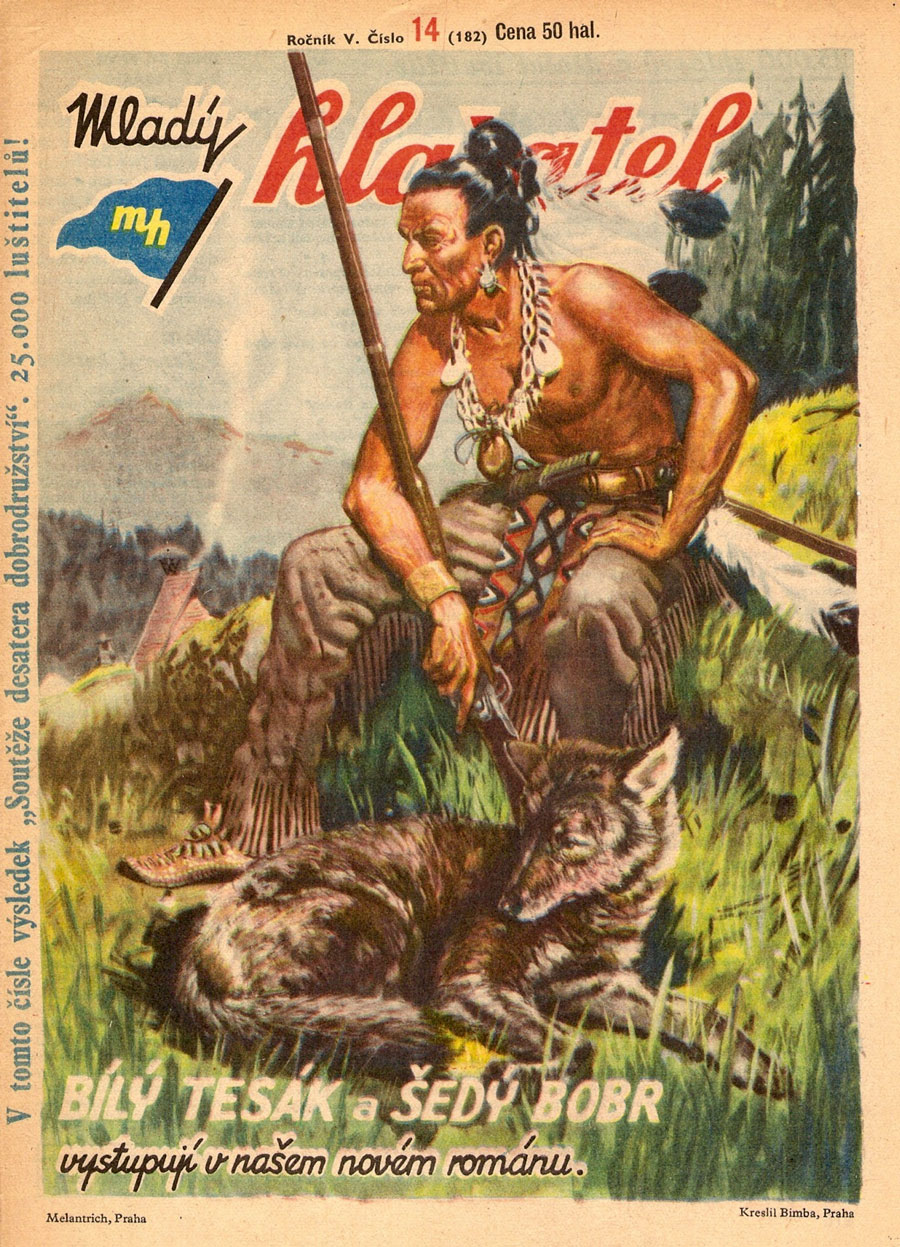
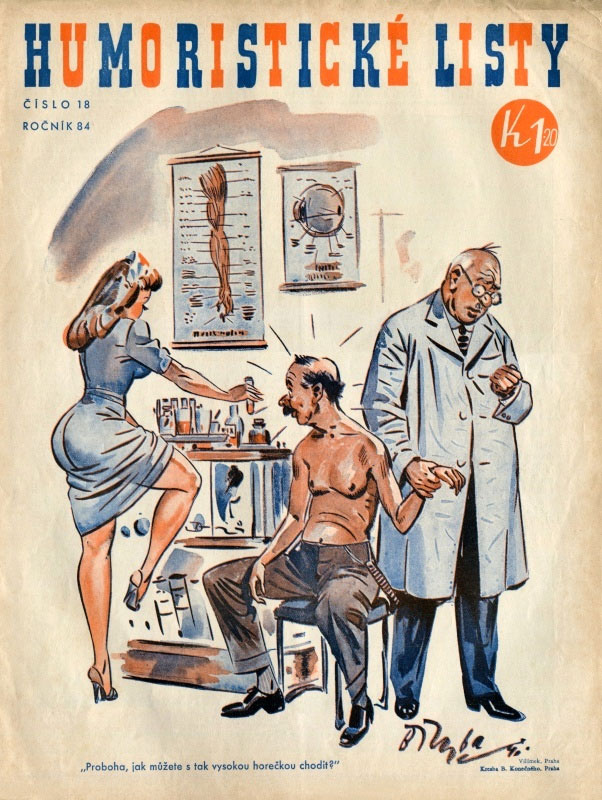
Magazine covers by Bohumil Konečný.
Adventure illustrator
Already during his student years in the second half of the 1930s, Konečný began his career in illustration. His artwork appeared in magazines like Ahoj, Humoristické listy ("Humorous letters") and Rozruch ("Uproar"). For the juvenile news magazine Mladý Hlasatel ("Young Announcer") and its post-World War II follow-up Vpřed ("Forwards"), Konečný illustrated the adventure serials of Otakar Batlička. Especially noted for his dynamic depictions of action scenes, the artist was often requested to provide the painted magazine covers.
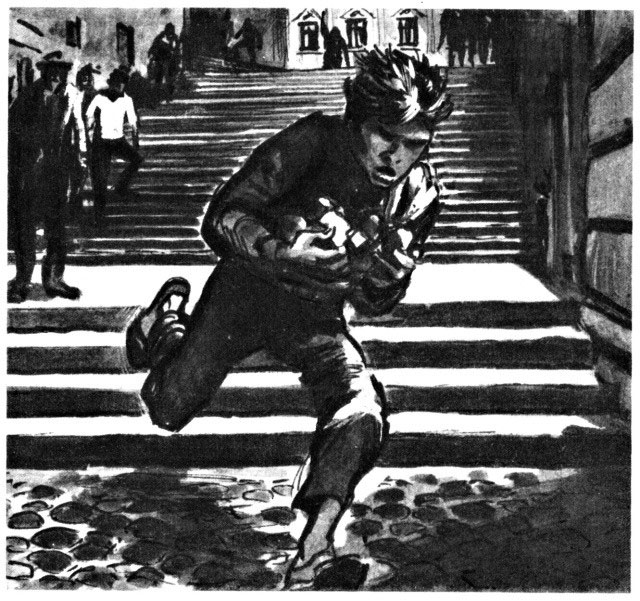
Illustration for 'Adventures in No Man's Land' (1969).
In 1939, Bohumil Konečný struck a close friendship with Mladý Hlasatel founder Jaroslav Foglar. Three years later, he illustrated Foglar's adventure book 'Přístav volá' ("The Port Calls", 1942), and several further collaborations followed in the 1960s. Together with fellow artist Gustav Krum, Konečný provided artwork for Foglar's youth novels 'Pod Junáckou Vlajkou' ("Under the Flag of the Brave", 1969), 'Dobrodružství v Zemi nikoho' ("Adventures in No Man's Land", 1969) and 'Stínadla se Bouří' ("The Shades Are Storming", 1970). During this period, he also received the offer of continuing the comic version of Jaroslav Foglar's kids gang book series 'Rychlé šípy' ("The Fast Arrows"), after the death of the original artist, Jan Fischer. Even though Konečný had already made a very popular 1946 magazine cover with these characters for Vpřed, the deal fell through. Instead, Marko Čermák became the comic's new artist.
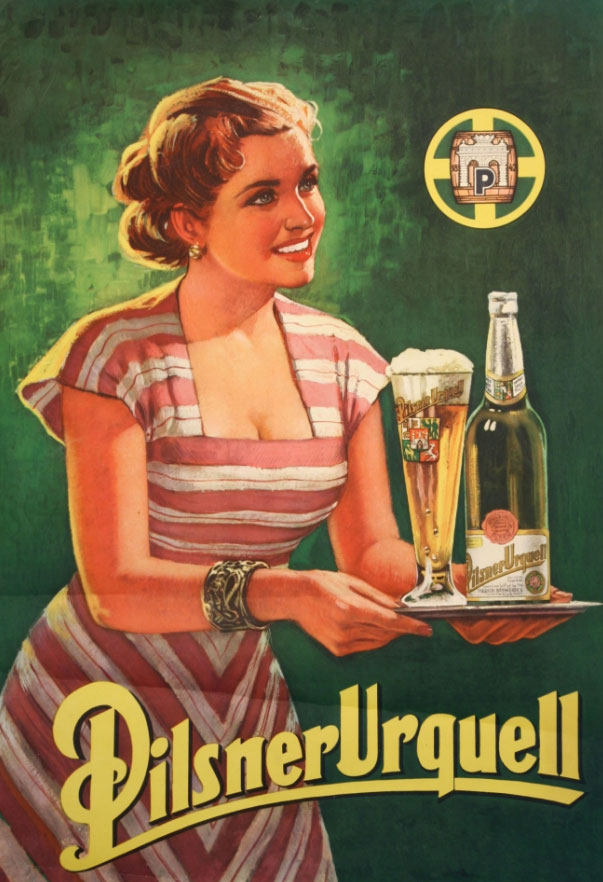
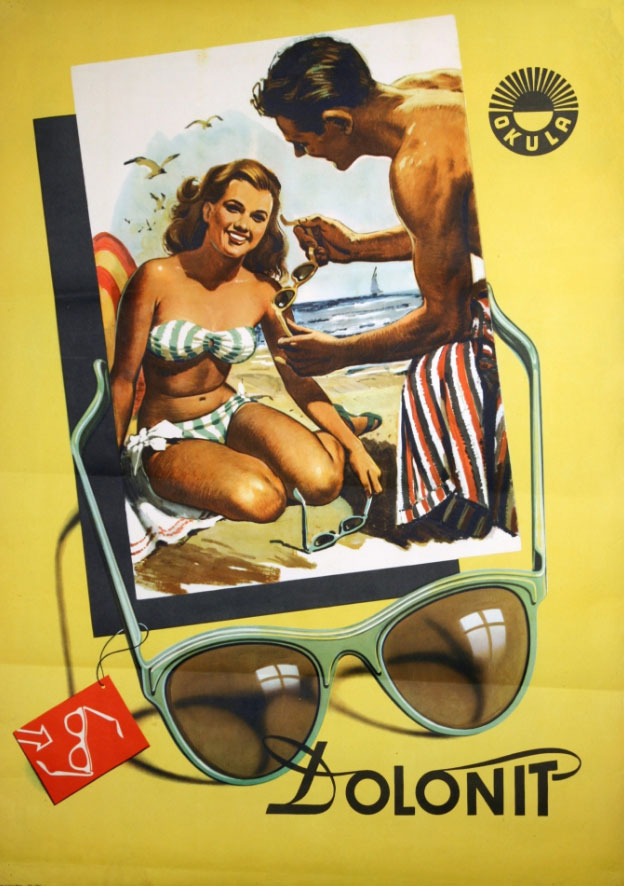
Advertising posters for export.
Commercial artist
Besides story illustrations, Bohumil Konečný was a popular advertising illustrator, creating posters and other promotional materials for export products. Trademarks in his commercial work were the many pin-up girls he created to sell products. Among the products his sex bombs promoted were Baťa footwear, Sigma pumping equipment, Prazdroj beer, Petrof pianos and Okula Nýrsko eyewear. After the nationalization of the Czechoslovak industry after 1948, his workload decreased dramatically. As he was being pigeonholed as a "Western cartoonist", he wasn't in much demand anymore. Instead, he returned to book illustrations, taking every assignment he could get for Soviet adventure novels, including the ones by his friends Otakar Batlička and Jaroslav Foglar. In addition, he made promotional covers for the satirical weekly Dikobraz ("Porcupine").
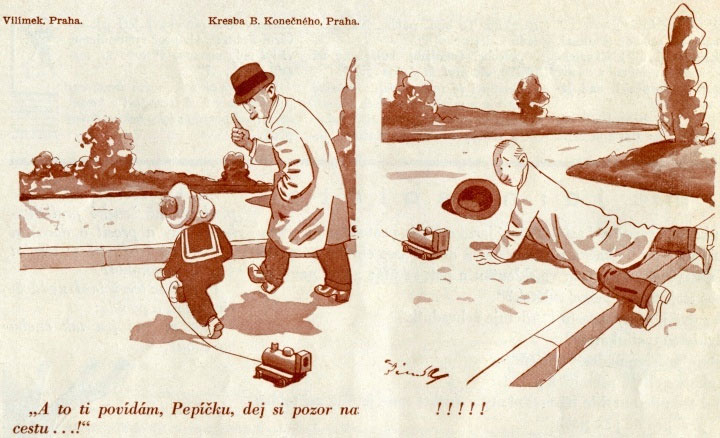
Cartoon for Humoristické listy (1939). Translation: "And I tell you, Pepícku, watch out on the road!".
Comics
During his career, Konečný had a handful of excursions into the comics medium. Between 1937 and 1939, he made his first humorous strips for the magazines Humoristické listy and Kvítko. His best-known work in comics was the romance serial 'Zuzanka a Její Svět' ("Zuzanka and Her World", 1947-1948), made with writer Jaroslav Přibík for Květen magazine. Following all the popular plot devices for a romance novel - a conniving rival, memory loss and the main star's indecisiveness between two men - the serial told the adventures of the beautiful Zuzanka and her happy-unhappy love for the handsome Jan.
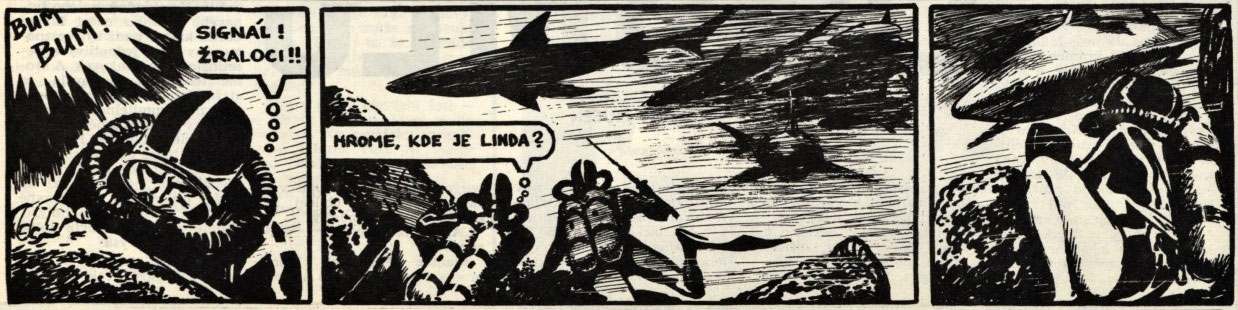
'Boj o Vrak' (1969).
When work slowed down during the 1950s and 1960s, the artist occasionally returned to comics. These have included adventure and western stories like 'Tajomstvo prérie' ("The Secret of the Prairie", 1964) in the magazine Mladá tvorba ("Young Creation"), 'Poklad' ("Treasure", 1966) in Roháč, 'Ocelová Hrobka' ("Steel Tomb", 1968), based on the short story by Otakar Batlička, in Pionýr, and 'Boj o Vrak' ("The Battle for the Wreck", 1969) in Signál, with writer Bohumil Veselý. Together with Gustav Krum, Konečný drew the comic serial 'Král Madagaskaru' ("The King of Madagascar", 1975-1976) in Pionýrská Stezka ("Pioneer Trail"), written by Jaroslav Weigel.
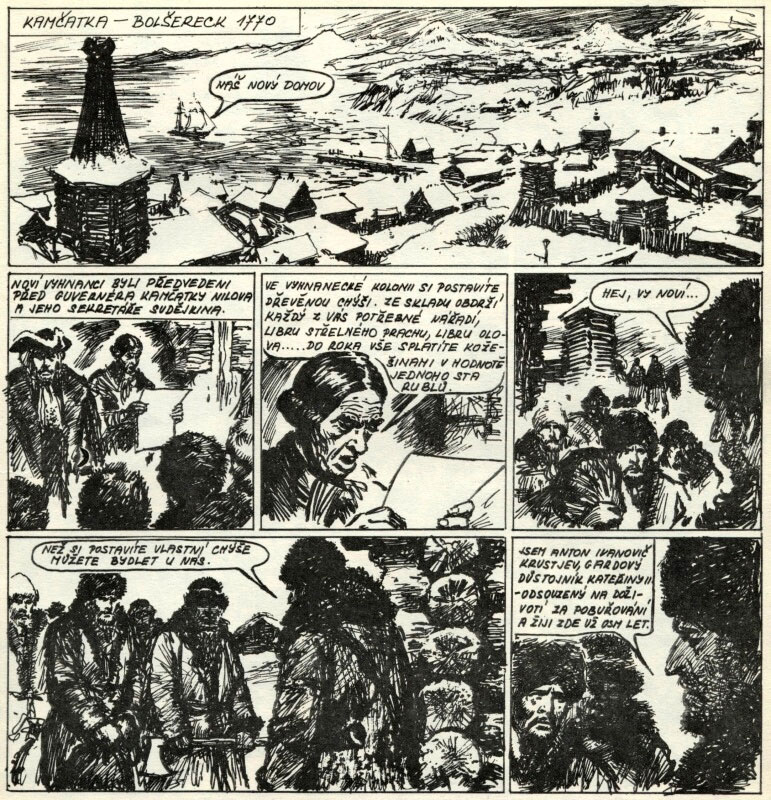
'Král Madagaskaru' (1975).
The 'Octobriana' hoax
To international audiences, the name of Bohumil Konečný is mostly connected to the infamous 'Octobriana' hoax, ignited by the publication of the 1971 book 'Octobriana and the Russian Underground'. The work, brought out in London by anti-communist publisher Tom Stacey, was presented as the account of an alleged Soviet defector, Petr Sadecký, who had ties with underground artist cells from behind the Iron Curtain. In the book, Sadecký described how in 1961 he was asked to give a lecture at the Kiev Academy of Arts, the first part about the national cultures of the USSR, the second about Western entertainment. Thanks to a power failure, the eighteen-year old professor was able to speak freely about Western comics, without the danger of the speech being recorded and picked up by Soviet spies. Following his lecture, Sadecký wrote, he was recruited by an underground artist group known as the PPP (Progressive Political Pornography). Turning away from politics, but embracing the original spirit of Lenin and his 1917 Russian Revolution, or 'October Revolution', the group embraced "sex as an expression of political nihilism", as they gathered in secret meetings throughout the Soviet Union. Joining the Kiev cell, Sadecký regularly attended their gatherings, which were characterized by heavy drug use and excessive sexual experimentation.
According to Sadecký, he worked with the PPP's Kiev division on the creation of comic stories starring a devilish, half-nude superwoman called Octobriana. The child of a Viking and a Toltec princess, she became immortal after undergoing radiation treatments and was then reborn as a superhuman in a radioactive volcano. Embodying the true spirit of the October Revolution, the centuries-old Octobriana travels throughout space and time, fighting monsters and other foes in several eras. On her forehead, she wears the Red Star symbol of the Russian Revolution. Her dialogues consist of Cyrillic-Russian hogwash that mocked the Soviets. Naturally, the subversiveness of 'Octobriana' stories meant that they could only circulate in the underground literary press of the Soviet Union and the Eastern Bloc, the so-called "samizdat".
At the time, the release and claims of 'Octobriana and the Russian Underground' were quickly picked up by the Western mainstream press. They were deemed credible, since publisher Tom Stacey had included a foreword by the prominent novelist and Soviet defector Anatoli Kuznetsov. On top of this, the United States and Western Europe had an underground comix scene, and the samizdats behind the Iron Curtain were a real phenomenon too, making the idea of Soviet underground comix quite plausible. Octobriana didn't seem all that different from that other alternative comic heroine from France, Jean-Claude Forest's 'Barbarella', and Sadecký even wrote that 'Octobriana' had sex and politics as key ingredients in her stories. In the early 1970s, Cold War hysteria was still in full effect, so it was easy for Western audiences to sympathize with Soviet artists standing up against an oppressive system. Compared with US and Western European underground artists, Eastern European underground artists actually risked their lives. Some fans fantasized about an ideological crossover between Octobriana and Western superheroines like Barbarella, or Wonder Woman. Another reason why the 'Octobriana' hoax wasn't instantly exposed had to do with Soviet censorship. Some things that went on in the East were kept a secret from the West, and vice versa. Journalists couldn't instantly check the veracity of what Soviet defectors claimed, while behind the Iron Curtain much of what went on in the Western press didn't always reach the authorities, let alone local citizens.
However, within a short time, Western journalists began questioning the authenticity of Sadecký's claims. While he said said "dozens" of stories existed, only two unfinished ones were included in the book: 'The Living Sphinx from the Radioactive Kamchatka Volcano 1934' and 'Octobriana and the Atomic Sons of Chairman Mao'. And while Sadecký spoke of sex and politics as key ingredients of the Octobriana stories, none of the printed ones reflected that. In one of them, the main heroine was even called by another name, Amazona. And indeed, none of the above was true. There was no artist group called Progressive Political Pornography, nor were there anti-Soviet superhero comics created behind the Iron Curtain starring a character called Octobriana. Petr Sadecký was a fraud, who had fabricated the 'Octobriana' story to make a buck. The true victims of his scheme were the people who had actually drawn the stories, the Prague-based artists Bohumil Konečný and Zdeněk Burian.
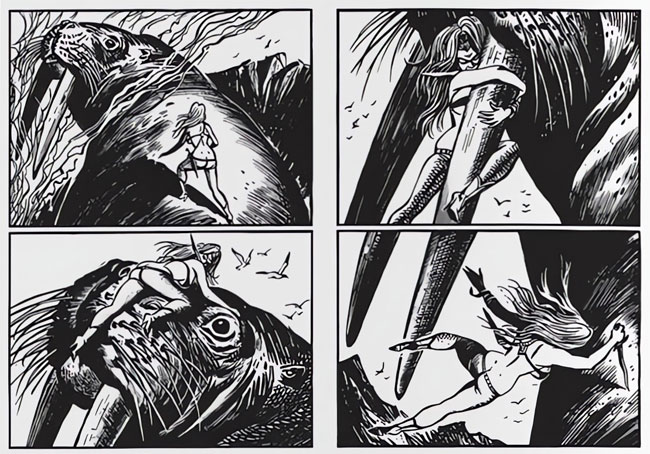
Amazona/Octobriana art by Bohumil Konečný.
Octobriana: the true story
During the 1950s and 1960s, Bohumil Konečný noticed that assignments began to dry up due to the social situation in his country. During this period, he came into contact with the Czech publicist and theorist Petr Sadecký (1943-1991). Although he was still in his early twenties, Sadecký had gained knowledge about market capitalism and Western culture during his travels to the Western countries. Sadecký suggested to Konečný to work on a stock of artwork about Native American and romantic subjects, which he could save for better days. To help his friend out, he offered to stockpile the produced material in his apartment. In 1965, Sadecký suggested creating fantastic comic stories about an amazonian superheroine, going by the name of Amazona. Besides Bohumil Konečný, the other artist involved was Zdeněk Burian, another prominent Czech cover painter who was also visited frequently by Petr Sadecký, and who considered him almost as a son. According to some sources, Miloš Novák was also producing artwork for the 'Amazona' series. Sadecký would try to sell the stories to publishers in Western Europe, where such comics were, according to him, in high demand. The young entrepreneur convinced Konečný and Burian that the team would need to associate itself with an expensive international agency. As payment for the firm's advance fee, Sadecký felt they should make some special artwork for free: a batch of about eighty diverse covers and other illustrations, inspired by the western novels of Karl May (of 'Winnetou' fame).
After Sadecký had crossed the Iron Curtain to West Germany in January 1967 on an alleged "journey for educational purposes", little was heard from him again. On occasion, he would send the Prague artists letters that gave the impression he was travelling the world trying to sell their comics, but in reality, he had found a steady homebase in Bamberg, Bavaria. From there, he supplied the local publisher Karl May Verlag with the so-called agency fee illustrations created by Konečný and Burian, but sold as his own. However, the 'Amazona' comics didn't sell at all, whose style already felt out-of-time among the 1960s wave of modern comics. Sadecký therefore dediced to boost sales by repackaging 'Amazona' as something more subversive and strange. He personally added the Red Star symbol to the character's forehead, and rewrote dialogues to make them more anti-Soviet and anti-American. To emphasize the comic's new satirical political nature, he renamed Amazona to Octobriana.
Eventually, Konečný and Burian got wind of Sadecký's antics, and rightfully feared the problems they could get into if the Soviet authorities would discover their involvement. In 1969, they decided to sue their former associate. In his defence, Sadecký said that his amendments were done according to the "Samizdat" principle: the reproduction by hand of forbidden material to avoid USSR censorship. A West German court ruled in favor of the two artists and granted them the right to reclaim their artwork. However, the sly Sadecký withheld some of the material and eventually moved to England, where he printed the remaining material in the book 'Octobriana and the Russian Underground', along with the phony description of how it was created.
The sensational release of the 1971 book had dire consequences for the artists Bohumil Konečný and Zdeněk Burian. Because of their supposed participation in creating these dissident comics, they received a ban from publishing, effectively terminating Konečný's career. On top of that, the betrayal by their former friend hurt the most. Over the course of the 1970s and 1980s, the fabulist Petr Sadecký sent Konečný dozens of irrational, offensive and eventually threatening letters from abroad. After Sadecký died from a brain tumor in 1991, the contents of his apartment, including several originals by Burian and Konečný, appears to have ended up in a garbage dump.
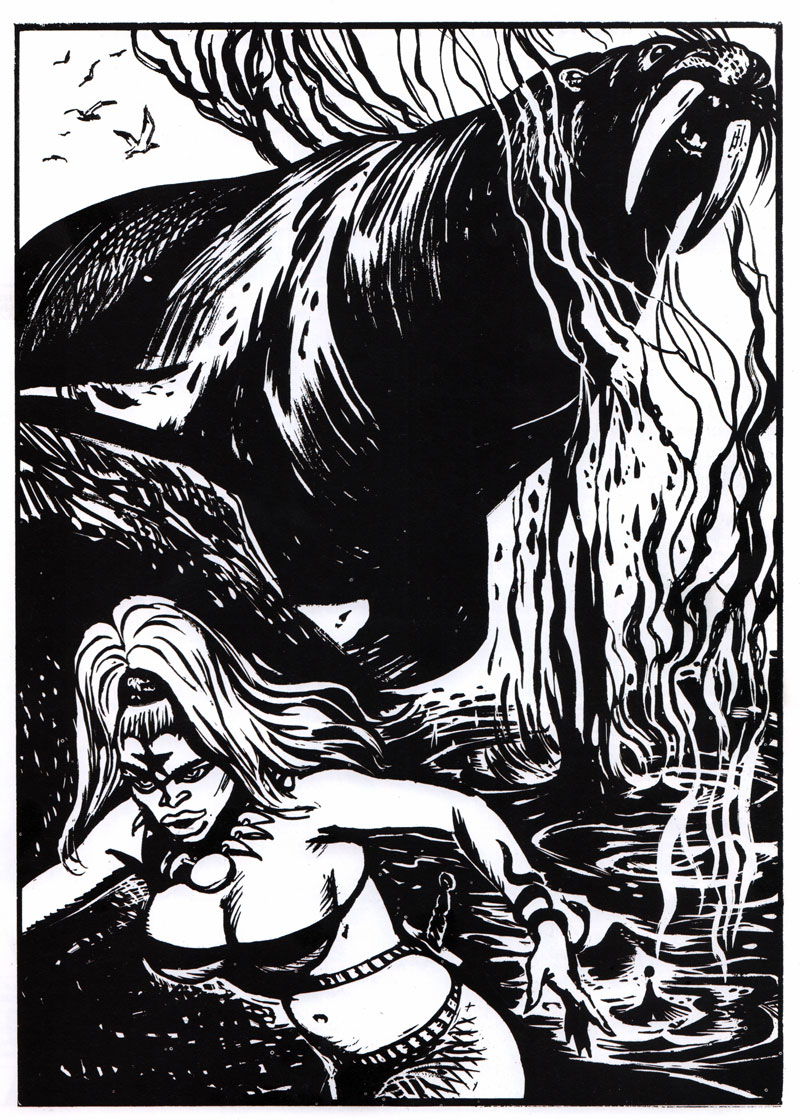
'Octobriana'.
Octobriana: aftermath
In the meantime, 'Octobriana' had gained cult status. Notable celebrity fans have been the pop singers Billy Idol, who has a tattoo of the character on his arm, and David Bowie, who once considered adapting the story into a film. Because the character supposedly had idealistic Communist origins, she was considered public domain, and several comic creators, mostly in England, created new stories with her. During the 1980s, Octobriana appeared in the first volume of Bryan Talbot's graphic novel series 'Adventures of Luther Arkwright', followed by a reprise in the pages of Larry Weltz's erotic comic 'Cherry’s Jubilee' in the USA. In the UK, Stuart Taylor co-wrote a six-issue 'Octobriana' mini series (Revolution Comics, 1996), followed by 'Octobriana: Filling in the Blanks' (Artful Salamander, 1998), with artwork by Blake O'Farrell, Dave Roberts and Mark Woolley. In addition, John A. Short wrote several stories with her, as well as the most thorough study of the entire hoax in his book 'Octobriana: The Underground History' (2017). The character has additionally appeared in 2000 AD magazine ('Nikolai Dante: The Octobriana Seduction' by Robbie Morrison and Andy Clarke, 1998) and in several anthologies. In her country of origin, Octobriana starred in a new comic created by Karel Jerie in 2003.
In the Netherlands, Martin Lodewijk featured a parody of Octobriana called Novembriana in the 'Agent 327' story 'Cacoïne en Commando's' (2001). Novembriana is a clever reference to the fact that the Russian Revolution, or 'October Revolution', actually took place in November 1917, due Czarist Russia following the Julian calendar instead of the Gregorian one. In 2020, the American cartoonist Jim Rugg used Octobriana in the one-shot graphic novel 'Octobriana 1976'. The backstory of Petr Sadecký and his 'Octobriana' scam was the inspiration for the 2019 graphic novel 'De Smokkelaar' ("The Smuggler"), by the Dutch artist Milan Hulsing.
Final years and death
For Konečný, the 'Octobriana' scandal meant the end of his career. Over the course of the 1960s, 1970s and 1980s, some new illustration work appeared in magazines like Pionýr, Ohníček, Junák/Skaut-Junák and Pionýrská stezka, but less frequent and less prominent as before. Bohumil "Bimba" Konečný died on 14 January 1990 in Kožlane, near Pilsen.
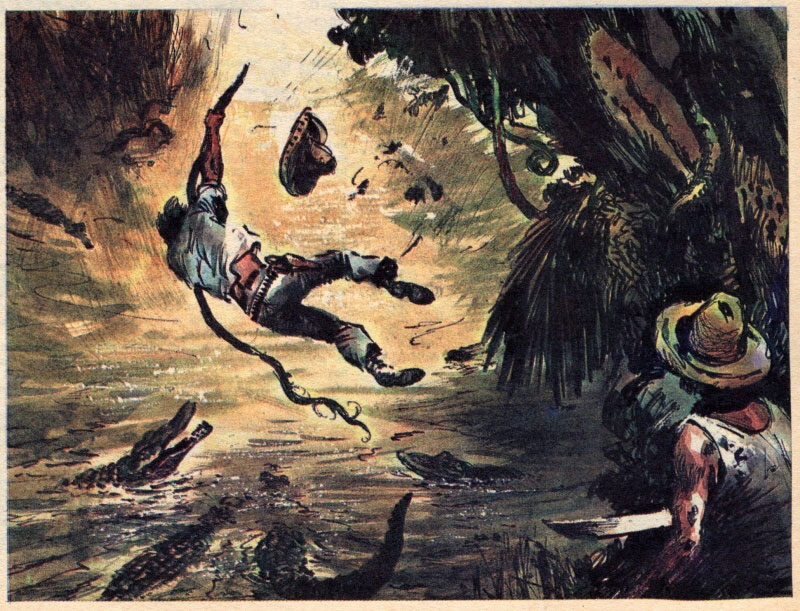
Illustration for Junák/Skaut-Junák #18, 1969/1970.
Legacy
Nowadays, Bohumil Konečný is remembered as one of the 1940s masters of Czech illustration and comic art. Together with Miloš Novák, Jan Černý Klatovský, Gustav Krum and Karel Toman, he ranked as one of the leading artists of adventure and action stories, following in the tradition of pioneer Zdeněk Burian. Kája Saudek, generally considered the best artist of contemporary Czech comics, named Konečný as his main inspiration.
Completely forgotten and unrecognized during his lifetime, interest in Konečný has been renewed since the 1990s. In 1994, an exhibition of his work was held in the city of Mladá Boleslav, curated by František Ulč. After that came large overview exhibitions at the West Bohemian Museum in Pilsen (2007) and the Municipal House in Prague (2008). The exhibitions also spawned the monograph 'Bohumil Konečný' by Tomáš Pospiszyl, and a documentary film by Ladislav Moulis: 'Bimba - příběh zapomenutého malíře' ("Bimba - the Story of a Forgotten Painter").
In 2018, the comic 'Zuzanka a Její Svět' was collected in book format for the first time. Four years later, the rest of Konečný's comics were compiled in the book 'Bimba - Velká Kniha Komiksů' ("Bimba - A Big Book Of Comics", 2022). All the stories were restored by the graphic artist Filip Konečný, and came with accompanying texts by the Czech comics historian Tomáš Prokůpek and Konečný expert Jan Hosnedl.
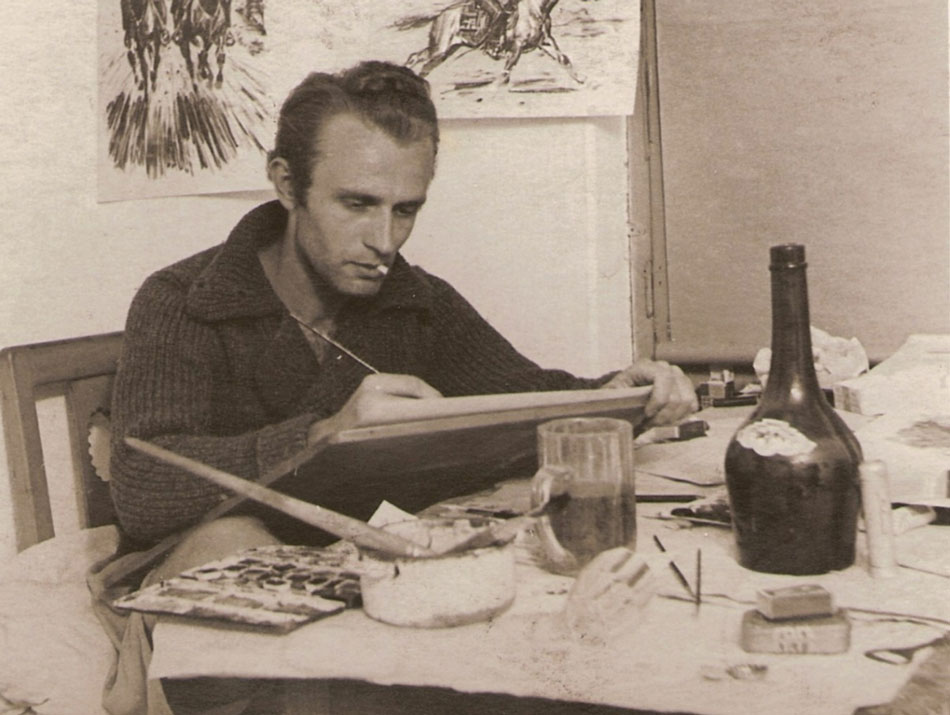
Bohumil Konečný.