


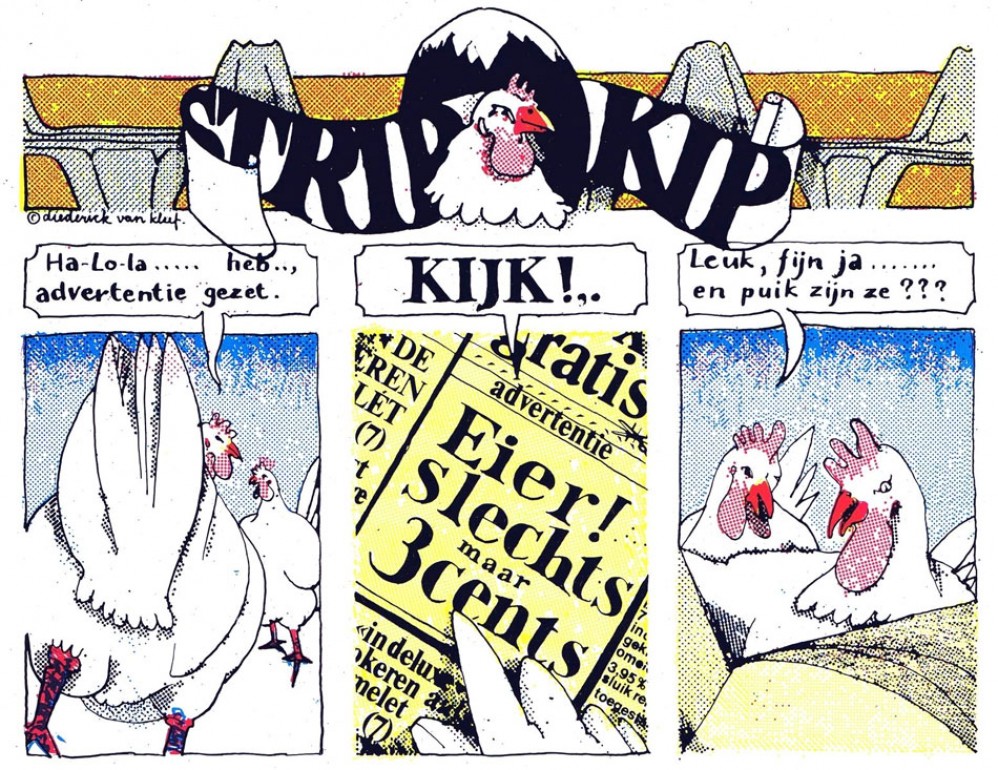

'Strip Kip' (In De Okeren Omelet, 1977).
Diederick van Kleef is a Dutch fine artist, multi-instrumentalist musician and former comic creator. During the 1970s, his comic stories appeared in the amateur comic magazine De Omelet. Later in life, he has been active in several artistic disciplines, notably as a painter and creator of "artist's books", with the book itself as a work of art.
Early life
Born in Rotterdam in 1954, Diederick van Kleef studied at the Academy of Fine Arts in Arnhem. During this period (1972-1978), he was known as an elusive artist, who billed himself as "Diederick de Ziekerick, Arnhem's Biggest Disgrace" to mock the myth of the genius comedian. At the Academy, he studied Painting, but also sought out teachers from the Graphic Design and Fashion Design departments. Active in several of Arnhem's art scenes, he worked in the graphic design studio of master printer Hans Gaarenstroom, and also did performances. Calling himself an "incidental artist", he made himself known by staging playful happenings, performing protest songs and squatting a local gallery. Following the philosophy that "everyone is an artist", he didn't limit himself to one particular style or artform.
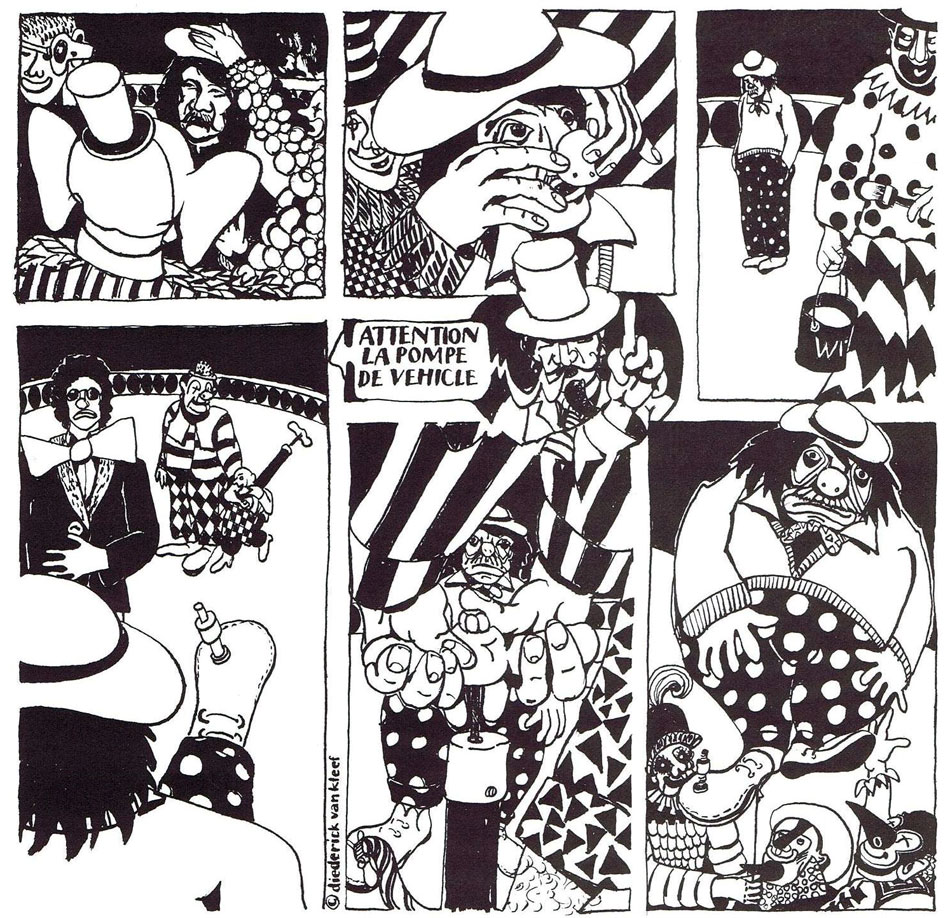
Comic story for 'In De Rode Omelet' (1977).
De Omelet
Together with several fellow students - Hanco Kolk, Aloys Oosterwijk, Ben Jansen, René Meulenbroek, Rieuwert Catz and Frank Langedijk - Van Kleef launched the amateur comic magazine De Omelet. Generally, the magazine is referred to as "In The Colored Omelet", as each issue had a specific color in its title ("In De Blauwe Omelet", "In De Oranje Omelet", etc.). Between February 1976 and 1978, seven issues of De Omelet appeared, the first two DIY issues were self-published, and the other five were released through Har van Fulpen's publishing house Drukwerk. Over the course of these seven issues, the group experimented graphically, while gradually improving their skills. Contributing to every issue, Van Kleef created short stories and the recurring backcover feature 'Stripkip', a cynical gag strip about the life of a chicken, who is either prepared for dinner, run over by a car or ending up at a poulterer.
Additional comics and cartoons by Van Kleef appeared in publications like Absent Minded Professor and ABA Krant. In 1978, De Omelet merged with the titles Tante Leny and Speedo into Talent, a new comic magazine published by Drukwerk. While Jansen, Kolk, Meulenbroek and Oosterwijk continued to contribute to this new magazine, and eventually united their activities in the collective Studio Arnhem, both Van Kleef and Rieuwert Catz pursued other career paths. Frank Langedijk had already left the Omelet project after its first issue.
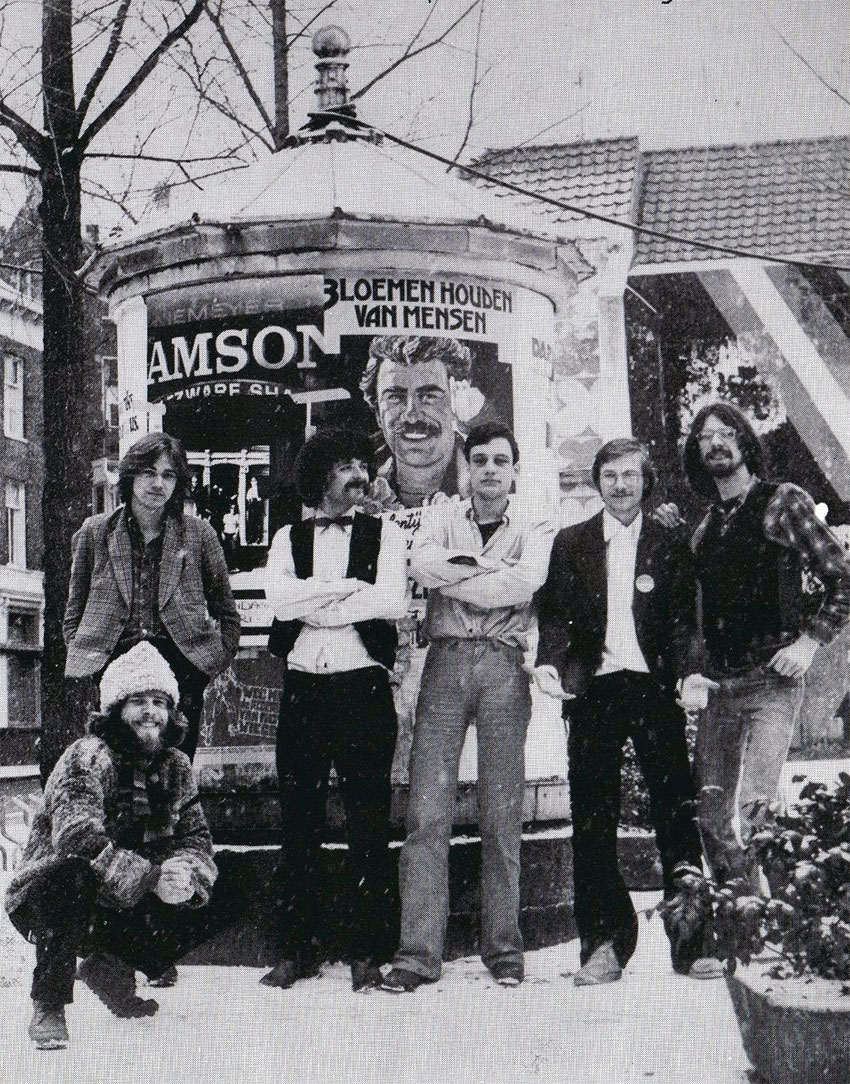
The Omelet team on 14 February 1978. Top row: Aloys Oosterwijk, Rieuwert Catz, Ben Jansen, Hanco Kolk, René Meulenbroek. At the front: Diederick van Kleef.
Later artistic life
In 1978, Van Kleef continued his studies at the Jan van Eyck Academy in Maastricht, but continued living in Arnhem. Together with two fellow students, he gave concerts under the name Trio Dubieus, while hosting his own Gallery Dibieus in one of the halls of the academy. However, he abandoned his studies in Maastricht in his second year. Benefiting from the Dutch BKR subsidy program for artists, he was active in several fields, including musical performances, art productions, and unique print projects, for instance his 'Diary in Mirror Image', about an unrequited crush. With his playful artworks, he quickly caught the attention of collectors, curators, and artist groups in Belgium.
During the 1980s, Van Kleef became particularly known for his handcrafted "artist's books" in low print runs, where the book itself was the work of art. One of his first creations was 'Hallo, U Spreekt' (Aorta, 1984), artistically collecting the responses of his phone conversations with phone numbers derived from the six-digit date of that day, month, and year. Whenever someone picked up, he answered with: "Hello, this is Diederick van Kleef, artist, but I'm lacking inspiration today. Could you please help me?". The book was picked up by the Museum of Modern Art in New York and the Victoria & Albert Museum in London.
In 1987, Van Kleef settled in a house near the Sarphatipark in Amsterdam, where he ran his Sporadisch Antiquarisch book and printing shop for 25 years. Installing a printing workshop in his front room, he produced small print runs with lead and wooden type. To make ends meet, he started selling secondhand books, also at the Albert Cuyp Market and the Friday book market on Amsterdam's Spui. While following his own artistic path and not conforming to existing movements, Van Kleef has had his work exhibited in both high class art galleries and local bars. In addition, he was regularly invited as a guest lecturer at art academies to share his knowledge of artist's books with students. Since 2013, he has been living in a former farmhouse with two hectares of land in the fields between Bourbon l'Archambault and Ygrande in the French Allier department.

Cover illustration for 'In De Okeren Omelet' (1978).