


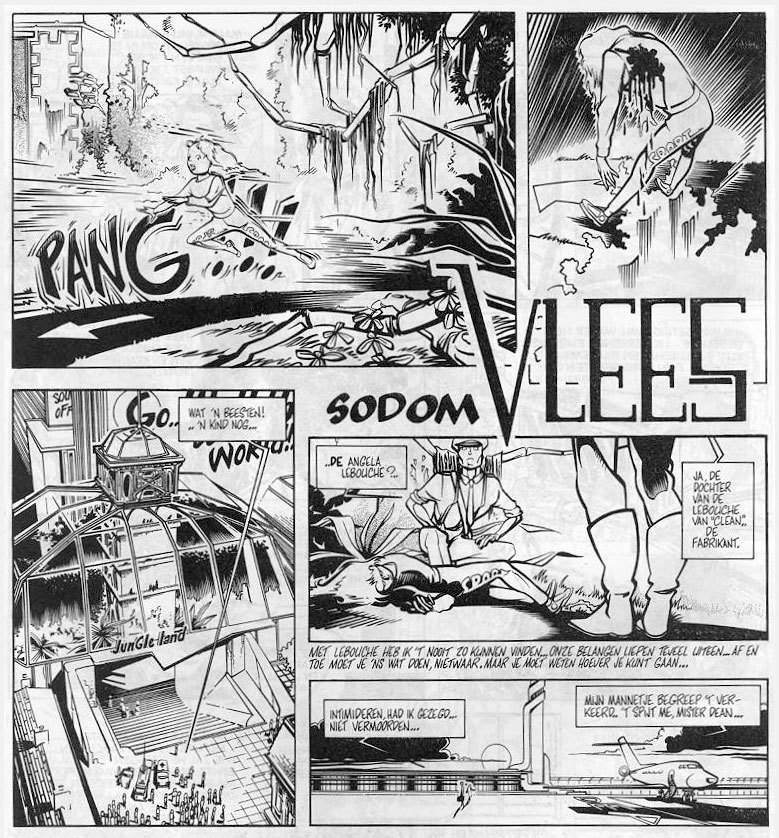
'Sodom: Vlees' (Wordt Vervolgd #62, 1986).
Ben Jansen was a Dutch comic artist and illustrator, one of the driving forces in the Arnhem comics scene, and co-founder of the comics collective Studio Arnhem. His stories ran in several of the alternative comic magazines in the Netherlands during the 1970s and 1980s, such as Tante Leny Presenteert, Talent, Wordt Vervolgd and Coyote. Working with some of his fellow studio members, Jansen was the main artist for the infamous comic book 'De Glunderende Gluurder' (1982), a pornographic spoof of Willy Vandersteen's popular comic series 'Suske en Wiske'. The parody eventually led to a court case over copyright infringement and plagiarism.
Early life and career
Ben Jansen was born in 1955 in Veldhoven, a town in the southern Dutch province of North Brabant. With his schoolmate Hanco Kolk, who was in a class below him, he filled the school newspaper with illustrations and cartoons. Jansen spent two years at the Arnhem Art Academy, where Aloys Oosterwijk, René Meulenbroek and Rieuwert Catz were among his fellow students. These five friends, along with Diederick van Kleef and Frank Langedijk, joined forces and launched the amateur comic magazine De Omelet. At the time, Jansen was living with his girlfriend in a squatted factory, and had already published some artwork here and there, making him the most experienced of the group. Between 1976 and 1978, seven issues of De Omelet appeared, the first two self-published, the other five through Har van Fulpen's publishing house Drukwerk. Over the course of these seven issues, the group experimented graphically, while gradually improving their skills. Eventually, Jansen, Kolk, Meulenbroek and Oosterwijk were ready to turn professional, while Catz, Van Kleef and Langedijk disappeared off the comics radar. In November 1977, Jansen opened the comic book store Het Gele Gevaar at Rosendaalseweg in Arnhem, which became a meeting point for comics fans. At the same time, Jansen drew his own comics in a corner of the shop.

'Zomer in Veldbeek' (Talent #1, 1978).
Studio Arnhem
In 1978, Ben Jansen and his friends also contributed to Tante Leny Presenteert, an underground comix magazine from The Hague, In its pages, Ben Jansen could showcase his passion for pin-ups, which he shared with magazine editor Evert Geradts. Shortly afterwards, De Omelet merged with the titles Tante Leny and Speedo into Talent, a new comic magazine published by Drukwerk, to which Jansen was also a regular contributor. During the late 1970s, the remaining artists of De Omelet - Ben Jansen, René Meulenbroek, Hanco Kolk and Aloys Oosterwijk - continued to work and socialize together, and in 1981 they joined forces with former Tante Leny artist Evert Geradts to form Studio Arnhem. Later on, other artists joined, such as Gerard Leever, Kees de Boer, René Uilenbroek and Jaap Stavenuiter, as well as colorists like Wilma Leenders, Ellen Klever and Trudi Klever. This legendary studio laid the basis for a new generation of comic artists that quickly made its mark in most of the leading comic magazines of the time. By 1984, Ben Jansen's girlfriend at the time, Marjolein Hoekstra, joined the studio as manager/salesperson. In addition to working on their comics, Ben Jansen played guitar and Aloys Oosterwijk sang in the local band De Rambo's (1982-1986), which also consisted of Rieuwert Catz, Wouter van der Laan and Wilco Wolfers.

'De Kat' (Strips voor Mozambique, 1987).
Comics
While most Studio Arnhem artists gradually found their way to the mainstream comic magazines of the time, Ben Jansen's comics remained focused on adult-oriented and alternative magazines. In the late 1970s and 1980s, Jansen saw his comic stories published in the magazines Talent, Harlekijn, Wordt Vervolgd, Star, Coyote, Midas, De Vrije Balloen and Vrijwilligerskrant, and also appeared with erotic comics in Spanish titles like Totem El Comix. Among his recurring characters were 'Michelle' and 'De Lepraman', and with the Belgian writer Jean Pica, he made the crime noir series 'Sodom' (1985-1986) for Wordt Vervolgd, the Dutch edition of Casterman's (À Suivre). This sci-fi-flavored four-part series was set in Sodom, a fictional mega-city with 300 million inhabitants, where crime and corruption are commonplace. In 1988, Jansen picked up the Sodom universe on his own for an additional 16-page story 'De Kolk', published in issues #82 and #83 of Wordt Vervolgd.
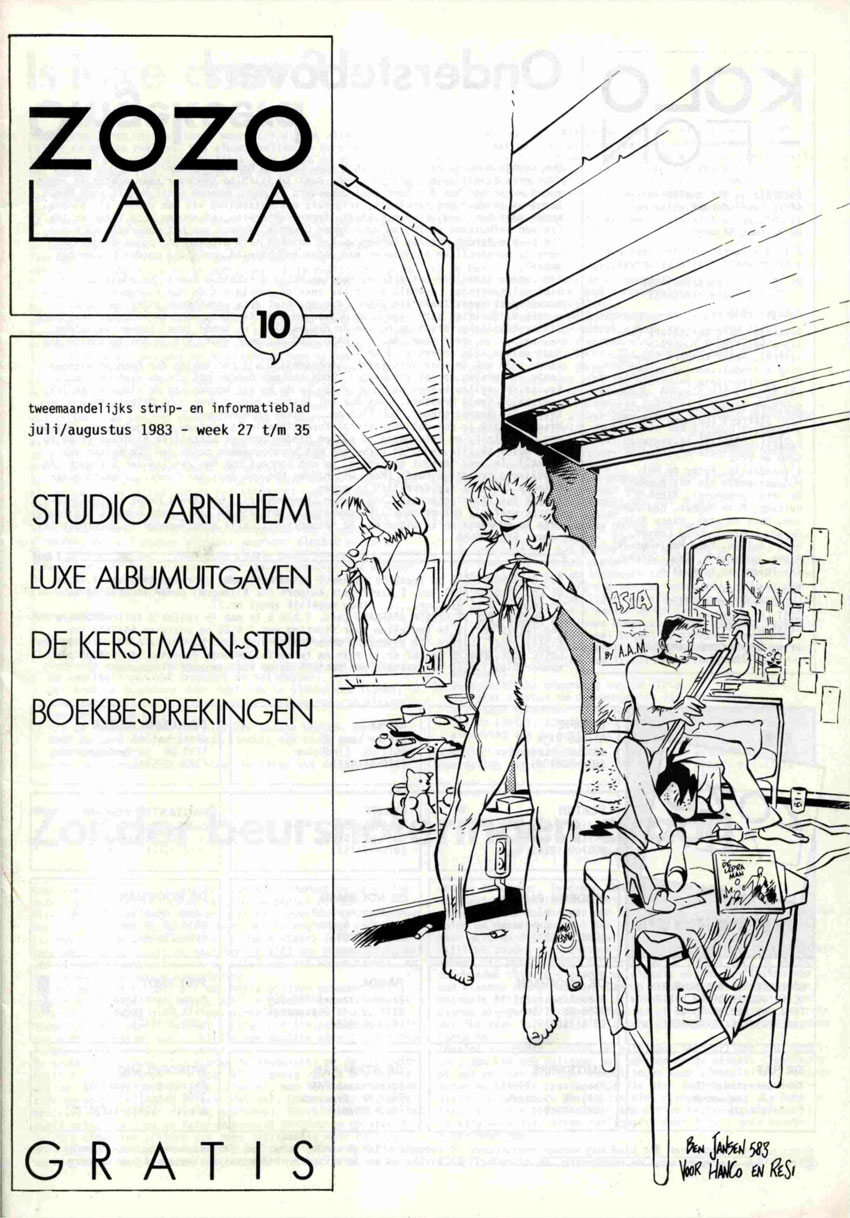
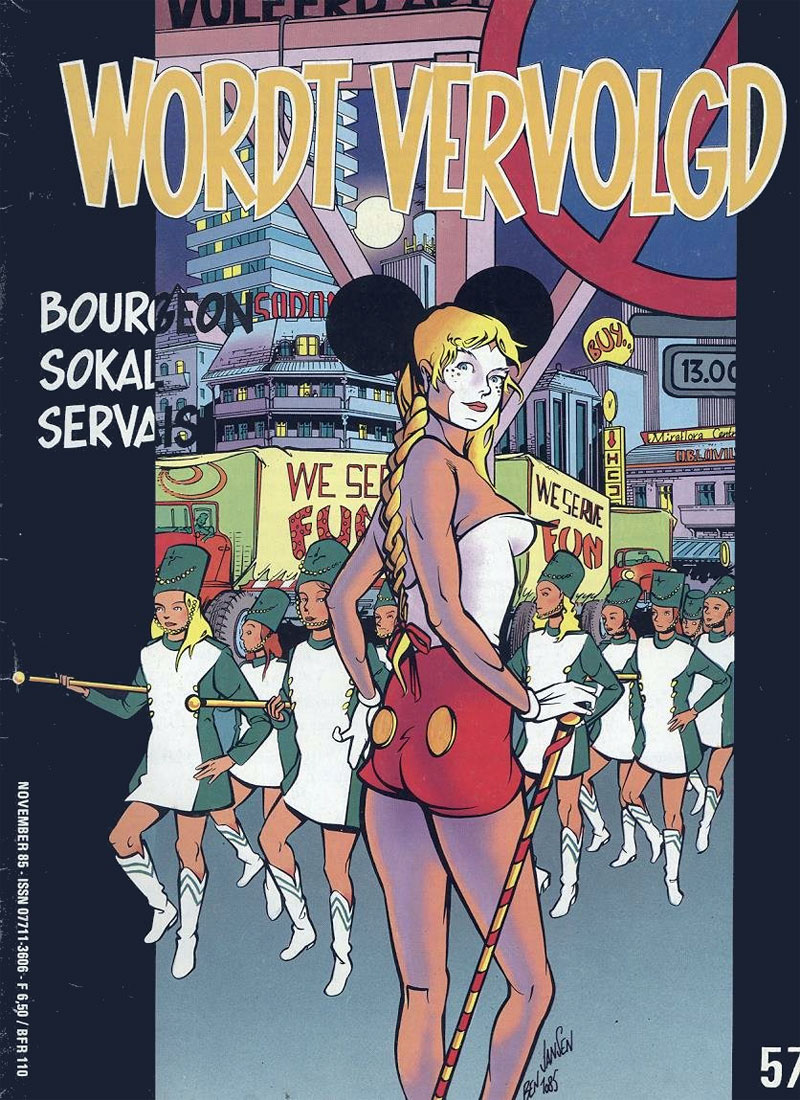
Cover artwork for Zozolala #10 (1983) and Wordt Vervolgd #57 (1985).
In addition, Jansen provided illustrations to magazines such as Oor, Hitkrant and Autovisie, worked on commercial art assignments and did comic book lettering for the publishers Drukwerk and Oberon. For the collective benefit book 'Strips voor Mozambique' (Van Bavel, 1987), Ben Jansen made a comic page spoofing both Disney's 'Beagle Boys' and Martin Lodewijk's pulp superhero 'De Kat'.
Some of the Studio Arnhem comic projects were solo efforts, while others were done collectively. For the group project about photographer 'Otto Raaf' for the Amsterdam newspaper Het Parool, Aloys Oosterwijk designed the characters, while the inking was done by Gerard Leever and the background art by Ben Jansen and René Meulenbroek. The script of the story was provided by non-studio member Ger Apeldoorn. One episode, 'Concert voor Carras', was serialized between 3 January and 26 March 1983.

'De Glunderende Gluurder'.
De Glunderende Gluurder
Another notable Studio Arnhem group project was 'De Glunderende Gluurder' (1982), a sex parody of Willy Vandersteen's classic children's comic 'Suske en Wiske'. While other studio members like Hanco Kolk also made contributions, as did external artist Ger Rijff, Ben Jansen provided the largest part of the artwork for this infamous comic book. The book consists of several short stories all written in mock Flemish dialect. The first one revolves around a small magical statue with a huge phallus, which Lambik buys at an auction. The plot is obviously inspired (and partially copied) from the 'Suske en Wiske' story 'De Sterrenplukkers'. The second tale in 'De Glunderende Gluurder' features the time machine of Professor Barabas, which Wiske uses to go back and have an orgy in ancient Rome. Much imagery in this narrative is lifted from the 'Suske en Wiske' story 'Het Geheim van de Gladiatoren'. The final story stars Lambik and Jerom in an orgy at the beach of St. Tropez. Both the artwork and the narrative in 'De Glunderende Gluurder' are inconsistent. Jerom is a raving homosexual with strong ejaculation powers in one story, while he has sex with women in the other. The parody also repeats the often believed, but incorrect, notion that Suske and Wiske are brother and sister.
In 1982, 'De Glunderende Gluurder' was the first sex parody of 'Suske en Wiske', so the book caused quite a stir in the Dutch-language press. Curiosity got the better of the original creator, Willy Vandersteen, and he bought a copy. In an interview he accepted it as the cost of fame: "It's to be expected. I do like the fact that my work inspires others to make naughty parodies. My dedicated fans really know that I don't make these phony stories myself." Still, in the same year, another, more activist parody of Vandersteen's creations was published, 'De Keizerkraker' (by Johnn Bakker), defending the squatters' movement. This time, Standaard Uitgeverij decided to sue both parodies, but originally lost the case, and a debate about the differences between plagiarism and parody followed. In an appeal, it was decided that the imitation of the main characters went further than necessary for parody purposes, and both books were eventually pulled back from the shops. Nevertheless, within a decade the story was reprinted in its entirety in issue #7 (1 May 1990) of Jan Bucquoy's short-lived controversial magazine Dol/Belge.

'Erotica' (Razzafrazz #4, 1994), originally published in Spanish in Totem el Comix.
Final years, death and legacy
While most of the original Studio Arnhem team eventually moved to other cities and studios, Ben Jansen remained a member throughout the studio's existence, from their location at 6, 1e Wijkstraat to their final spot in an old school building at 31A Kastanjelaan. New members came and went, and most of the initial camaraderie was gone, but Jansen insisted on maintaining the Studio Arnhem banner. In the 1990s, Jansen shared the studio with Ronald van Vemden, Hans Pieko and Hendrik J. Vos. During this period, Jansen advertised himself as an artist for comics, illustrations, advertising art and scriptwork, while operating as an agent for coloring and lettering work.
After a period of failing health, Ben Jansen passed away on 11 September 1994, at the young age of 39. His death marked the end of the Studio Arnhem name. In 1995, the members of studio Funny Farm moved into the Kastanjelaan studio space, where they joined the last remaining artist Hendrik J. Vos (Pieko and Van Vemden had already left to form their own studio). Since then, Funny Farm has continued the Studio Arnhem spirit as a homebase for comic creators, illustrators and other creatives from the Gelderland region, spearheaded by Kees de Boer. In the fourth issue of Funny Farm's magazine Razzafrazz, Ben Jansen was commemorated, and one of his erotic stories for the Spanish market was reprinted.
Because of his short lifetime, Ben Jansen is often overlooked in Dutch comic history. In August 2016, on the occasion of the 40th anniversary of the launch of De Omelet, comic news magazine StripNieuws dedicated its entire 64th issue to Studio Arnhem and the Arnhem comics scene. Looking back, the original members of Studio Arnhem have all praised their friend's work and called him the most talented of the gang. The memorial book 'Terug Naar Studio Arnhem' (Personalia, 2017) was dedicated to Jansen, and prominently featured his artwork..

Ben Jansen at work in Studio Arnhem. Photo by René Meulenbroek.