


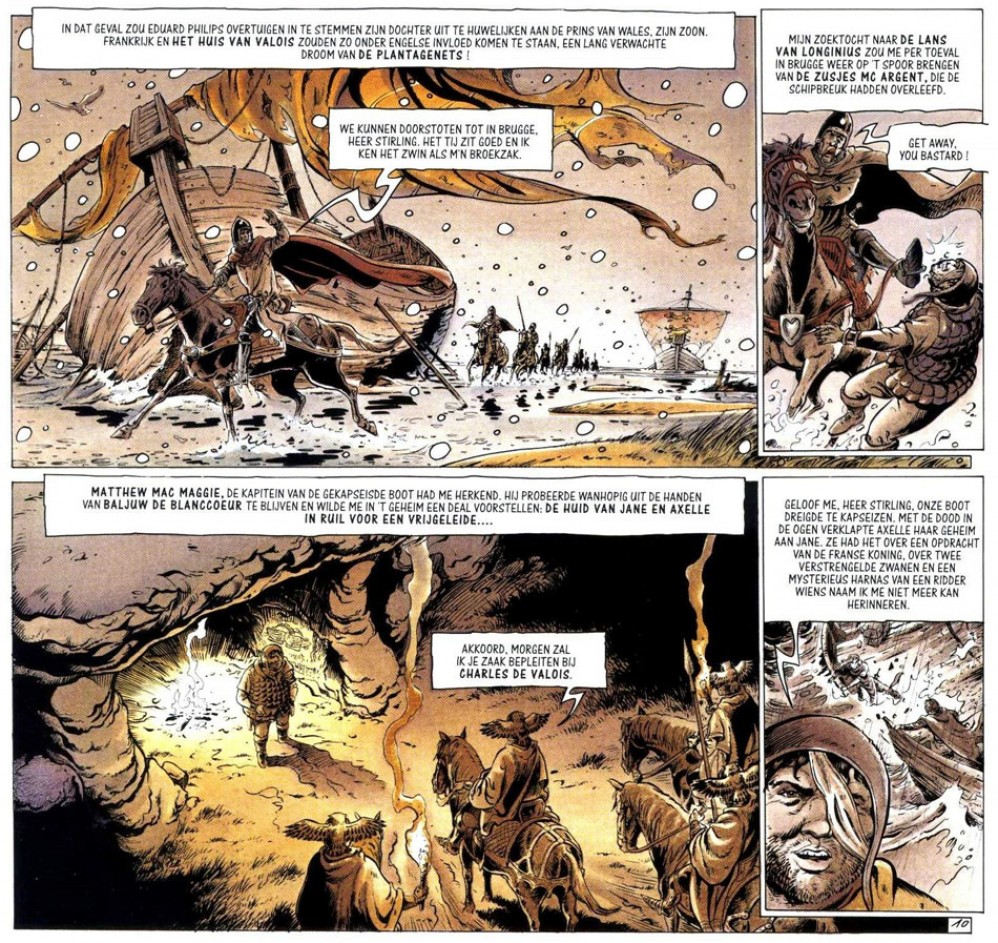
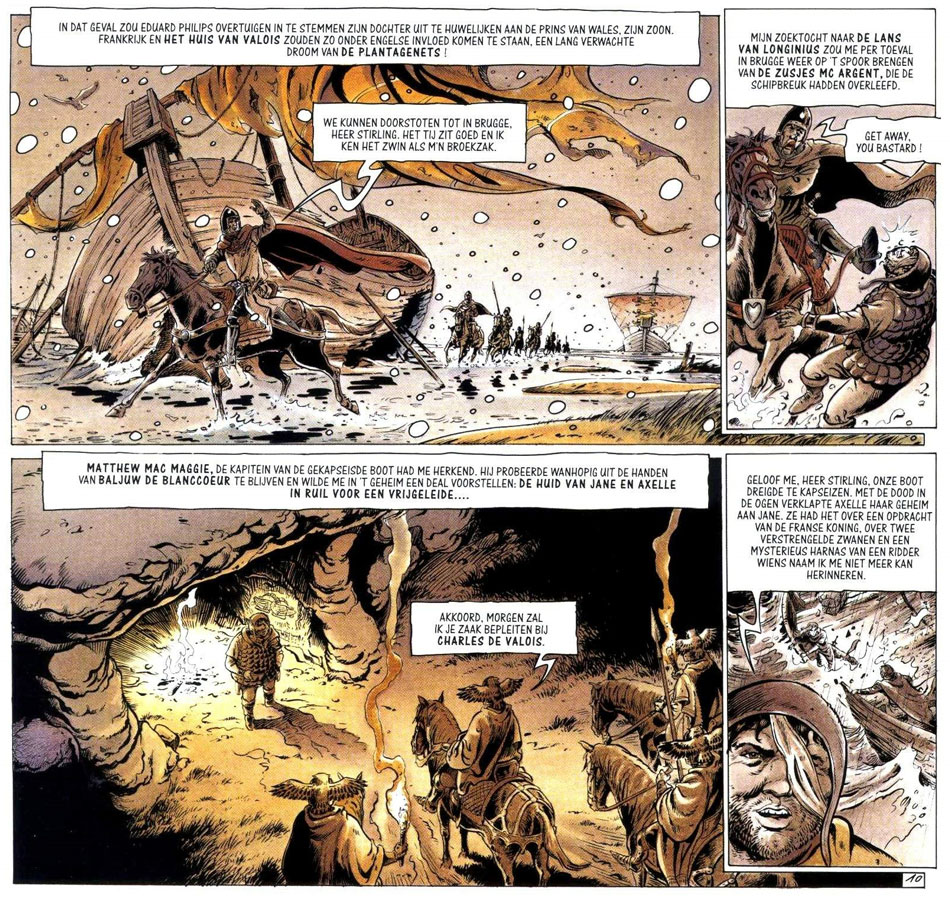
'Kroniek der Guldensporenslag' #4 - 'Zomer' (1995).
Christian Verhaeghe is a Belgian comic artist who made historical comic series in collaboration with writer/publisher Ronny Matton: 'Bezette Stad' (1993) and 'Kroniek der Guldensporenslag' (1994-1995). For the French market, Verhaeghe has drawn fantasy series like 'Les Traîne-Ténèbres' (Soleil, 2002) and 'Les Contes de Mortepierre' (Soleil, 2004-2006), both with writer Brice Tarvel. Since 2013, he has been the background artist for the Flemish comic series 'Suske en Wiske' at Studio Vandersteen.
Early life and career
Born in 1966, Christian Verhaeghe studied to become a mechanic. As a comic artist, he is self-taught. In 1988, Verhaeghe debuted in 'Idolen', the music-themed third volume of comic collection 'Krimpvrij Verpakt' of publisher Clumzy, an anthology aimed at young talent. In 1993, he published his first six-page comic story in Jet, a magazine for new talent of publisher Lombard.
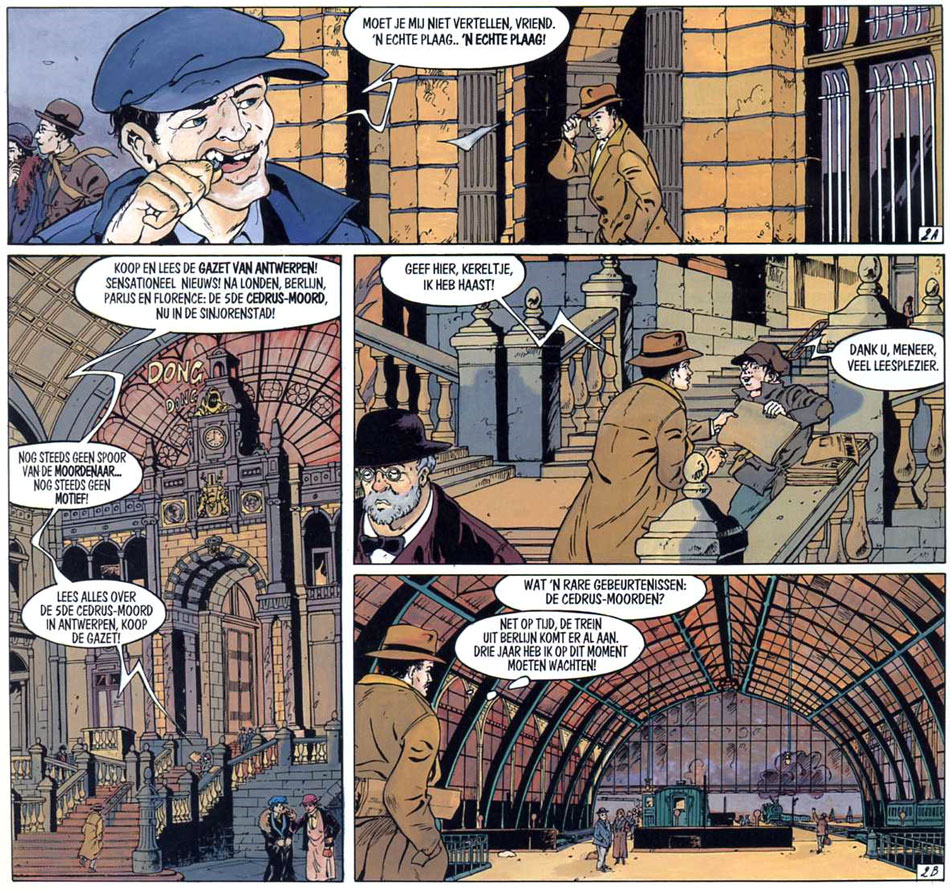
'Bezette Stad' #1 - 'Cedrus' (1993).
Collaborations with Ronny Matton
In 1988, Verhaeghe had first met publisher/writer Ronny Matton, but they didn't work together yet. By 1993, Matton had started his publishing imprint Talent. Since the city of Antwerp was that year's Cultural Capital of Europe, Matton and Verhaeghe felt it was the right time to launch their 'Bezette Stad' project. Named after Flemish poet Paul Van Ostaijen (1896-1928)'s poetry collection 'Bezette Stad' ("Occupied City", 1920), their graphic novel series 'Bezette Stad' is set in Antwerp during the First World War, while Van Ostaijen himself is the protagonist. After his exile in Berlin, the writer returns to the "Sinjoren city", where his plans are troubled by a couple of murders. Both volumes of the series, 'Cedrus' and 'Samen Alleen', were released in the same year.
Between 1994 and 1995, Matton and Verhaeghe continued their collaboration with 'Kroniek der Guldensporenslag' (1994-1995), a four-volume historical comic about the 1302 Battle of the Golden Spurs, when Flemish civilians managed to win a battle against French nobility. Three volumes of the series were also released in French under the title 'Ambre Blanc'. In contrast with the more romanticized retellings of the epic confrontation, Verhaeghe and Matton chose for a more gruesome and fantasy-flavored approach. With the release of these first action-filled comic books, Verhaeghe was quickly heralded as the most promising new realistic comic artist in Flanders.
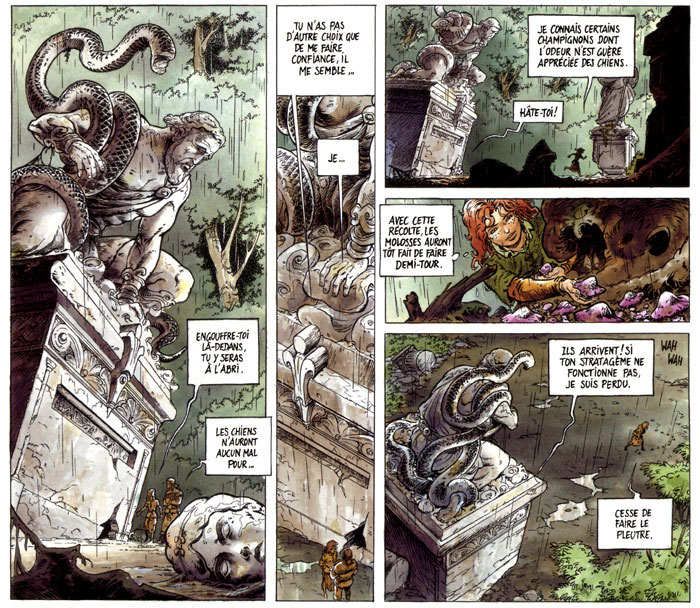
Les Contes de Mortepierre #1 - 'L'Homme aux Oreilles Déchirées' (2005).
Soleil Productions
Following the national success, Verhaeghe decided to try his luck on the French market. It proved a difficult undertaking for a Flemish artist to get a French publisher interested in his services, but Verhaeghe's luck changed when he met scriptwriter Brice Tarvel during a comic festival. Through Tarvel, he began a collaboration with Soleil Productions, a French publisher known for its heroic fantasy comics. Verhaeghe's first work for Soleil was drawing the fourth installment of Brice Tarvel's 'Les Traîne-Ténèbres' saga (2002), succeeding the original artist Peter Nielsen. Described by the artist as a fantasy version of the famous 'Once Upon A Time In The West' story, the comic shows a quest through unreachable, dark forests of the warlord Jahom who, together with the sorceress Azira and the one-eyed vagabond Porok, wants to conquer the mysterious treasure chest of King Urvis.
However, the series was canceled after Verhaeghe's sole album, after which the artist continued his collaboration with Tarvel for 'Les Contes de Mortepierre' (two volumes, 2004-2006). This medieval fantasy series was a spin-off about a younger version of the red-headed heroine Mortepierre, title character of a heroic fantasy series created by Brice Tarvel with the artist Mohamed Aouamri (1995-2005).

'Amika' (Studio 100 Krant #27, 2010).
Flemish studios
After his excursion into French comics, Christian Verhaeghe returned to the Flemish market. Between 2009 and 2013, he worked for Studio 100, a production company for popular children's TV shows in Flanders. Being part of Luc Morjaeu's comic team, Verhaeghe drew comics based on the Studio 100 TV series 'Amika', about a riding school and its white stallion Amika. The comic stories appeared on a weekly basis in the Studio 100 Krant, a supplement of the newspaper Het Laatste Nieuws. In 2011, he also drew comics based on Studio 100's superhero TV show 'ROX'.
When Studio 100 closed down its comics studio, Verhaeghe joined Luc Morjaeu at Studio Vandersteen, the division of publisher Standaard Uitgeverij producing the classic 'Suske en Wiske' comics. Replacing Peter Quirijnen as background artist in 2014, he has been working with lead artists Morjaeu and later Wout Schoonis on new stories, starting with the episode 'Het Schrikkelspook' (2015).
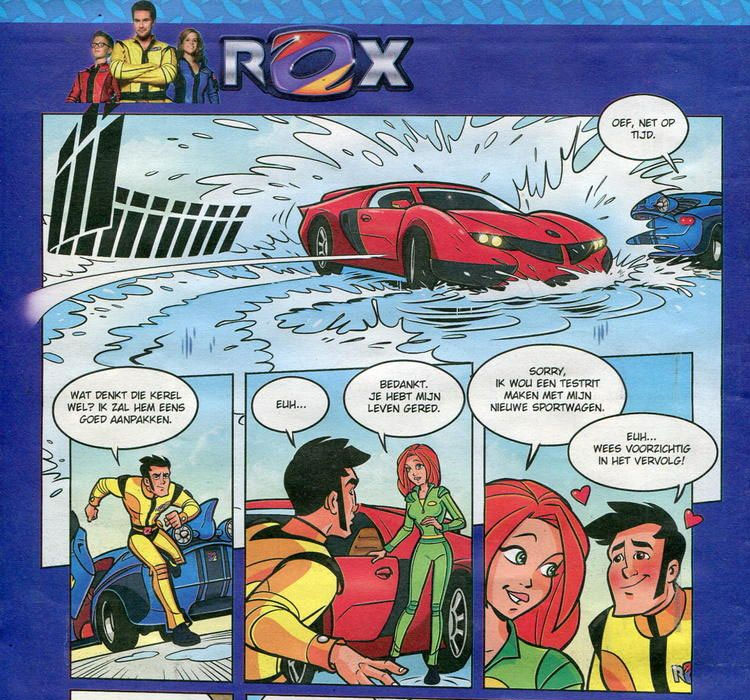
'ROX' (Studio 100 Krant #135, 2012).
Graphic contributions
In 2011, Christian Verhaeghe paid graphic homage to the comic artist Pom in the collective tribute album 'Op Het Spoor van Pom' ('t Mannekesblad, 2011).
Recognition
In 1994, the Belgian Comic Strip Center in Brussels awarded Verhaeghe and Matton's 'Bezette Stad' the prize for "Best Flemish Album". In 2000, Verhaeghe received the Comic Prize of the city of Kortrijk for his entire body of work, and his 'Kroniek der Guldensporenslag' cycle in particular.
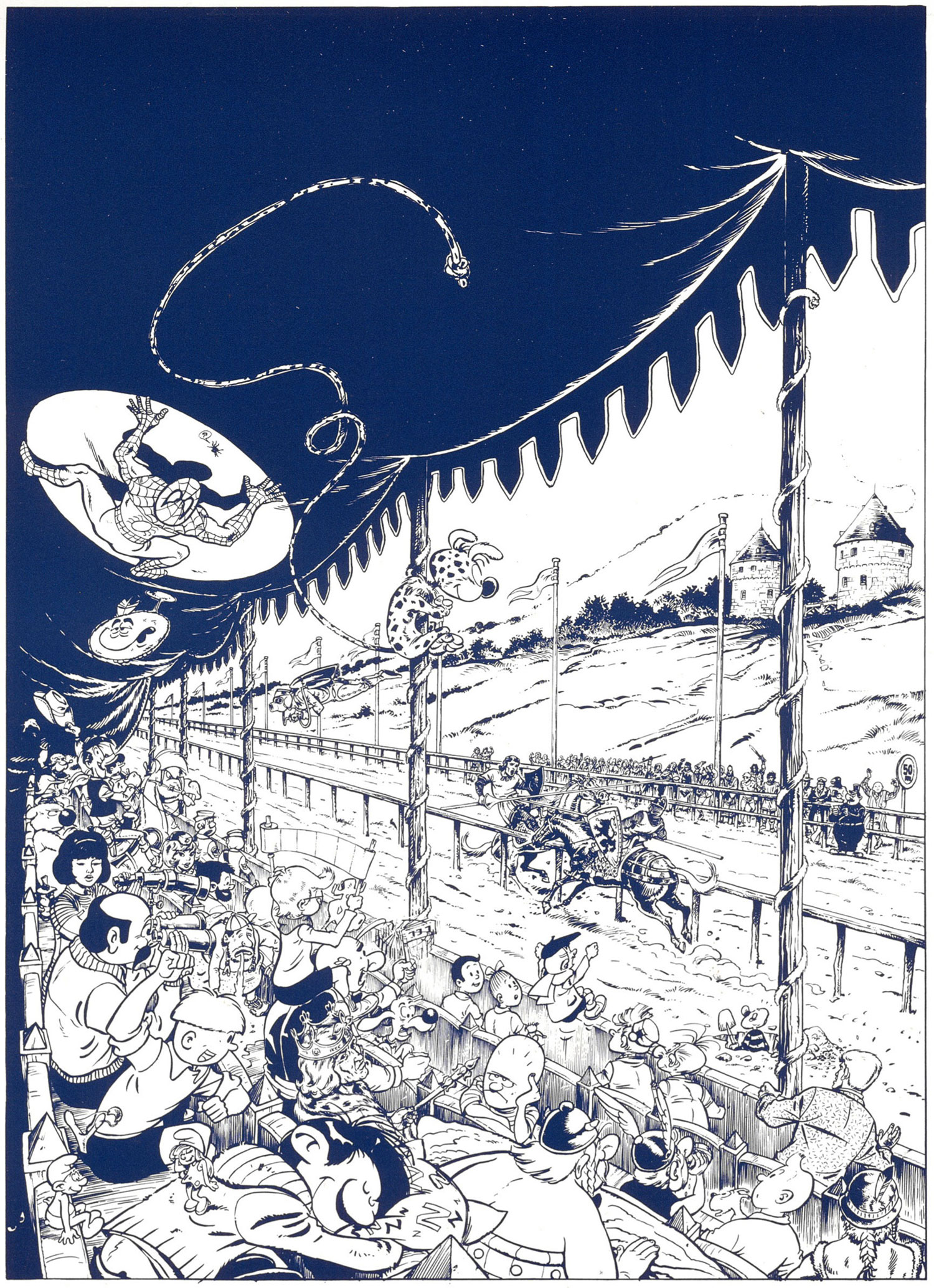
Promotional drawing for the 1997 Kortrijk comic festival. On the roof there are Steve Ditko's Spider-Man and Charles Degotte's Flagada, while André Franquin's Marsupilami has climbed in the pole, with Cedrus from Verhaeghe's own comic series 'Bezette Stad' passing by. In the back row (from the back to the front) E.C. Segar's Popeye, Gos' Le Scrameustache, Dupa's Cubitus, Paul Deliège's Kroston, Roger Leloup's Yoko Tsuno, Merho's Marcel Kiekeboe, Jef Nys' Jommeke, Peyo's Smurfs and André Franquin's Gaston Lagaffe. In the second row Marc Wasterlain's Dr. Poche, Morris' Lucky Luke and Jolly Jumper, Willy Linthout's Urbanus, Jacques Devos' Génial Olivier, Marc Sleen's Nero, king Philippe de Valois from Verhaeghe's own comic series 'Kroniek der Guldensporenslag' and Albert Uderzo's Obelix. Continuing in the third row, there are François Walthéry's Natacha, Will''s Tondu and Tif, Jean Roba's Bill, Marc Legendre's Biebel, Albert Uderzo's Astérix, Hergé's Tintin and Snowy and Hermann's Kurdy. In the front row Willy Lambil's Les Tuniques Bleues, Willy Vandersteen's Suske and Wiske, Peyo's Benoît Brisefer, André Franquin's Spirou and Fantasio and Tibet's Ric Hochet. On the field, Paul Deliège's Bobo has dug himself a way up, while Willy Vandersteen's De Rode Ridder ("The Red Knight") battles another knight. Across the field can be seen Jacques Martin's Alix, Jean Giraud's Blueberry, Hugo Pratt's Corto Maltese, Enki Bilal's Horus and Daniel Kox' Agent 212.