


'The Simpsons' #6 (1994).
Bill Morrison is a U.S. advertising illustrator, poster artist and comic artist, most notable as co-founder, co-writer and co-artist of Bongo Comics, the publishing company devoted to comics based on Matt Groening's animated TV series 'The Simpsons' and 'Futurama'. Between 1994 and 2018, he was creative director of Bongo Comics. He was also art director and character designer on the 'Futurama' TV show itself. Morrison has also drawn humorous comic series of his own: 'Roswell - Little Green Man' (1996), 'Lady Robotika' (2010) and 'Dead Vengeance' (2015). He was chief editor of Mad Magazine (2018-2019).
Early life and career
Bill Morrison was born in 1959 and grew up in Lincoln Park, near Detroit, Michigan. He learned drawing from his older sister, Sue. Among his main graphic influences in the field of high art were Salvador Dalí, M.C. Escher, Alphonse Mucha, John Singer Sargent and Norm Saunders, and in terms of comic book art, Neal Adams. Sergio Aragonés. Matt Baker, Robert Crumb, Dan De Carlo, Will Eisner, Lee Elias, Bob Oksner, Dick Sprang, Jim Steranko, Wallace Wood and Bernie Wrightson. His favorite animator is Tex Avery. Morrison is also a lifelong collector of Batman-related merchandise.
Morrison studied at the College for Creative Studies in Detroit, graduating in 1981. He began his career as a technical illustrator in the Detroit automotive sector. Through a friend, he got a job at Artech, Inc. in Livonia, where he worked on diagrams and illustrations for owner's manuals. Aspiring a more creative utilization of his art skills, he moved to California. Between 1982 and 1986, he illustrated film posters for B.D. Fox and Friends Advertising, where he first met Matt Groening, who worked as a freelance writer there. B.D. Fox was a boutique ad agency for the entertainment industry, where Mili Smythe was art director. Smythe sometimes asked Morrison and other co-workers for some additional inspiration for Groening's latest 'Life in Hell' episode. Interviewed by Ryan Place (Detroit Book Fest, 1 December 2021), Morrison remembered reminscing about old children's playground songs that Groening could use as a frame of reference in his comic strip. Other than these collaborations, they didn't have much contact.
In 1986, Morrison worked for David Willardson's illustration studio Willardson & Associates, making advertising art for Nestles Quick and Maxell Tape. Willardson is best-known for his poster for George Lucas' film 'American Graffiti' (1973).
Poster design
In the late 1980s, Morrison's most notable endeavor was designing film posters. Between 1987 and 1990, he made posters for Disney films, including 'Oliver & Co.', 'The Little Mermaid' and 'The Prince and the Pauper', but also the re-releases of 'Cinderella', 'Peter Pan', 'The Lady and the Tramp', 'Jungle Book' and 'Bambi'. Don Bluth's 'The Land Before Time' and live-action horror movies like 'The Return of the Living Dead' (1985), 'House' (1985) and 'Blood Diner' (1987). His personal favorite was his poster for 'The Prince and the Pauper', but it was 'The Little Mermaid' that would gain the most infamy.
In the late 1990s, reports started to circulate that one of the castle towers in the background of 'The Little Mermaid' video cassette poser had a very phallic shape. Urban legends claimed that the artist who made it did this out of spite against Disney, either because he was about to be fired, or fired afterwards. Other variations on the story claimed that the artist made the poster early in the morning and unconsciously gave this risqué shape. The rumors were enough for Disney to take the precaution to alter the cover and make it less phallic-looking.
Interviewed by Brendan Mears Connery for Hour Detroit (11 August 2022), Morrison dismissed all these rumors and said that it was simply an unintentional effect: "All of the stories and urban legends that came out of that were very entertaining. I used to go into comic shops, and I would hear people talking about it and just be kind of a fly on the wall listening to whatever the story was, and it kept growing, like it was like a game of telephone…It was totally unintentional, just a fluke. I think the very first version of the story was that the artwork was done by an artist who was being fired so his last act of defiance against Disney was to paint this phallic image in the video box art…But of course, none of that was ever true." Morrison also said that, in technical terms, he didn't "work" for Disney, as he was a freelance artist at the time, so they couldn't fire him. In a podcast interview with Jeff Dwoskin (3 March 2025), he recalled that his wife once overheard somebody in a dressing room talking about the "degenerate artist who created that sexual 'Little Mermaid' cover". She approached the woman, told her what really happened, but the gossip simply wouldn't accept the truth and kept on raving. Morrison: "It so cleary illustrates somebody comes over and gives you the real, true story, and it's not as much fun as the story you were telling. (...) People don't want the truth. The truth is too boring. People want the made up stuff."


'The Simpsons' - 'Bart Simpson's Treehouse of Horror' and 'Roswell. Little Green Man'.
The Simpsons and Futurama
By 1990, Morrison started his longtime association with Matt Groening, becoming an art director for merchandising related to Groening's hit TV series 'The Simpsons'. Although the Fox Network owns 'The Simpsons' broadcasting rights, Groening does own the publishing rights of the franchise, allowing him to maintain creative control over all associated merchandising, guarding the show's style. For the first six months, Morrison created merchandising art on a freelance basis, after which he was hired full time. Morrison created a special merchandising style guide, suitable for companies who license the brand to pick out imagery from. If custom artwork is required, they have to pay extra. In this capacity, Morrison created art for T-shirts, posters, calendars, books, video games and DVD covers. He was, for instance, responsible for the crowd posters featuring the main cast and side characters. The first poster featured the Simpson family amidst a mere 30 side characters. As the seasons continued, Morrison designed new posters, cramming in more characters, including ones that only had one memorable appearance in one specific episode. His favorite 'Simpsons' character is Radioactive Man.
Morrison also designed the album cover of 'The Yellow Album' (1997), an album with original songs sung by 'The Simpsons' voice actors. The sleeve is a parody of The Beatles' 'Sgt. Pepper's Lonely Hearts Club Band'. In 2012, he also designed a promotional poster for 'The Simpsons' TV episode 'A Serious Flanders' (2021). Morrison initially also made merchandising art for other animated shows produced by Klasky Csupo, like 'Rugrats'.
Between 1998 and 2003, Morrison was art director for Groening's other animated TV series, 'Futurama', co-designing several of the side characters, based on Groening's initial designs. His favorite 'Futurama' character is Leela.
Bongo Comics
In April 1991, a limited 'Simpsons' comic book series was launched under the title 'Simpsons Illustrated'. All ten issues sold well and from February 1993 on, Morrison, Groening and editor Steve Vance developed it into a full-blown comic book series, 'Simpsons Comics and Stories'. In November of that same year, they established their own comic book publishing company: Bongo Comics. The name was lifted from Bongo the rabbit, a character from Groening's comic strip 'Life in Hell'. Steve Vance was editor, his wife Cindy colorist and letterer. In 1994, Vance left and Morrison succeeded him as creative director (editor/art director), scriptwriter, inker, art director and main artist. Morrison also designed two comic reader apps, 'The Simpsons Store' and 'Futuramaland Comic Reader'.
After drawing the first 'Simpsons' comic strip, which focused on Krusty the Clown, Morrison asked whether he could draw and write a story for the next comic book release. Since they were behind schedule and had nobody else to create a comic, his proposal was accepted. Only then Morrison panicked, because he had never done anything like this before. But he started thinking about what he as a child would find entertaining and transposed this to a 'Simpsons'-themed plot.
As a comic writer and artist, Morrison made many memorable stories for Simpsons Comics: all exclusive new original tales, not directly based on TV episodes, but making extensive use of the characters. In the original TV show, for instance, Bart Simpson is a fan of the fictional superhero comic 'Radioactive Man'. In Bongo Comics' stories, Morrison and his staff developed this idea into an actual comic book series, adding extra side characters and back stories. Some of these ideas would eventually find their way in the TV series too, like Radioactive Man's sidekick Fall-Out Boy, a spoof of Batman's Robin. Other Bongo Comic stories were based on short scenes from one specific episode. In 'The Simpsons' episode 'Three Men and a Comic Book' (1991), bus driver Otto Mann talks about a self-made comic book, 'Busman', in which a bus driver (who is a muscular version of himself) fights vampires in a post-apocalyptic world. In Simpsons Comics issue #4 (May 1994), Steve Vance (writing) and Bill Morrison (comics) worked this idea out into an actual short story, 'The Gnarly Adventures of Busman'.
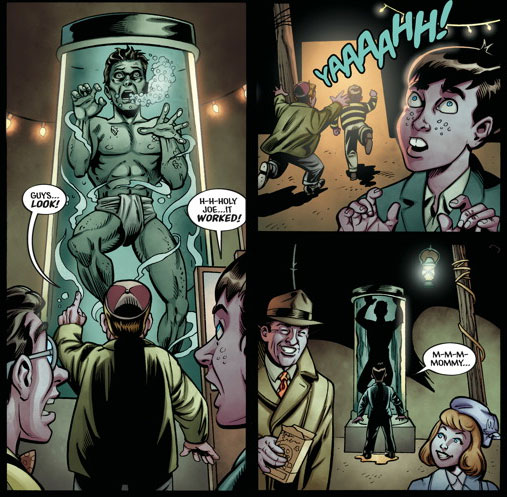
'Dead Vengeance'. #1
Roswell - Little Green Man
Encouraged by Matt Groening, who wanted to see Bongo Comics expand beyond his own creations, Morrison created his own comic strip, 'Roswell, Little Green Man' (1996). The story is based on the notorious 1947 incident in Roswell, New Mexico, where supposedly an unidentified flying object crashed, later denied by the authorities. Over the decades, the incident grew into an urban legend with numerous sensational conspiracy theories about extrarrestrial aliens and government cover-ups. In Morrison's comic, one of the aliens who survived the crash starts a new life on Earth. Although intended as an ongoing series, 'Roswell - Little Green Man' ended after six issues, because he had his hands full wth Groening's next animated TV series, 'Futurama' (1999-...). Yet in one 'Futurama' episode, 'Roswell That Ends Well' (2001), the cast also time travels to Roswell in 1947. Morrison designed some side characters for that episode. The diner waitress that Fry ends up having sex with and turns out to be his grandmother, making him his own grandfather, is a direct nod to Julian Fries from Morrison's 'Roswell, Little Green Man'.
Heroes Anonymous
Morrison's six-issue mini-series 'Heroes Anonymous' (2000) for Bongo Comics revolved around a support group for superheroes. Morrison was assisted by editorial assistant Scott Gimple. Together they developed it into a script for a pilot episode, intended to be broadcast on the SyFy Channel. But they eventually abandoned the project when network executives forced them to make too many changes.
Lady Robotika
Together with Jane Wiedlin, co-founder of the rock band The Go-Go's, Morrison made a comic book, 'Lady Robotika' (Image, 2010), starring Wiedlin as a cyborg space hero.
Dead Vengeance
In 2015, Morrison launched 'Dead Vengeance', his own creation for Dark Horse Comics. The plot, set in 1940s Detroit, pays homage to pulp comics.
Mad Magazine
In 2017, it was announced that the satirical comics magazine Mad would relocate its headquarters from New York City to Burbank, California. At this occasion, they would also renumber each issue from #1 again. From this reboot (May 2018) on, Morrison succeeded John Ficarra as Mad's new chief editor. Morrison was no stranger to the magazine, having devoured it since childhood. In 2016, he already illustrated two articles for them, printed in respectively issue #537 (February 2016) and 542 (December 2016). As chief editor, he also contributed illustrations for the first two issues of the rebooted version.
Interviewed by Brendan Mears Connery for Hour Detroit (11 August 2022), Morrison explained that he and his staff were assigned to reach a wider reader demographic, without losing the core subscribers: "We succeeded in getting subscription numbers up, had expansion ideas that were ambitious but doable, talked about the possibility of live comedy shows at the Hollywood American Legion Post 43, simulcasting, taking it on tour, new merchandise, etc. We were getting great positive feedback. I’m connected with hardcore (and therefore critical) MAD fans who told us we had struck a great balance. But corporate decisions beyond my control caused MAD to go to a reprint format.” On 4 February 2019 after only a year, he resigned as editor of Mad and VP executive editor of DC Comics, as part of new lay-offs at DC. Within the same season, it was announced that Mad would slowly but gradually evolve to a reprint-only publication.
Graphic and written contributions
In 2018, Dark Horse Comics commissioned him to make a graphic novel, 'All You Nerd Is Love: A Yellow Submarine Puzzle Book', to celebrate the 50th anniversary of the Beatles animated feature 'Yellow Submarine', directed by George Dunning. Morrison wrote the book 'Innocence and Seduction. The Art of Dan DeCarlo' (Fantagraphics, 2001), about one of his favorite comic artists, Dan De Carlo. In 2024, Morrison wrote the script for an upcoming animated feature starring Pieter De Poortere's character Boerke (known as 'Dickie' in English).
Recognition
Bill Morrison received the Eisner Award for Simpsons Comics (2000), 'The Amazing Colossal Homer' (1994) and the 'Radioactive Man' comics. In 2022, he received an Inkpot Award.
Between 2015 and 2019, Morrison was president of the National Cartoonist Society.
Recent years
In recent years, Morrison teaches at the College of Creative Studies.

Bill Morrison in Leipzig (Photo: Henrik Bernd).