


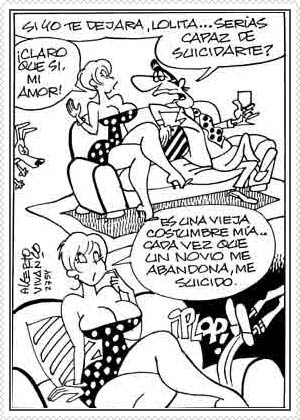
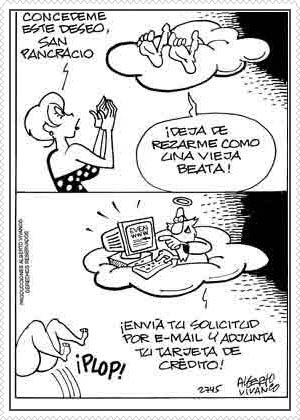
'Lolita'. Translation of the first gag: "If I left you, Lolita, would you be capable of commiting suicide?" - "Certainly, my love! It's an old habit of mine that each time a love leaves me, I commit suicide." Translation of the second gag. "Grant me this wish, Saint Pancracio" - "Stop praying to me like an old saint! Send your request by e-mail and attach your credit card!".
Alberto Vivanco Ortiz is a Chilean newspaper cartoonist. He is best-known for his long-running gag comic 'Lolita' (1960- ), about a sexy young woman. Its cheeky comedy was very popular with readers. Vivanco also drew a gag comic about a cat, 'Yo-Yó' (1965-1967) in his very own magazine Ritmo. Vivanco established several other publications in the 1970s, like the erotic humor magazine El Pinguino (1967-1969), the satirical magazine La Chiva (1968) and the women's magazine Paloma (1972).
Early life and career
Alberto Vivanco was born in 1939. His younger brother, Pepe Huinca (1942-2004), later became a comic artist in his own right. At age 20, around 1960, Vivanco left his home town Quilpué to study Journalism at the University of Chile in Santiago. While in the nation's capital, he offered his cartoons to several magazines, before getting his first job at the Catholic weekly La Voz, where he replaced Hernán Vidal, the creator of 'Malaquías', during an illness. Vivanco also published some work in the children's magazine El Peneca of Editorial Zig-Zag, and was present in La Pandilla, a magazine based around the creations of Chilean writer Marcela Paz, with the story 'El Gordo Sotito'. At this magazine, he befriended the comic artists Pepo and Abel Romero, and journalist Carlos Alberto Cornejo. Vivanco also worked with Pepo on his classic 'Condorito' comic.
Lolita
In 1960, Vivanco joined the daily newspaper Clarín, because it was a paper without a comic strip. In line with the publication's demographic, Vivanco and his editors felt Clarín could use a comic strip about a young, hip, slightly naughty modern young woman. They envisioned her as a direct answer to the popular comic strip 'Pepe Antártico' in rival newspaper La Tercera, drawn by Percy Eaglehurst.
In September 1960, 'Lolita' made its debut. Originally, Vivanco wanted to name the character Coca, with the subtitle "a very crazy girl". But chief editor Dario Sainte-Marie disliked this name, because it sounded like product placement for Coca Cola or - even worse - the coca plant, associated with drugs. He suggested a more trendy name, like Lolita, who was a local stripper who recently made headlines. Vivanco liked this alternative and thus Lolita was born. In hindsight, Vivanco didn't care what his character was called, as long as he could draw comics and get paid for it. The association with Vladimir Nabokov's controversial novel 'Lolita' (1955), about a middle-aged man who falls in love with a teenage girl, was purely unintentional. At the time, the book was banned in many countries and thus not as well-known in Chile as today.
Clarín's Lolita is a prototypical dumb blonde, oogled by many horny men. The gags were scripted by journalist Carlos Alberto Cornejo. While some readers felt the cheeky jokes were sleazy, it was popular with others for the exact same reasons. Shortly after the comic's debut, the comic already received a Sunday page. A testament to the comic's popularity was that the word "lolita" became a household term in Chilean society, shifting its original connotation with sexualized teenage girls in Nabokov's scandalous novel to a more broader and more innocent synonym for young, pretty teenage girls. In a broader perspective, 'Lolita' became one of the symbols of the generation gap between the older, conservative generation and the new, young, liberated teenagers. Between 1965 and 1967, when Vivanco was busy with his magazine Ritmo, 'Lolita' was drawn by a different artist, Ricardo González, A.K.A. Ric. Vivanco also did this under pressure of publishers who wanted him to disassociate himself from that "lewd 'Lolita' comic strip.
In 1974, after emigrating to Venezuela, 'Lolita' continued in the local newspaper Diario 2001, distributed in Caracas. From there on, the series also ran in other Venezuelan, Mexican and Colombian magazines and more than 80 newspapers. During the 1970s and 1980s, episodes of 'Lolita' were assisted by Chilean artists Nestor Espinosa, Hervi, Pepe Huinca, Jecho and Edmundo Pezoa. In the early 1990s, Vivanco returned to being a full-time cartoonist and turned 'Lolita' into a syndicated comic strip.
Looking back on his signature comic, Vivanco felt that his sexy female protagonist helped him build a career. If she had been a child, a senior or an anthropomorphic animal, publishers and general audiences wouldn't have been so interested. Even the scandal made him more famous, while, in the long run, 'Lolita' eventually became an established part of the Chilean press. Contrary to U.S. newspaper comics, which Vivanco regarded as "boring and childish", 'Lolita' had more of an edge and a local style.
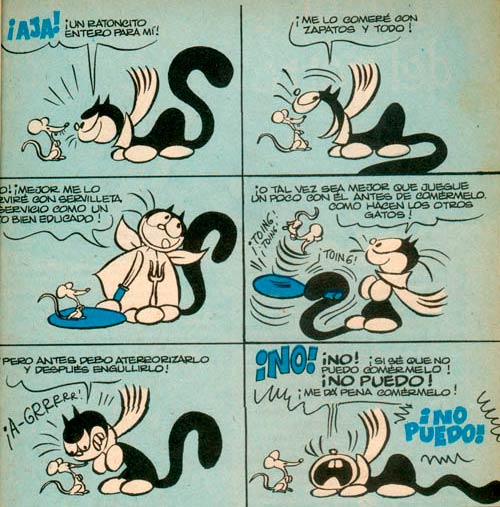
'Yo-Yó'. The cat wants to eat the mouse, but eventually breaks down because he feels sorry for the rodent.
Ritmo
On 9 September 1965, Vivanci launched his first magazine, Ritmo, aimed to reflect the growing role of adolescents and youth in Chilean society. It was distributed by small publishing firm Lord Cochrane. Vivanco served as deputy director, while Chilean performer and radio host María Pilar Larraín was appointed editor-in-chief. In Ritmo, Vivanco drew the gag comic 'Yo-Yó' (1965-1967), about an unlucky black cat.

'Somorava'.
Magazine publications in the 1960s and 1970s.
Vivanco continued to launch new publications in the following years. With his friends Hernán Vidal (Hervi), José Palomo and his brother Jorge Vivanco (Pepe Huinca), he formed the artistic team of the satirical magazine La Chiva in 1968. Vivanco also launched the women's magazine Paloma (1972), which sold 240,000 copies per issue in the 1970s.
Between 1967 and 1969, Alberto and Jorge Vivanco were head of the erotic humor magazine El Pinguino, which published regular work by Hervi Hervi, Themo Lobos and Mateluna.


Cover illustrations for El Pinguino. Translation for the first cover: "So your jealous husband left the beach, huh?"
Later years
On 10 September 1973, Vibanco was late with his deadline and forced to swear to his editor that it "would never happen again." A day later, this promise became reality but for reasons nobody saw coming: the country was suddenly taken over by a coup d'état on behalf of colonel Augusto Pinochet. Socialist president Salvador Allende was assassinated and Pinochet established a brutal dictatorship (1973-1990). In the chaos of this military takeover, many magazines were abruptly discontinued and Vivanco found himself without a job. After 10 months of uncertainty and unemployment, Vivanco decided to seek safer horizons...
In July 1974, he fled to Venezuela. Vivanco had no money, nor a presentable CV. But he showed local editors his comics and cartoons, which helped him get 'Lolita' published in the local press, while simultaneously earning extra bread as an advertising artist. Later he also lived in Colombia for a while. By 1990, Pinochet had been forced into abdication, making it possible for Vivanco to return to his home country again.
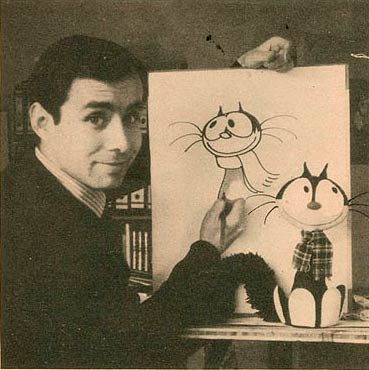
Albert Vivanco.