


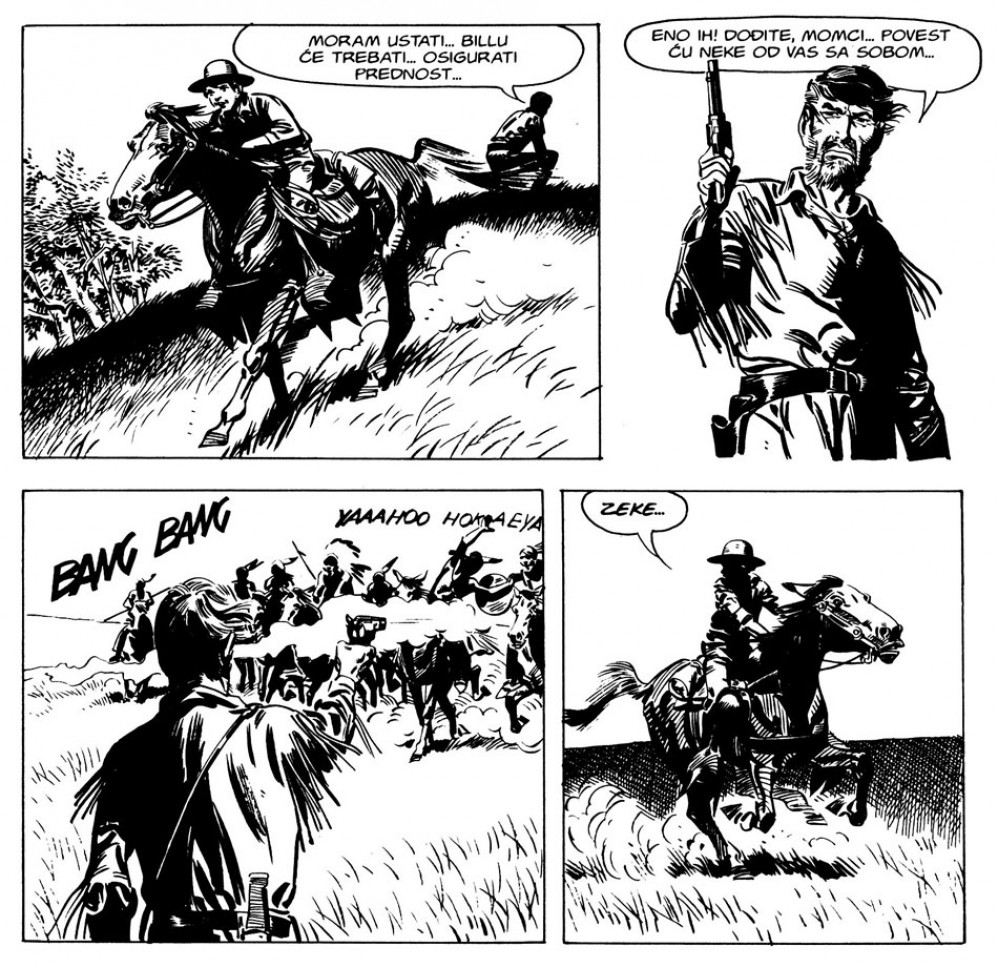
The dramatic power of Zeke's heroic act ('Storia del West: Le Carovane').
Sergio Tarquinio was an Italian painter, engraver, illustrator, and above all, a highly accomplished comics artist. After his start in Italian comics in the second half of the 1940s, he had a notably international career, first in Argentina at the publishing house Editorial Abril, and then during the 1950s and 1960s as one of the agency artists working for the several 'Picture Library' anthology titles of the British publishing house Fleetway. There, Tarquinio stood out as a highly skilled artist for western comics, a talent he further pursued in Italy during his fruitful collaboration with the publisher Sergio Bonelli. Starting out with short-lived comic series like 'Il Giudice Bean' and 'Rick Master', Tarquinio excelled as one of the lead artists of the ambitious 'Storia del West' project, a comic book anthology series created and written by Gino D'Antonio, aiming to provide a well-documented and realistic interpretation of the Old West, through the adventures of fictional characters participating in historical events and interacting with real historical figures.
Early life and career
Sergio Tarquinio was born in 1925 in Cremona, northern Italy. He was the seventh child in the family of a merchant; his older brother Enzo Tarquinio (1911-1985) later became a painter and decorative artist. From the 1930s onward, the family was struck by a series of misfortunes. Tarquinio's father went bankrupt as a consequence of the 1929 Wall Street Crash and the global economic crisis that followed. At age eleven, Tarquinio fell gravely ill and spent more than a month in hospital with little chance of survival. During this period, his father died. Although Tarquinio recovered, the family's difficulties continued: his mother and one of his sisters became seriously ill, requiring long-term treatment.
Because of the family's dire financial situation, and against his own inclination toward the visual arts, Tarquinio pursued a technical education after completing primary school. By age nineteen, he had graduated as an industrial technician with excellent results. At the same time, he continued to cultivate his artistic interests independently, publishing illustrations, teaching himself painting, and carving woodcuts. In 1944, during World War II, he was conscripted. Immediately after the war, Tarquinio sought employment wherever possible, producing advertisements, bar posters, and even a fresco depicting a frieze of cherubs for the Camilliani church.
In 1945, at the urging of a friend, Tarquinio tried his hand at comics, albeit with considerable scepticism. His first attempt, 'Luna d'Argento' ("Silver Moon"), a western written by Cesare Solini for Editoriale Dea, was launched in 1946. In 1948, he collaborated with Gino Casarotti's publishing house Mediolanum, working on Roy d'Ami's 'Blek e Gionni' series. Immediate success secured Tarquinio a place in the comics medium for nearly five decades. He remained active in comics until the early 1990s, after which he left the field and returned fully to painting and engraving, his long-standing artistic interests.
Influences and affinities
By the late 1940s, Tarquinio was deeply impressed by and influenced by Alex Raymond ('Rip Kirby', 1946-1956), Milton Caniff, Frank Robbins, and Ray Bailey ('Bruce Gentry', 1945-1951). The latter three, in particular, may have influenced his strong use of black-and-white contrasts and bold black areas. Notably, at the very beginning of his career, Tarquinio drew 'La Rosa di Gaurishankar' ("The Gaurishankar Rose"), a story set in Nepal near the Chinese border, which was rejected by the publisher for its excessive use of dark tones. Stylistic affinities can also be found with a number of artists known for the elegance of their line, including Dan Barry ('Flash Gordon', daily strips 1951-1963), Warren Tufts ('Casey Ruggles', 1949-1955; Lance, '1955-1960'), George Tuska ('Buck Rogers', 1959-1967), Stan Drake ('The Heart of Juliet Jones', 1953-1989). Sergio Tarquinio has been named the "Dan Barry of the Bonelli World".
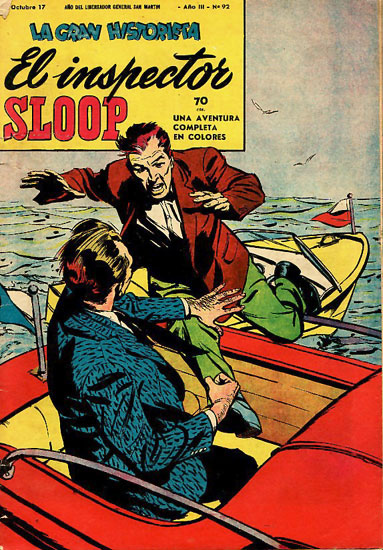
'El Inspector Slop' (1949).
Argentine period
By 1947, Tarquinio was increasingly active as a cover artist, a role for which he later became particularly renowned. At the same time, he developed a strong admiration for American adventure comics. The post-war revival of Italian comics proved short-lived, and opportunities abroad became increasingly attractive. Rather than reaching the United States, which he had hoped for, Tarquinio accepted an offer in mid-1948 to work in Buenos Aires and embarked on a nearly month-long sea voyage to Argentina.
Unlike some of the Italian comic artists who arrived in Argentina after him - most notably Hugo Pratt, whose sociable and hedonistic temperament allowed him to thrive there -Tarquinio found the stark proximity of extreme wealth and extreme poverty unsettling. Professionally, however, his Argentine period was highly productive. For Editorial Abril, the publishing house founded by Cesare Civita, he produced a large number of covers (115 for 'Misterix' and approximately 100 for 'Salgari'). From scripts by Imero Gobbato, he drew the series 'Alan Blood' (1948) and 'El Inspector Slop' (1949), and with writer Fausta Leoni he made three serials in Rayo Rojo magazine: 'Simbar, el Sheik Indomable' ("Simbar, the Indomitable Sheik", 1951), El Secreto de la Pirámide' ("The Secret of the Pyramid", 1952), and 'La Dinastia de los Mántaras' ("The Dynasty of the Mantaras", 1952). He also wrote and drew 'Igor y la Ciudad Azul' ("Igor and the Blue City") and produced a number of shorter comics. His story 'Yukali' was published in Misterix in 1956, after Tarquinio was already back in Italy.
During his Buenos Aires period, Tarquinio met Alberto Breccia, Hugo Pratt, Alberto Ongaro, Héctor Germán Oesterheld, and many other comics creators, with whom he maintained close relationships in later years. After four years in Argentina, he decided to return to Italy in 1952. Much of the comics work and cover art he produced there remained in Argentina due to administrative restrictions that made export difficult.
Return to Italy
Back in Italy, Tarquinio renewed his collaboration with publisher Gino Casarotti of the Dardo publishing house, with whom he worked for the next seven years. His first work for Dardo was the 'Marussia' feature in the short-lived Ardito comic book (1952). For Dardo's Italian version of the American 'Classics Illustrated' comic book series ('I Classici Illustrati'), Tarquinio illustrated issue #4, an adaptation of the 1833 Massimo D'Azeglio novel 'Ettore Fieramosca'. However, cover illustrations became one of his two main areas of activity for Dardo, the other being comic book series such as 'Ray Fox' (1953-1954), '3 Storie Avventurose' ("3 Adventurous Stories", 1954), 'Condor Gek, il Cavaliere delle Tenebre' (1955) and several literary adaptations.
During this period, he acquired a reputation for combining high output with consistent quality, a trait that would characterize his entire career. In parallel, and through the mediation of Gino D'Antonio, he also began working for the publisher A.V.E., producing short comics and the longer series 'La Spada Spezzata' ("The Broken Sword", 12 episodes, 1956), written by Renata Gelardini. In the A.V.E. magazine Il Vittorioso, he drew the comic serial 'Ibubbu: nel Cuore dell'Africa' (May-July 1956).
Throughout these years, Tarquinio never abandoned painting and engraving. By now financially secure, he traveled extensively, visited museums, and ran a school for painting and engraving. His daily routine was typically divided between drawing comics in the mornings and dedicating his free time to his fine arts projects. In 1966, he married Giovanna Piazzi, with whom he had a son, Marco.
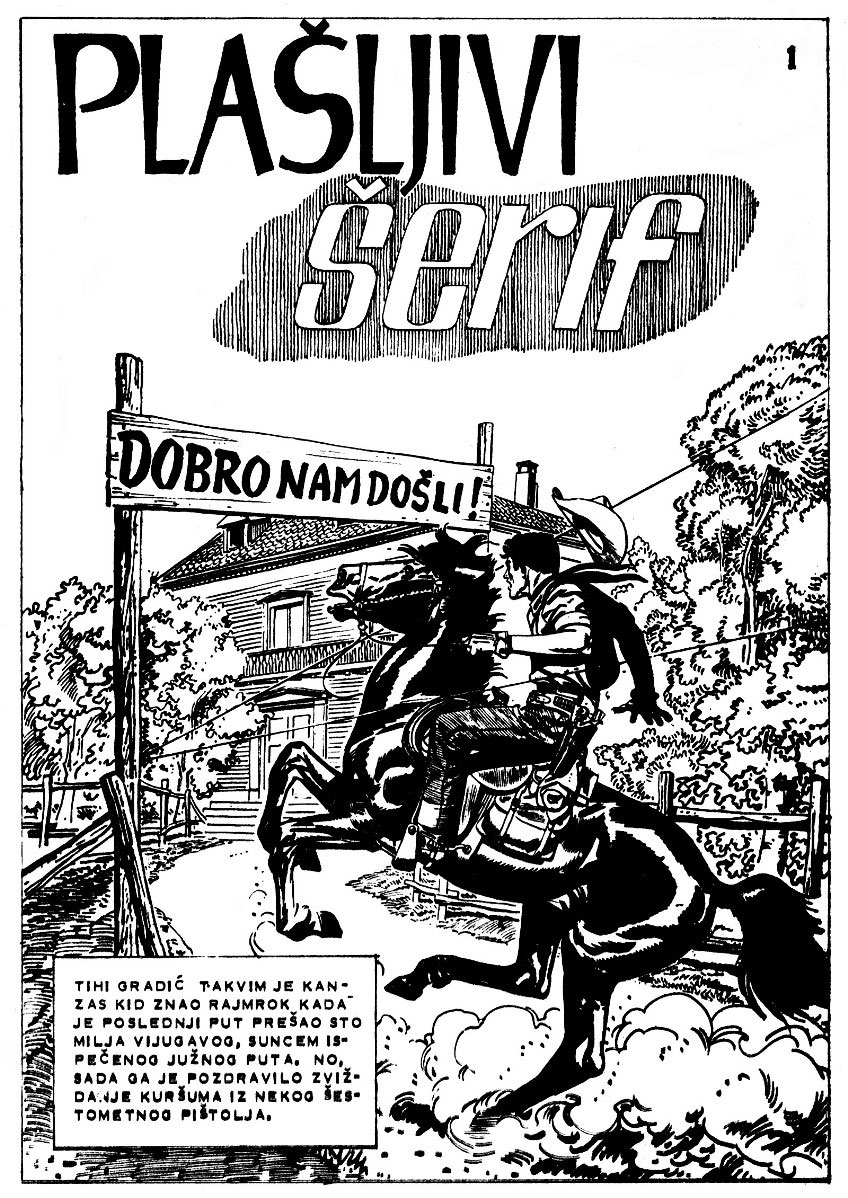
Cover illustrator experience applied to great splash pages: 'Kansas Kid & the Gun-Shy Marshal' (Cowboy Picture Library #392, February 1961).
Fleetway
In 1955, Tarquinio began working for Creazioni D'Ami, the studio of Milan-based writer and artist Rinaldo Dami (known under the anglicized version of his name, Roy D'Ami). There, during the 1950s and 1960s, Tarquinio was part of a group of Italian comic artists working for the British publisher Fleetway, often referred to as "Fleetway's Italian Connection." This group included prominent figures such as Dino Battaglia, Hugo Pratt, Renzo Calegari, and others. In the popular anthology series 'Cowboy Picture Library' and 'Thriller Picture Library', Tarquinio was especially prolific in western stories, a genre particularly well suited to his visual approach. He also tried his hand at war stories, notably for 'War Picture Library' and 'Battle Picture Library', both devoted largely to World War II narratives.
Because Fleetway publications were typically issued without artist credits, no comprehensive catalogue of Tarquinio's contributions exists. Much material from this period was also inadequately documented, further complicating precise attribution. Anecdotes circulate of original artwork being deliberately destroyed in front of artists. For 'Cowboy Picture Library', however, documentation is available: between 1958 and 1962, Tarquinio drew twenty-four western stories. The original Fleetway format (13.5 × 18 cm, 64 pages) was rigid, usually allowing only two, occasionally three panels per page.
An outstanding cover illustrator, Tarquinio transferred and further developed this expertise within his comics work. His westerns from this period are particularly noted for their striking opening splash pages, a feature he would continue to employ in later western series. For 'Cowboy Picture Library', he drew stories featuring characters such as 'Kansas Kid', 'Kit Carson', 'Billy the Kid', 'Roy Renk', and 'Davy Crockett'. For 'Thriller Picture Library', he worked on several series, the best known of which was 'Dick Daring'.
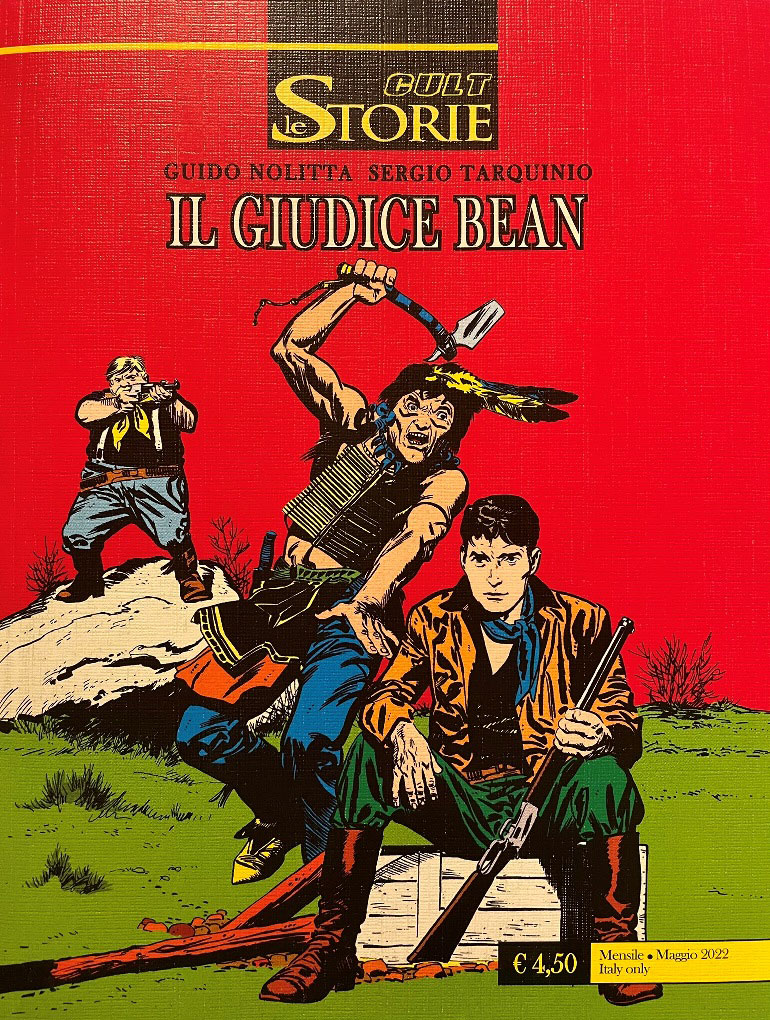
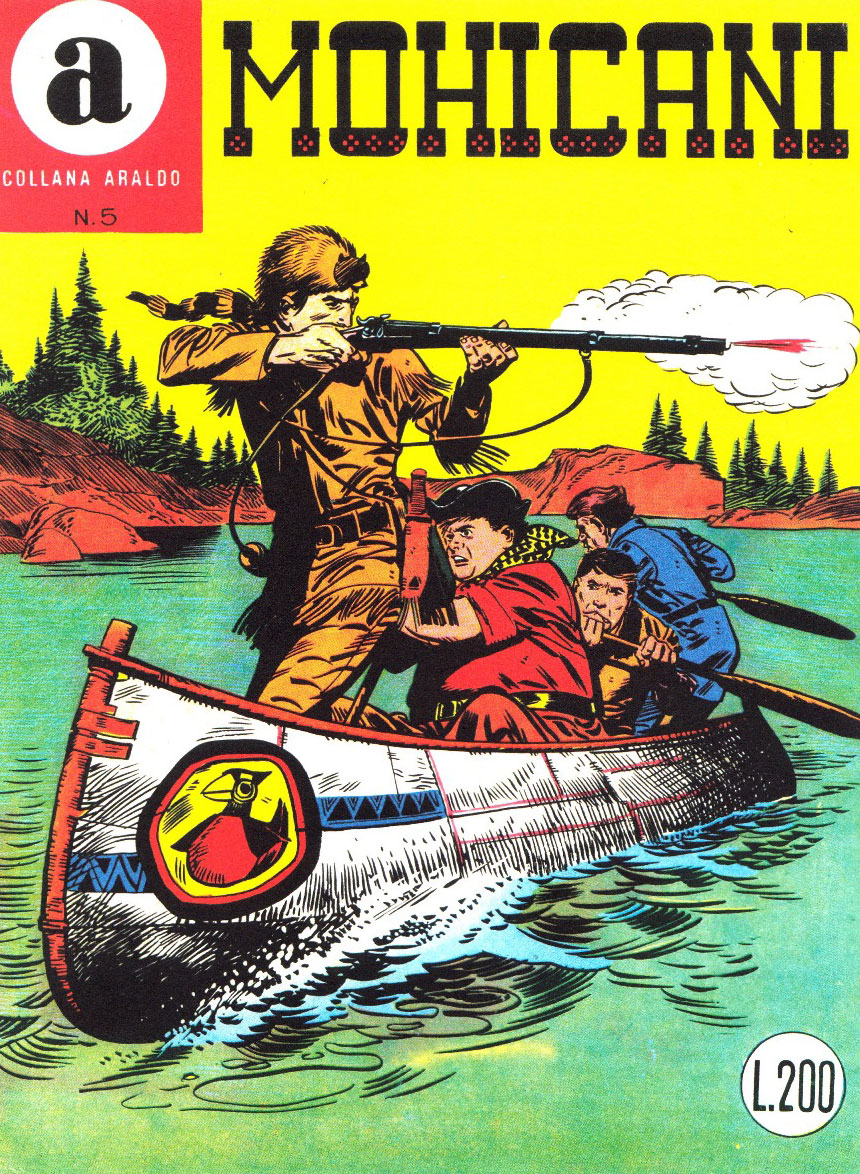
Cover art for 'Il Diudice Bean' and 'Red Buck'.
Bonelli: Il Giudice Bean/Il Ribelle/Red Buck
In 1957, Tarquinio met the publisher Sergio Bonelli in Milan, initiating a long-standing friendship that, during the 1960s, developed into a professional collaboration lasting twenty-three years, until 1983. Tarquinio began by drawing Giubba Rossa, an existing series that was published in strip format between 1959 and 1962. Originally produced in the UK, the series was translated and adapted for the Italian market by Gian Luigi Bonelli, and graphically adapted by artists such as Sergio Tarquinio, Virgilio Muzzi, and Gallieno Ferri, who retouched the original panels.
His main partnership was however with scriptwriter Guido Nolitta, the pseudonym of Sergio Bonelli. Their first collaboration was the five episodes of 'Il Giudice Bean' ("Judge Bean"), inspired by the legendary Old West figure Roy Bean. Although created in 1960, the series was not published by Bonelli's Edizioni Araldo until 1963 in the series 'Gli Albi Del Cowboy'. Also completed in 1960 but published later, in 1966, was 'Il Ribelle' ("The Rebel"). It consisted of the two episodes, the follow-up being 'Dopo la Sconfitta' ("After the Defeat").
Tarquinio's third project from this period was 'Red Buck', a kind of reimagined Davy Crockett figure belonging to the "pre-western" genre, comparable in some respects to Hugo Pratt's 'Fort Wheeling'. Unlike the previous two series, 'Red Buck' was written by Cesare Melloncelli. Its three episodes - 'Red Buck', 'La Spia' ("The Spy") and 'Mohicani' ("Mohicans") - were published monthly between June and August 1966.
In these works, Tarquinio's language of comics appears fully mature, displaying the vigor and enthusiasm already evident in his best Fleetway stories. He also indulged more frequently in comical visual exaggeration than he had in his earlier British westerns. The rotund character Sam, dressed in a military uniform with suspenders and reminiscent in volume of Albert Uderzo's Obelix, formed a memorable duo with the diminutive Judge Bean. Together with Bean's nephew Danny, they create an almost invincible trio.
Rick Master
In 1968, the first episode of 'Rick Master' was drawn by Guglielmo Letteri for Edizioni Araldo's 'Collana Rodeo', after which Tarquinio illustrated three subsequent episodes: 'Ombre Gialle' ("Yellow Shadows"), 'Texas', and 'Un Piano Diabolico' ("A Diabolical Plan"), amounting to a total of 135 pages. 'Ombre Gialle' was written by Gian Luigi Bonelli, while the other two episodes were scripted by Glauco Veroci. Both visually and narratively, the series was inspired by the crime fiction of 'Rip Kirby', created by Alex Raymond and Ward Greene.
The protagonist was a young inspector who relied equally on intellect and physical strength, smoked a pipe in clear homage to Rip Kirby, and operated in San Francisco in 1892. Consequently, influences from the Fu Manchu genre, as developed across various media, were unmistakable: Chinese characters and criminal gangs played a prominent role throughout the stories. Tarquinio drew 'Rick Master' in a notably elegant manner, though with fewer backgrounds and a more static staging than his other comics of that period. Secondary characters, however, were depicted with particular vividness. Rick was frequently shown in profile, and the approach to visual storytelling was deliberately classical, even archaic, resulting in what may today be described as a consciously retro narrative tone.
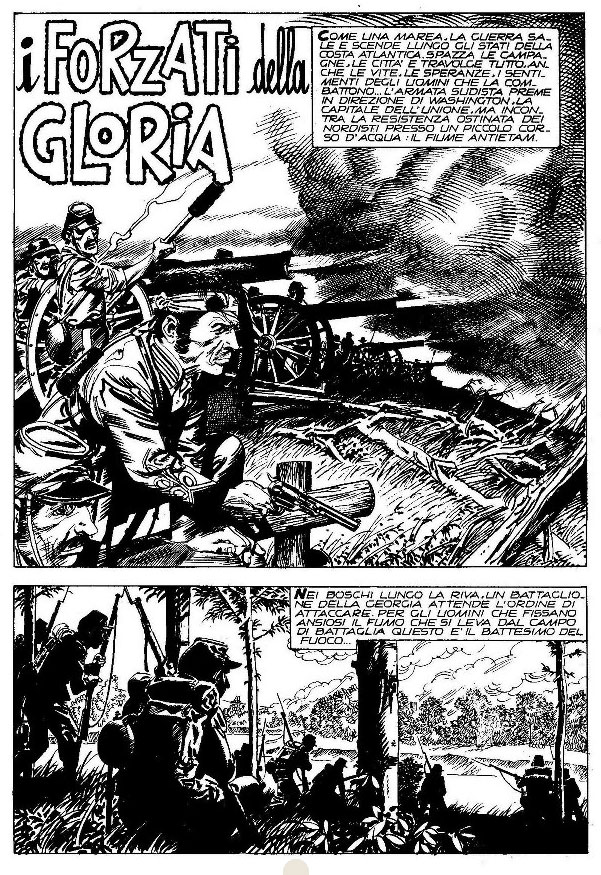
'Storia del West' provides a detailed and well-documented account of the history.
Storia del West
Fleetway's internationally distributed picture libraries had already helped stabilize the western genre in European comics through strong standalone stories and refined visual storytelling. Bonelil's Italian series 'Storia del West' ("History of the West") represented a large-scale epic western adventure of exceptional scope. Rather than a conventional series repeating variations of the same narrative structure in an "eternal present", it was conceived as a graphic novel with a beginning and an end, spanning a total of 7,200 pages.
The series provided a detailed and well-documented account of the history of the Wild West through the stories of the MacDonald and Adams families, beginning in 1804 and continuing through the 1880s. The narrative doesn't have a single main character, but a series of characters who take turns playing the lead role. Various historical figures appear in the stories, including Wild Bill Hickok, Buffalo Bill, Calamity Jane, George Armstrong Custer, Wyatt Earp, Kit Carson, Sitting Bull, Crazy Horse, Geronimo, Cochise, and Chief Joseph. Historical events such as the Lewis and Clark Expedition and the Battle of the Alamo were also covered. Originally published in Italy between 1967 and 1980, the project was conceived by writer and artist Gino D'Antonio, who also wrote the scripts. Artwork was provided by D'Antonio himself, Renzo Calegari, Renato Polese, Sergio Tarquinio, and several other artists. Later reprints by Sergio Bonelli Editore included introductions and editorial texts placing the episodes in their historical context, enhancing the reading experience. D'Antonio's historical prefaces and accompanying texts constitute a significant contribution to the culture of Italian comics publishing.
Tarquinio was the most prolific illustrator of 'Storia del West', visually shaping thirty-four of the seventy-five episodes, each consisting of ninety-six pages, for a total of 3,264 pages. Tarquinio's drawing style reached the peak of its evolution in the first ten episodes he illustrated for the series. Among these, 'Le Carovane' ("The Caravans", 1968) is often regarded as the most accomplished. In this episode, the full strength of Tarquinio's mature talent is evident, particularly in his rendering of landscapes and natural settings. Also the story was among Gino D'Antonio's most accomplished scripts. The death of Zeke, a trapper and caravan guide, was depicted with narrative restraint, achieving considerable emotional impact through minimalism. Tarquinio's visual storytelling here was marked by spontaneous expressive power. 'Le Carovane', as part of the huge epic graphic novel 'Storia del West', stands comparison with the finest western films.
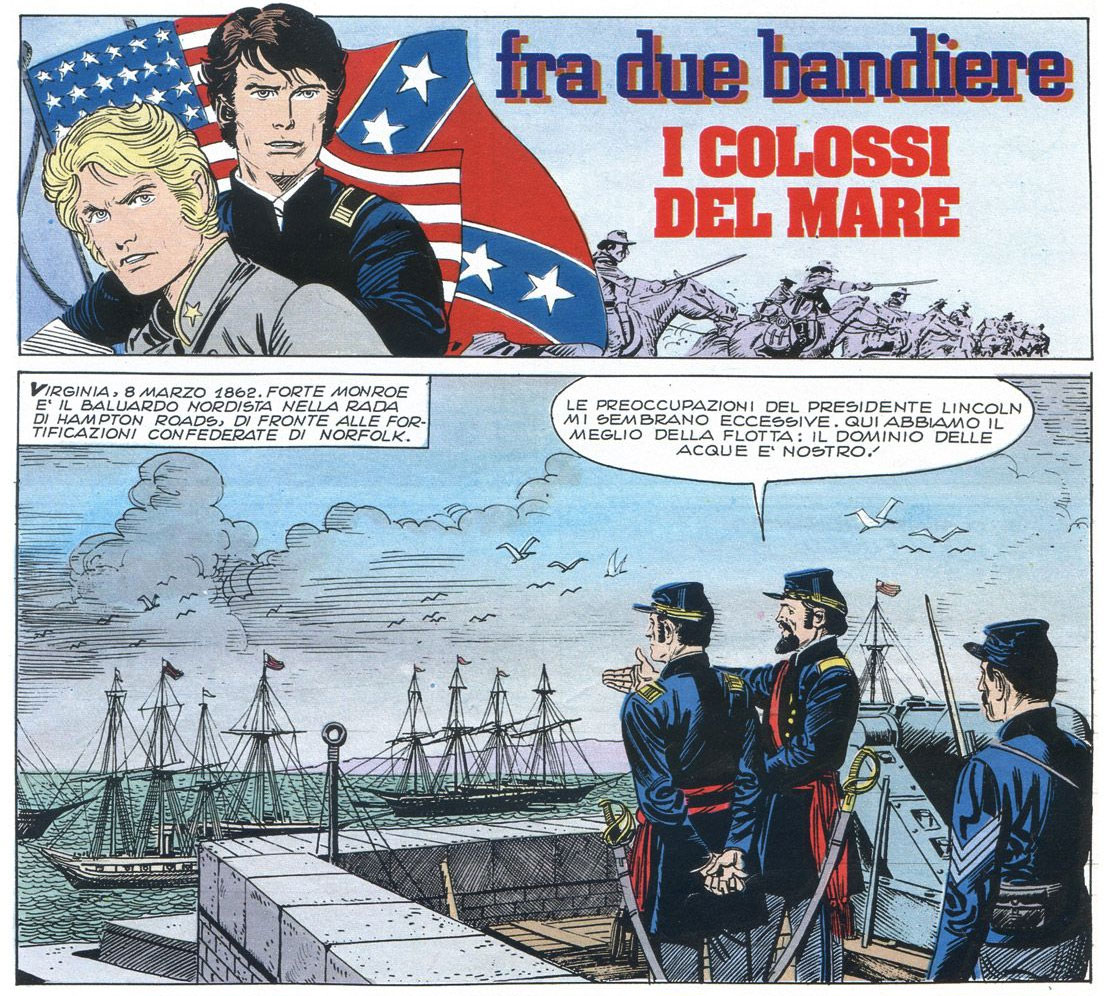
'Fra Duere Bandiere'.
Further comics
In the mid-1960s, Tarquinio had a brief excursion to the publishing house Mondadori, where he drew some Italian-produced superhero stories with DC's 'Superman' and 'Batman'. He also appeared in the magazine Il Corriere dei Piccoli with a long pirate serial, but otherwise his time was mostly dedicated to Bonelli work.
In the concluding phase of 'Storia del West', Tarquinio also drew 'Il Sicario' ("The Hitman"), a 1983 episode of 'Ken Parker', which reflected a more than noticeable decline in his style. Following his involvement with 'Ken Parker', Tarquinio, under a reduced workload, completed three further western comics, published in Il Giornalino magazine: the diptych 'Fra Due Bandiere' ("Between Two Flags," 1985-1986) and 'Nuove Frontiere' ("New Frontiers," 1990) centered on two brothers on opposing sides of the American Civil War, as well as his final comics work, 'Leo Battaglia' (1993). All three of them were written by Alessandra and Manlio Bonati.
Sources differ regarding the exact end of his comics career. According to some accounts, in 1993 he completed the historical comic 'Leo Battaglia', set during the Risorgimento, the nineteenth-century unification of Italy. He then reportedly declined an offer from Gino D'Antonio to draw 'Il Nipote di Garibaldi' ("Garibaldi's Grandson"), which marked the end of his work in comics. Other sources state that Tarquinio had already left the medium in 1988, although this seems unlikely considering the 1993 publication of 'Leo Battaglia'.
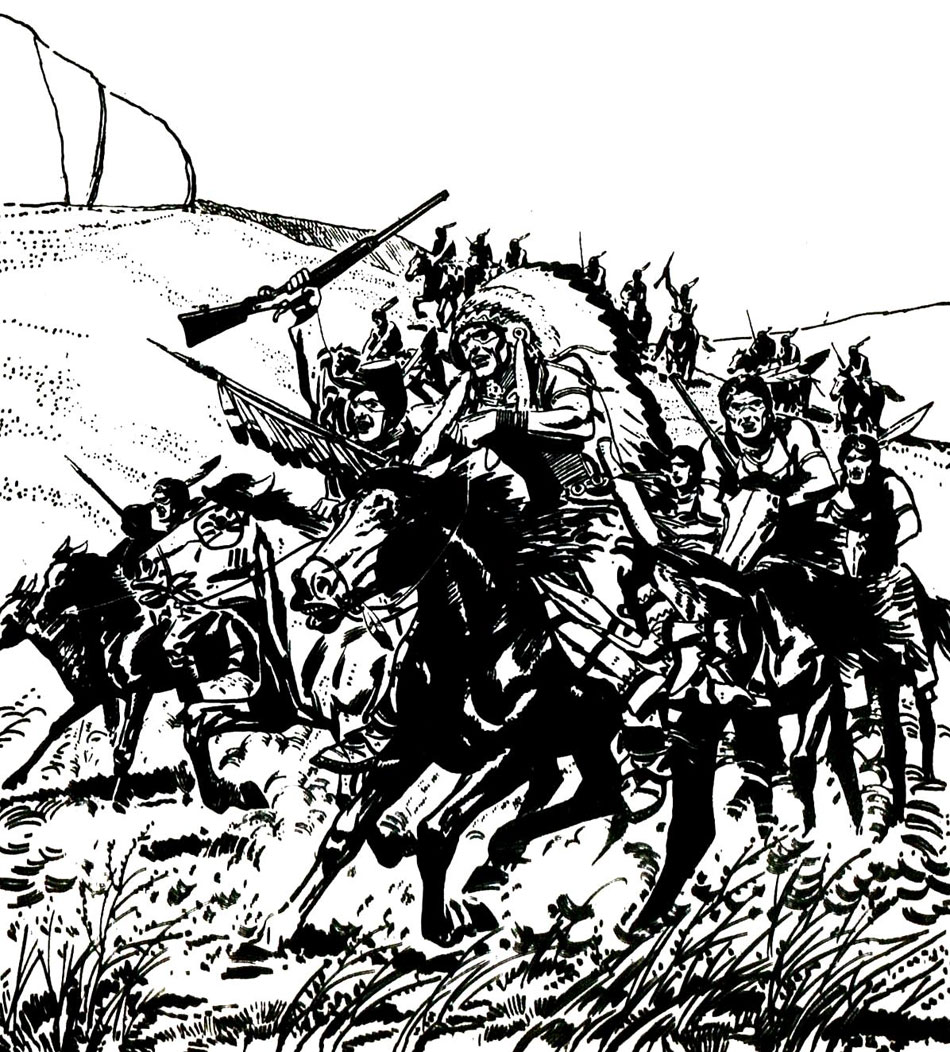
Enchanting dynamic compositions of action scenes for Fleetway comics.
Drawing style
Tarquinio's line was meticulous and calligraphic, yet governed by a distinctive form of refinement that differed fundamentally from the reductive approach associated with artists such as Ivo Milazzo, whose style moved toward highly expressive sketch-like drawing. Tarquinio's refinement served the elegance of pen-drawn lines and the precision of figure contours. At the same time, he employed looser brush strokes to suggest folds in clothing and to give depth and volume to his drawings. This seemingly paradoxical combination of two opposing techniques produced a sense of fullness combined with refined elegance.
Even when using the brush to define facial features, Tarquinio worked with the same delicacy as if using a pen, striving to maintain clarity of line and avoiding cross-hatching. This absence of hatching contrasted sharply with the approach of, for instance, José Luis Salinas in 'The Cisco Kid'. Tarquinio's work was characterized by reflective highlights on leather belts, saddlebags, boots, hair, and the bodies of horses. His use of shadow and black areas was efficient rather than exploratory.
Compared to many of his contemporaries, Tarquinio's drawings appeared smoother and more elegant, reflecting a specific kind of idealization. Despite his stylization, he was fundamentally a realist and did not pursue abstraction. As a result, the omission of detail in his work tends to lead to flatness rather than expressive suggestion.
Tarquinio developed his mastery of composition gradually. While Fleetway stories already contained numerous examples of impressive scene composition, compositional maturity became fully evident in 'Storia del West', particularly in the episode 'Orizzonti lontani' ("Distant Horizons", 1969). Unlike masters such as Dino Battaglia and Sergio Toppi, whose compositional brilliance is continuously foregrounded from panel to panel, Tarquinio employed composition more discreetly, prioritizing narrative clarity over visual virtuosity.
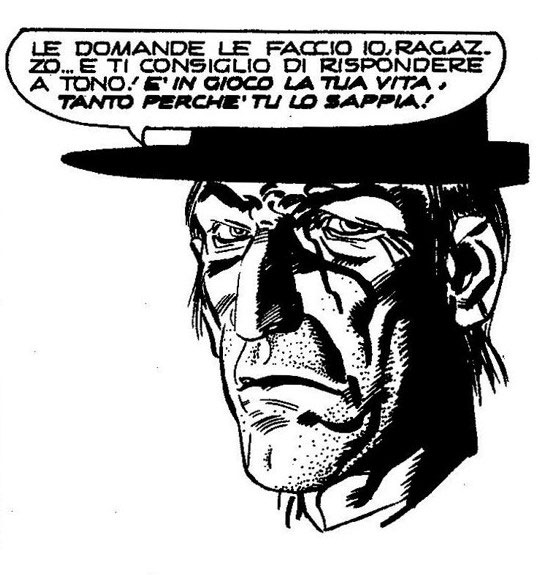
Tarquino's unforgettable portraits of one-off characters with striking visual individuality.
Body language
Hands played a prominent role in Tarquinio's visual vocabulary: open palms with raised thumbs that point, explain, and emphasize. Serbian artist Bane Kerac, also working for Bonelli, has remarked on "Tarquinio's hands" as a characteristic element of his body language, a recurring expressive trope that, through frequent use, approaches the level of a cliché. To sustain his prodigious workload, Tarquinio developed a standardized style and a limited but efficient range of expressive devices. While this resulted in a high degree of repetition, it also produced a remarkable set of archetypal western poses, rendered with striking effectiveness.
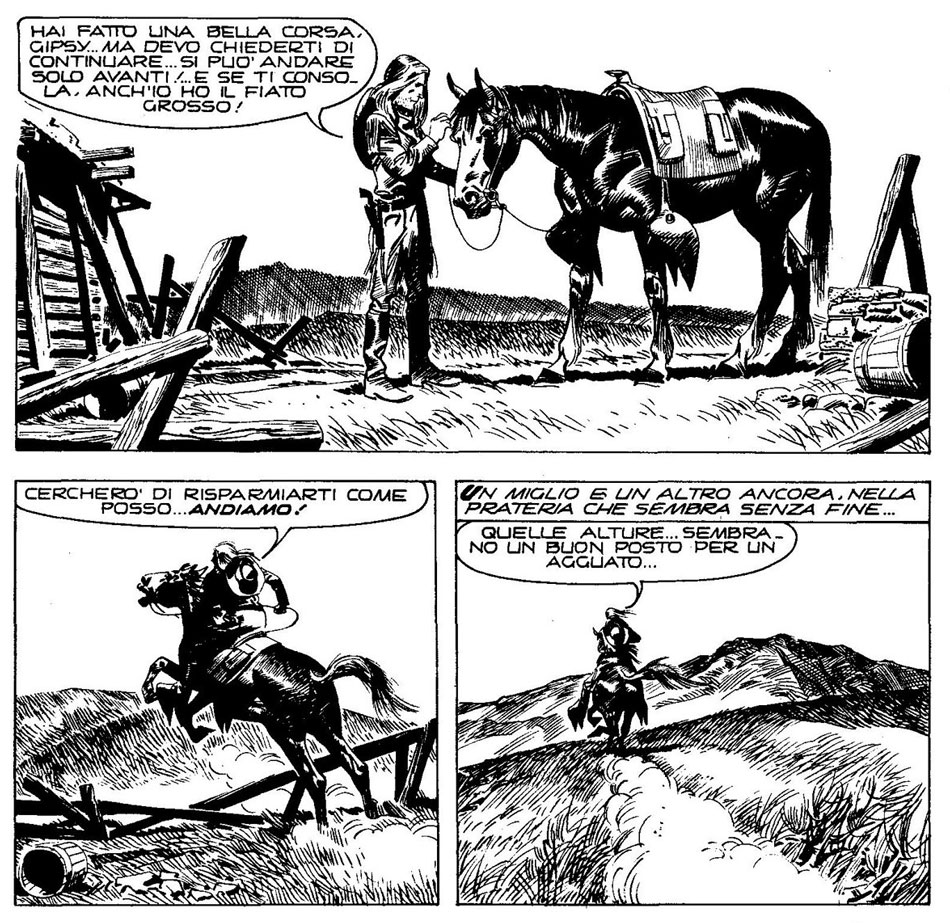
Visual poetics of storytelling expressed through horses.
Women in Tarquinio's work were consistently portrayed as gentle and fragile. Their fragility and delicacy were defining features, whether they appear as virtuous heroines or as femme fatales. A trace of melancholy often accompanied these portrayals. Although his emotional range was not particularly broad, the specific states he conveyed were convincing and memorable. Horses occupied a special place in Tarquinio's comics. Their beauty in full gallop was rendered with exceptional grace, and they often dominated the visual field. Their movement, too, was reduced to archetypal forms.
The selection of movements and body language in Tarquinio's comics is highly recognizable: stalking, aiming, shooting, running, falling, fistfights, Native American attacks, various forms of gallop, mounting and dismounting horses. This constituted a form of choreography, a recurring repertoire of movements. Such reliance on archetypes lies at the very core of genre comics, and Tarquinio's work exemplified this principle with particular clarity.
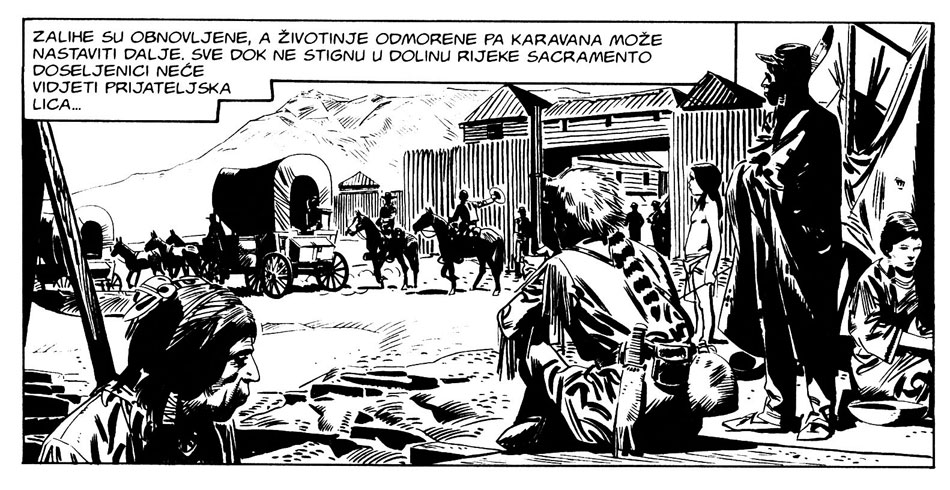
Genre scenes: Tarquinio's talent to capture the moment.
Iconography of Tarquinio's westerns
From his Fleetway westerns through 'Il Giudice Bean', 'Il Ribelle', 'Red Buck', and 'Storia del West', three major phases of Sergio Tarquinio's career reveal a distinctive and coherent iconographic range. His comics are remembered for their precise and expressive costuming: the fringes on the clothing of Native Americans and trappers, elaborate feathered headdresses, painted bodies and garments, raccoon caps, military headgear with visors, and the recurring motif of striped trousers. Tarquinio was an accomplished costume designer, consistently selecting and emphasizing specific clothing details to function as visual signatures. These elements vary within individual works and reappear as leitmotifs across his oeuvre.
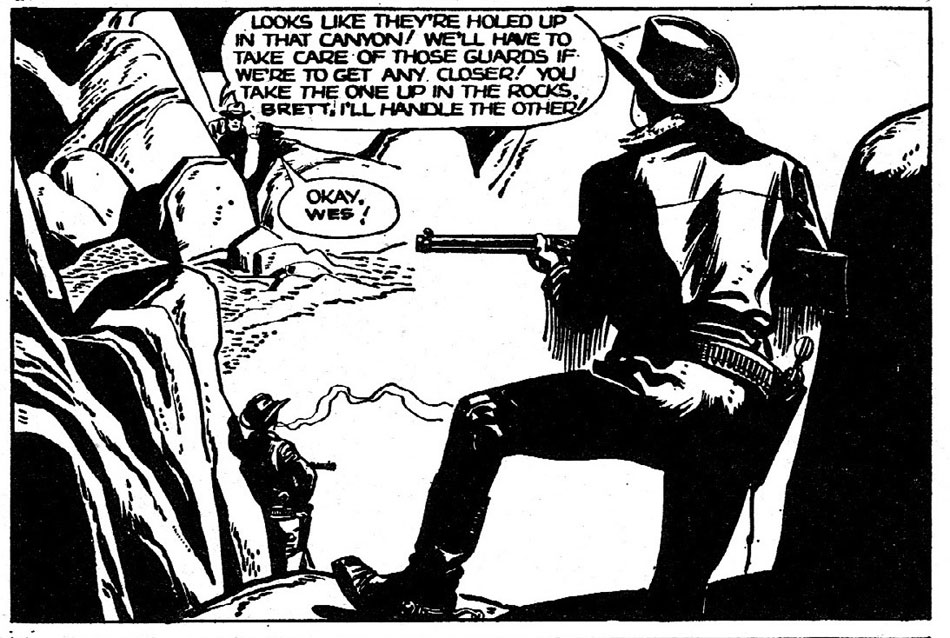
Typical body language for Tarquinio. The protagonists are frequently depicted in contraposto, from behind.
Equally characteristic are Tarquinio's gun belts and ammunition bandoliers, often shown descending in a gentle arc along the cowboy's thigh, frequently depicted from behind. The placement of the revolver and bandolier was integral to body language, with figures often posed in contrapposto. During his Fleetway period, Tarquinio frequently drew revolvers in their holsters with the grip facing forward, adding a distinctive visual tension to the act of drawing a weapon. As critic Marko Fančović has observed, Tarquinio was among the first western comic artists to depict the Navy Colt 1851 instead of the ubiquitous Colt 1873 Peacemaker, impressing not so much through historical accuracy as through his ability to render the revolver convincingly and elegantly, exploiting the distinctive linear grace of the weapon's design.
If iconography involves the description, identification, and interpretation of content, Tarquinio's westerns demonstrate that it is not merely a matter of critical perspective. He created worlds that are immediately recognizable and impossible to confuse with those of any other artist. Across his works, he carried forward a distinctive western universe with its own symbolism, thematic scope, ornamentation, stylization, and mythology of the American frontier. His favored motifs enabled him to construct memorable genre scenes through continual variation. Within the three major phases of his career, these elements crystallize into the highest achievements of his visual style.
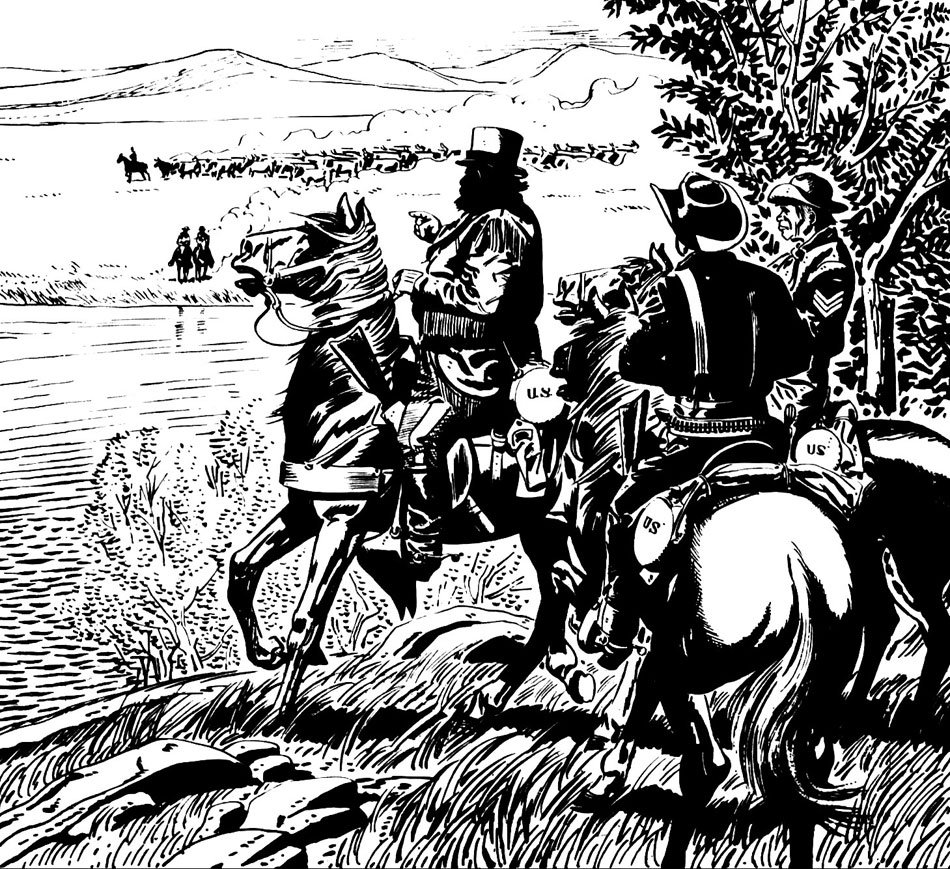
Tarquino's comics are remembered for their precise and expressive clothing details.
Tex - Ombre di Morte
Tarquinio's contribution to Bonelli's signature series 'Tex Willer' was rediscovered shortly before his death. For reasons that remain unclear, possibly related to health issues or other professional obligations, Tarquinio was unable to complete this project. Only much later, in 2023, was the 'Ombre de Morte' ("Shadows of Death") episode published in its unfinished state, a circumstance that paradoxically further underscores his importance within the Italian comics tradition. Editors at Sergio Bonelli Editore have stated, based on indications in the script, that 'Ombre di Morte' was drawn in 1965, prior to the beginning of 'Storia del West', and likely intended for one of the final horizontal strip editions, a format discontinued in 1967. There is no material evidence to contradict this dating. On stylistic grounds, the unfinished 'Tex - Ombre di Morte' appears more likely to have been drawn in the 1970s rather than the 1960s, regardless of when the script itself was written.
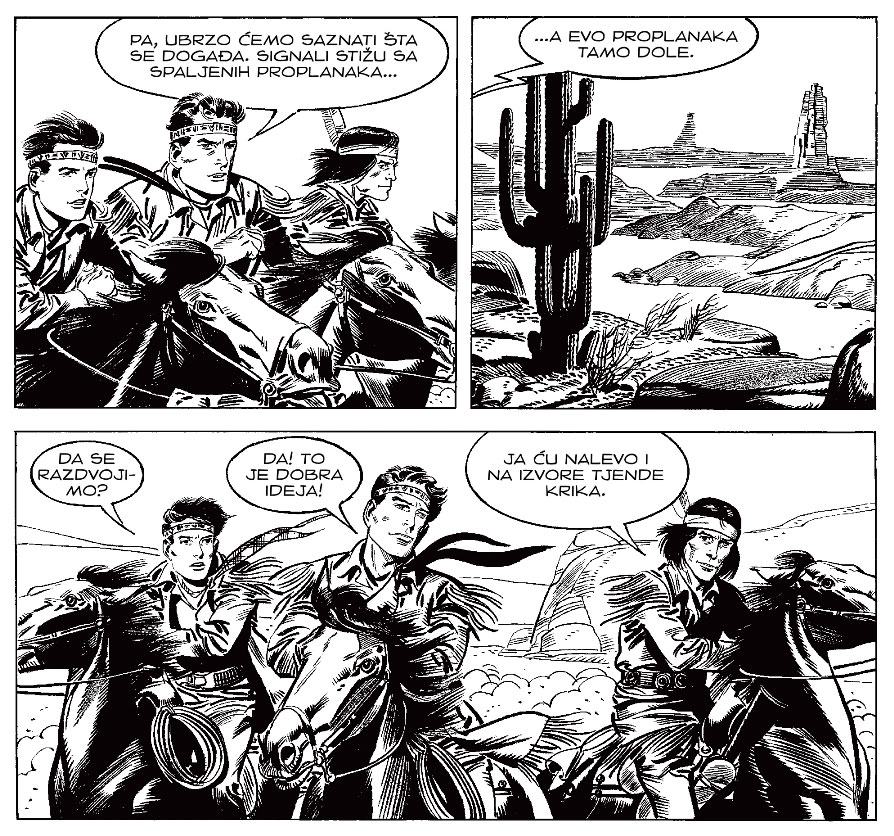
'Tex: Ombre di Morte'.
Death and legacy
Living to become a centennial, Sergio Tarquinio died in Cremona on 11 January 2026, at the age of 100. One of the masters of Italian comics, he was neither the first nor the last exceptional artist to enter comics out of economic necessity and then flourish within it. Unlike many others, Tarquinio managed to maintain a parallel career as a painter and engraver, treating comics primarily as a commercial activity.
One of his major projects, 'Storia del West', represented a decisive step toward narrative seriousness in Italian western comics, and in the western genre more broadly. Just as Fleetway's westerns played a crucial role in shaping the European comics western and paving the way for 'Storia del West', so too did 'Storia del West' clear the path for later masterpieces such as 'Ken Parker' by Giancarlo Berardi and Ivo Milazzo, by creating a bridge between the classic western and the modern western.
Graphically, Sergio Tarquinio left no direct disciples. Contemporary masters of the Italian western, such as Corrado Mastantuono and Stefano Andreucci, are not his pupils, though Tarquinio's conception of action has undoubtedly entered the collective visual vocabulary of the genre, including theirs.
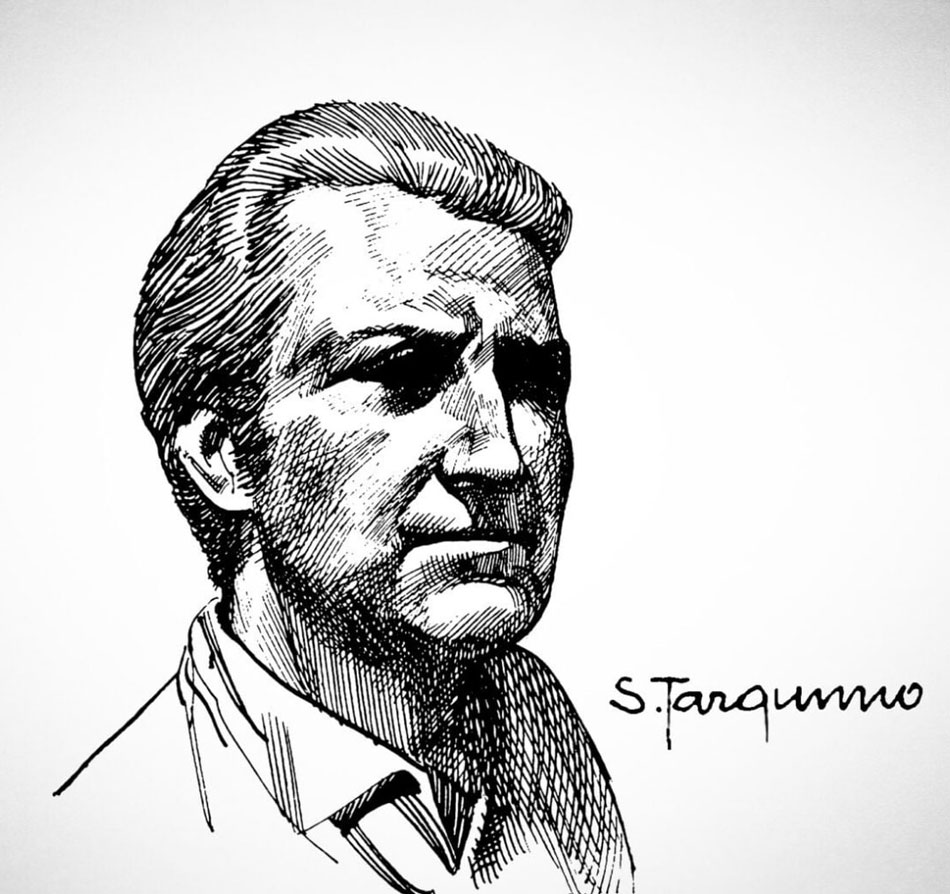
Self-portrait.