


'Pompon Rouge'.
François Bel was a French comic artist who enjoyed a long and fruitful career, almost entirely devoted to the publications of the Catholic publishing house Fleurus. He was the author of the children's adventures series 'Pat et Moune' (1948-1971) and 'Pompon Rouge' (1956-1964), which appeared in the children's magazines Âmes Vaillantes and Coeurs Vaillants until the end of their run, and were then continued in Fripounet et Marisette. He created several animal and nature-related comics for both Fripounet and Francs-Jeux later on. Bel was one of the most prominent artists in the Fleurus magazines during the 1950s and 1960s, along with Pierre Chéry, Pierre Brochard, Claude Dubois, René Bonnet, Roger Bussemey, Robert Rigot, Érik and Pierdec.
Early life and career
François Bel was born in 1927 in Toulouse as the son of a railway inspector. Raised in a devout Roman Catholic household, Bel initially wanted to become a missionary, which would allow him to travel a lot. Instead, he enrolled at the Saint-Cyr military school in Brittany (Bretagne), so he could serve his country as a recruit in France's colonies in Africa. At age 16, Bel fell seriously ill and had to spend two years at the Font Romeu sanatorium. The downside was that one of his legs remained crippled for the rest of his life, making him unable to chase both of his dreams. The plus side was that all these hours in bed gave him ample time to read and raw. His interest in drawing was sparked by Émile-Joseph Pinchon's classic comic series 'Bécassine', while in magazines like Pierrot and Coeurs Vaillants, he discovered the work of Hergé and Marijac. In college, he created his own paper, Le Courrier de Marathon. Bel even wrote to his idol Hergé, who encouraged him to continue. Most of his later comics were drawn in a style inspired by Hergé's Clear Line.
Pat et Moune
By 1947, Bel got his start at the Fleurus girls' magazine Âmes Vaillantes. The editors had such a lack of illustrators that even he, an unexperienced amateur, was able to get a job there. He took the pseudonym Franbel, a contraction of his first and last name. His adventure comic, 'Pat et Moune', about a brother, Pat and his sister, Moune showed obvious influence from Hergé's children's comic 'Jo, Zette et Jocko', which incidentally previously ran in Âmes Vaillantes' other magazine Coeur Vaillants. The very first adventure was set in Lapland, but Bel drew he entire setting completely from his imagination, improvising the events as he went along. Although 'Pat et Moune' was featured on the front page of each issue, Bel only made two full-length serialized stories before Âmes Vaillantes suddenly fired him in 1949. The decision was motivated by other, younger artists whom the editors also wanted to give a chance.
Bel returned to his father for a while, taking evening art courses at the School of Fine Arts in Toulouse. He improved his graphic skills, drawing from nature and using documentation, while simultaneously learning how to sculpt and make ceramics. In the early 1950s, he made illustrations for Le Croisé and L'Almanach du Croisée, publications of the Apostleship of Prayer. Through Le Croisé's chief editor, Bel was eventually allowed back in Âmes Vaillantes' pages, where 'Pat et Moune' made a comeback in issue #47 (20 November 1956). He made the child characters a bit younger, while introducing a new side character, Dr. Sulpice Calluset, who is their uncle. Sulpice serves as Pat and Moune's surrogate parent and comic relief. At the time, many children's comics, especially in Catholic magazines, felt young readers should respect parental authority, so child protagonists would rather team up with an uncle or aunt than their biological parents. In 1957, Pat and Moune also received a pet dog, Flico, who, just like Snowy from 'Tintin' is a white fox terrier. Compared with the previous version of the series, Bel's stories were far better drawn, written and researched. His globetrotting characters compensated the travels he couldn't make in real life, due to his handicap.
However, Bel's handicap again interfered with his career. In 1957, his hip had to be operated. 'Pat et Moune' was suddenly discontinued, just when a new story, 'Le Roc de la Morisque', had taken off. For 18 months, he was forced to refrain from working. The story was eventually recontinued in 1959 and concluded in 1960. Between 1961 and 1962, Fleurus also published comic book compilations. Around this time, 'Pat et Moune' were moved from Âmes Vaillantes to Fripounet et Marisette, a magazine by Fleurus aimed at younger readers. Although Bel was forced to make his stories simpler, due to the age demographic, 'Pat et Moune' was a mainstay of Fripounet et Marisette from 1964 until 1971.
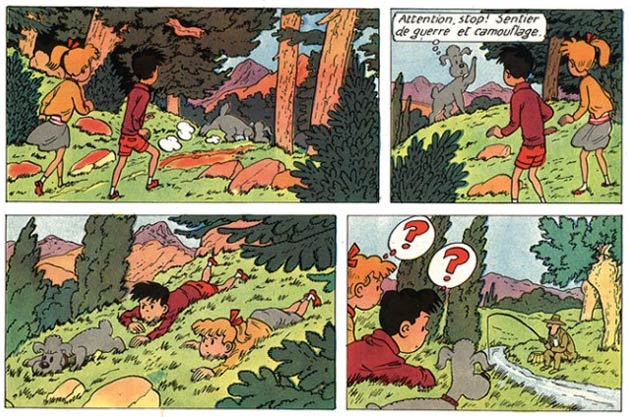
'Pat et Moune'.
(Phil et) Jordi
In the mid-1950s, Fleurus was more convinced of Bel's talents, and asked him to create a serial for their boys' magazine Coeurs Vaillants. This resulted in the series 'Phil et Jordi' (1956-1961). This comic dealt with the bookseller Phil, who inherits a sail boat and engages a ship mate called Jordi (who is nicknamed Pompon Rouge). The graphics in this series were very close to Hergé; even Jordi and his inseparable white cat Biniou are clearly inspired by Tintin and his white fox terrier Milou. While the first story appeared under the title 'Phil et Jordi', Jordi quickly became the star of the series, and the adventures appeared under the name 'Jordi' from the second story, L'Idole de Manaiki', onwards, which was finished by Pierre Chéry, due to Bel's illness at the time.
Phil and Biniou eventually disappeared from the scene completely. Just like 'Pat et Moune', 'Jordi' was also continued in Fripounet et Marisette from 1962 until 1964, and returned under the title 'Pompon Rouge' (1966-1968) in Coeurs Vaillants' follow-up magazine J2 Jeunes. Fleurus released four book collections in 1961 and 1962. The small label P.B.D.I. published five more limited edition books in their collection Le Bel Illustré.

Phil et Jordi - 'Les Trois Feux Rouges' (Coeurs Vaillants #48, 25 November 1956).
Other comics in Coeurs Vaillants
In the 1950s and 1960s, Bel created several gags, short stories and illustrations for Coeurs Vaillants and its successors J2 Jeunes and Formule 1, and also for Âmes Vaillantes and its follow-up J2 Magazine. For Fripounet et Marisette (renamed Fripounet in 1969), Bel created three-page stories about the elderly but adventurous lady 'Miss Justine' (1964-1971) and her cat Édouard, nicknamed Doudou, in cooperation with writer Claire Godet (who used the pen name Dany François).
For J2 Magazine, Bel and Godet cooperated again on the adventures of 'Sidonie Fleurdepois' (1968), a 17th-century housemaid at the court of king Louis XIV. François Bel's final creations for Fripounet and Éditions Fleurus were the funny animal comic 'Mohican' (1979-1982) and the science fiction series 'Zophyta' (1983-1985).
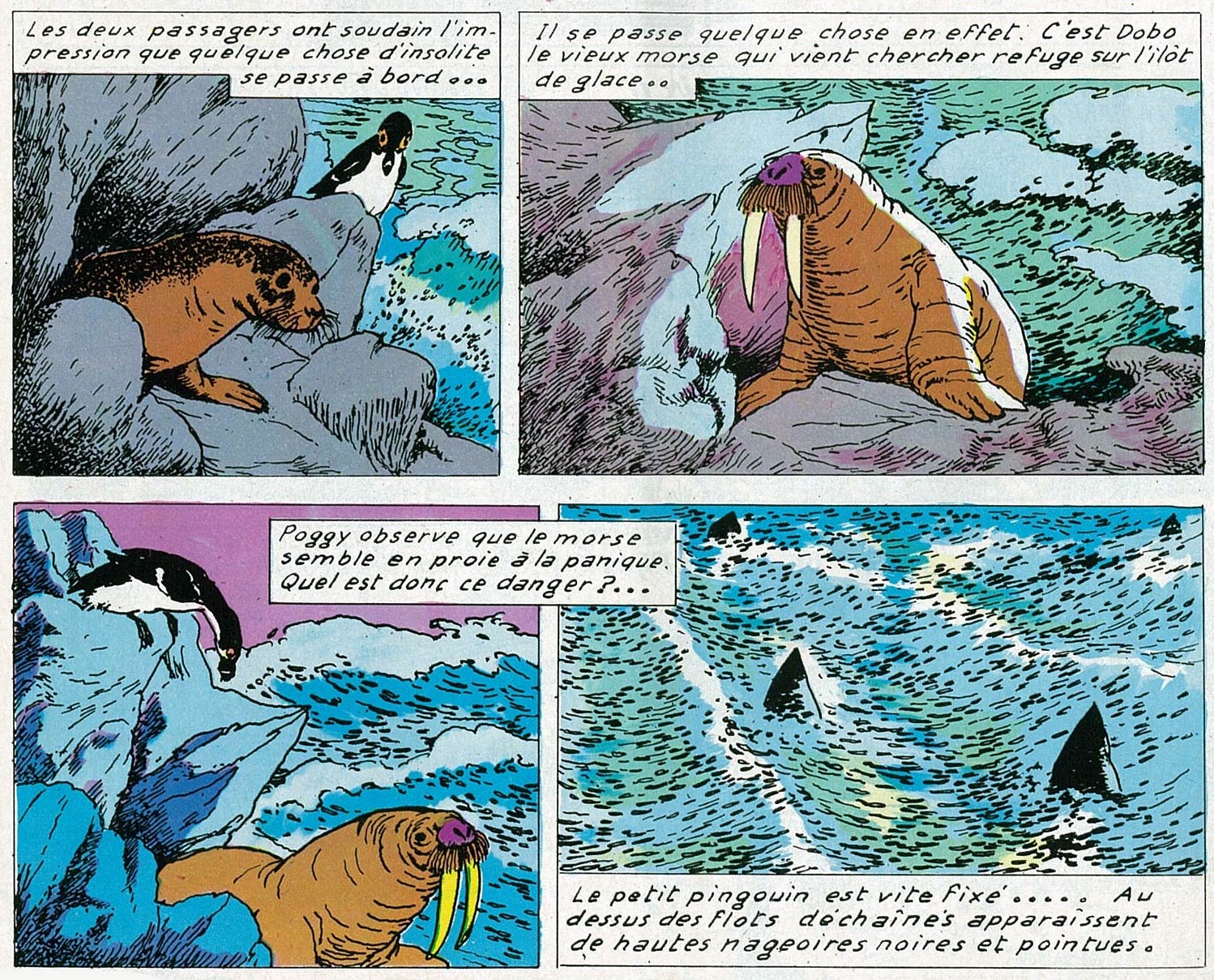
'Pinny et Poggy' (Fripounet #18, 1978).
Comics for other publishers
During his career, François Bel only made a couple of excursions to other publishers. In 1967, he appeared in Lisette/Nade of Bayard Presse with the comic series 'Tante Zaza', made in cooperation with S. Mandron. Between 1969 and 1976, Bel was present in Francs-Jeux, a magazine published by SUDEL. He drew the serial 'Pyle Fait Face' (1971-1972), but also a series of ecologically-themed stories with the character 'Pistil', in which he accurately showed the lives of real animals. In the same tradition, he subsequently made the documentary-style comics serial 'Pinny et Poggy' (1978), about a seal and a penguin, for Fripounet. In the same magazine, he also drew 'Zophyta' (1983-1985), about an extraterrestrial alien who educates professor Sylvestre Pépin about environmental issues and endangered animals.
Final years and death
By the late 1960s and especially the 1970s, Bel's career went into a downward spiral. Many of his classic children's adventure stories were deemed too old-fashioned with newer generations. Editors either moved them to magazines for younger readers, or forced him to make them hip and trendy. In 1974, he was fired by the editors of J2 Jeunes Formules 1 (the modernized version of Coeurs Vaillantes). Bel tried to go along with the times and made several educational and environmentally conscious stories, since he always had an interest in animals. More and more, he felt underappreciated and drowned his sorrows in alcohol. In 1985, he was sent off into early retirement. He made another historical album set in Scotland for Éditions Loubatières, called 'Le Fantôme Rouge de Fynnmore' (1991). The project in direct colors was however aborted, and didn't appear until La Vache qui Médite released it in 2016. This publishing label has been reprinting most of the artist's classic work since 2008.
François Bel passed away in 2009.
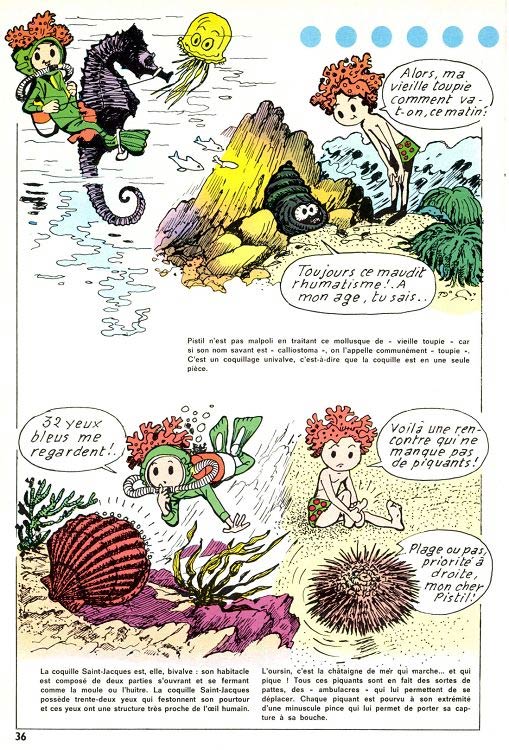
'Pistil'.