


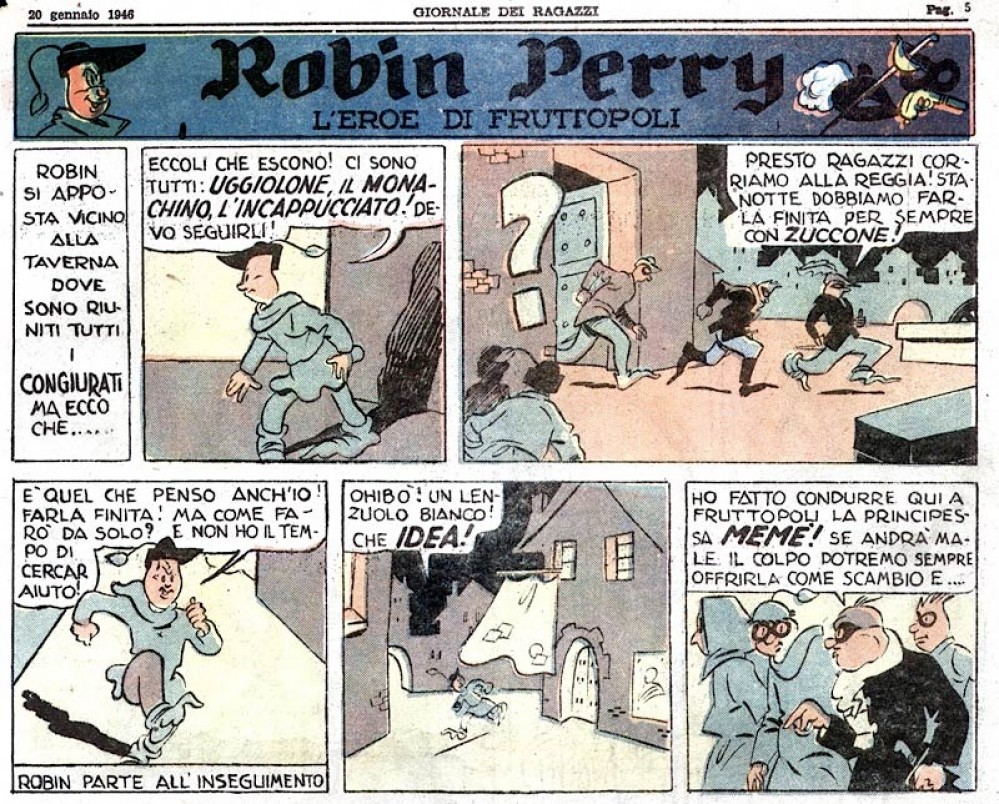
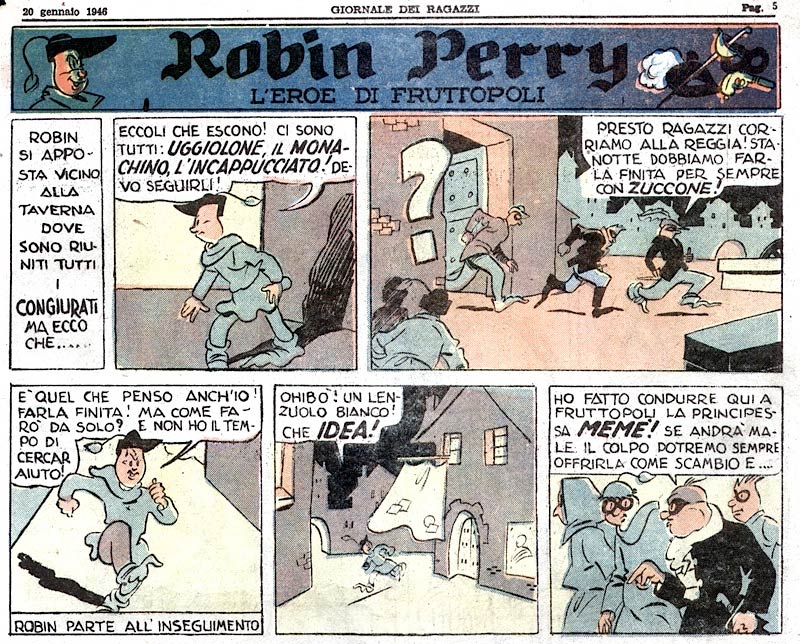
'Robin Perry'.
Mario Fantoni was an Italian comic book artist, contributing from the late 1930s throughout the 1950s to publishers like Nerbini, Tedeschi and Dardo. Initially working in a cartoony style, he appeared in several Dardo's humor books, most notably drawing the characters 'Robin Perry' and 'Capitan Pappafico'. By the 1950s, he was working in a steady collaboration with his father Guido and sister Liliana on the comic books about aviator 'Capitan Walter' (1953-1957). After the death of their father, brother and sister Fantoni continued their team-up on adventure comics for the magazine Il Vittorioso and the associated 'Jolly' comic book series, until they parted ways and explored other artistic activities.
Early life and career
Mario Fantoni was born in Florence in 1926. Like his older sister Liliana, he followed in his father's footsteps and pursued a career in arts. While his father Guido Fantoni mostly worked on realistic comics, Mario focused on cartoony creations. At the early age of 13, he became an apprentice of the comic artist Buriko, drawing a comic based on the fairy tale 'Little Thumbling' ('La Storia di Pollicino') for Pisellino (June-July 1939), a comic book published by Casa Editrice Nerbini. From August to October 1939, the title also ran Fantoni's second story, a comic version of the classic Italian folk tale 'Giovannin Senza Paura' ("Fearless Giovanni").
During World War II, Mario Fantoni drew for the weekly satirical paper Il Brivido, edited in Florence by Alberto Manetti. With writer Ezio D'Errico, he created the comic feature 'Ghigo Investigatore' (1943) in issues #537 through #564 of Mondadori's Topolino magazine. For the Giornale dei Ragazzi from Naples, using the pen name "Maf.", he created his comic character 'Robin Perry' (1944-1946), a swordswinger with a pear-shaped head.
Post-World War II comics
After World War II, Fantoni resumed his activities for Nerbini, also the main publisher of his father, making the western comic book 'Lo Sceriffo Dick Person' (1949-1950) with writer Emilio Fancelli. The comic book's Western story was (fictionally) presented as "real", because the stories allegedly came from a manuscript left by the hero (Sheriff Dick Person) to his son, who then delivered it to the publisher (Nerbini). Other artists for the 26 issues were Roberto Lemmi, Zenobio Baggioli (Bizen) and Erio Nicolò. Around that time, Fantoni also associated himself with the Florence-based publisher/writer Corrado Tedeschi and his Albi Colibri/Albi Avventurosi collection. From Tedeschi's scripts, he worked with his father Guido on comic book issues about 'Il Piccolo Indiano' (1948), a Native American boy reminiscent of Walt Disney's 'Little Hiawatha'. Also with Corrado Tedeschi, Mario Fantoni created six comic books with the masked vigilante 'Il Fantasma del Laghetto dei Cristalli' (1951).
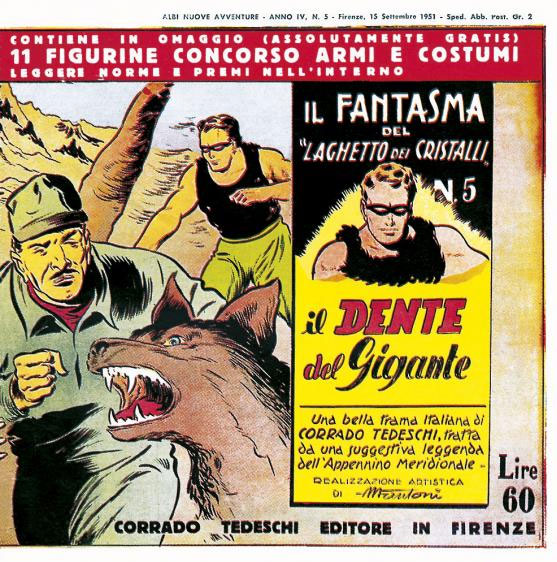
'Il Fantasma del Laghetto dei Cristalli' (1951).
Cri Cri and other Dardo titles
In the 1950s, Mario Fantoni began an association with Ediciones Dardo in Milan, where he worked on the publisher's comic books, filled with funny animal or other cartoony characters. In issues #3 and #9 of Cri Cri, he revived his anthropomorphic pear 'Robin Perry' (1954). For both Cri Cri and Chicchirichì (as well as its follow-up Tarzanetto), Fantoni also created a great many new characters throughout the 1950s, most notably 'Capitan Pappafico', about a pirate captain and his multi-ethnic crew on board the Caterina. Himself a descendant of the 17th-century pirate Pappafico Nero, the captain's most faithful advisor was Loreto, a talking parrot with a pipe and hat. In addition to their Italian publications by Dardo, the 'Capitan Pappafico' strips were also published in France, both by Éditions Impéria (as 'Le Capitaine Pappafic') and by Aventures et Voyages (as 'Cap'tain Vir-de-bord'). For the latter publisher, additional stories were produced by the French artist Eugène Gire.
Among the other characters that Mario Fantoni worked on for Dardo were 'Bertoldino', 'Tony e Salacca', 'Fata Turchina', 'Torello Seduto', 'Tony e Salacca', 'Chiribù' and 'Scaramuccia'. Several of these productions were in collaboration with his father Guido and sister Liliana, as by then the family had begun working as a team.
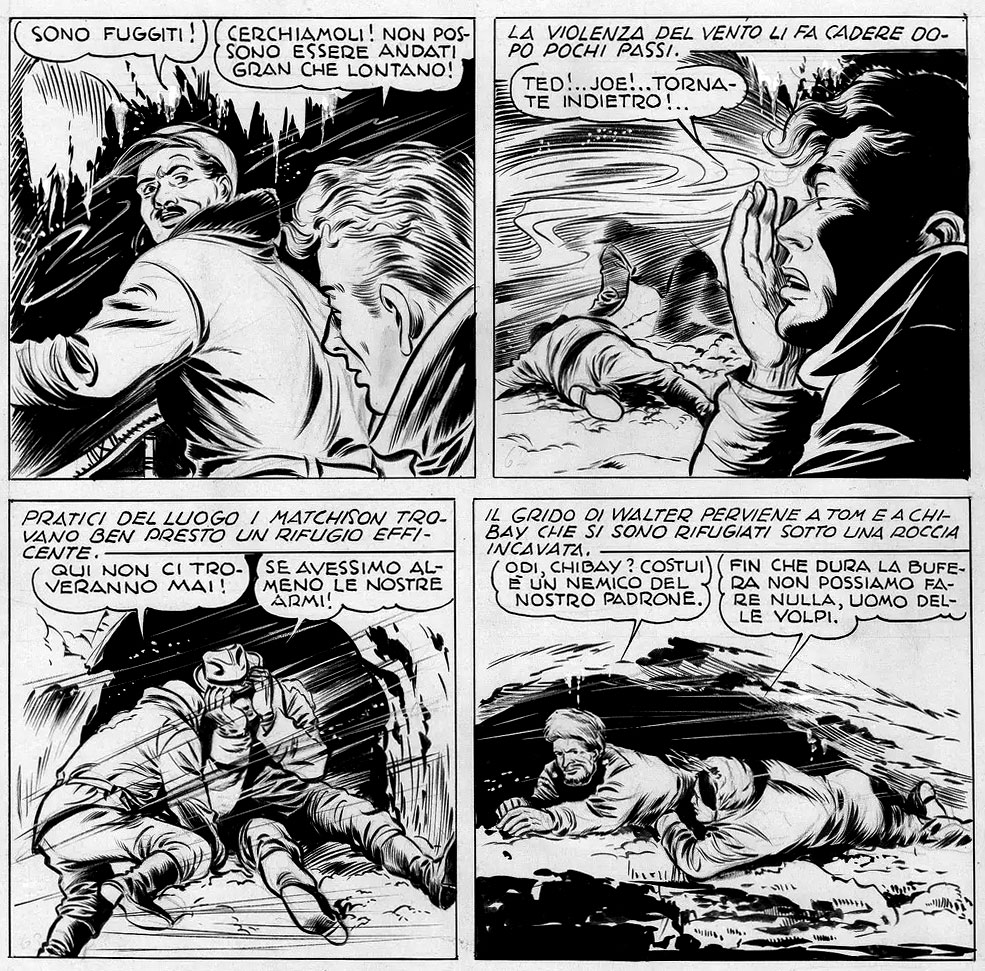
'Captain Walter' by the Fantoni family.
Fantoni family collaboration
In the years after World War II, the Fantoni family began working together regularly. In the late 1940s, the Fantoni siblings Mario and Liliana had already joined their father in his work with Lee Falk's 'The Phantom' for publisher Tedeschi. In 1952, Mario Fantoni also teamed up with his sister to produce the Dardo comic books about the journalist 'James Taylor, il Reporter Giramondo' and about the Native American 'L'Indian Agent Gessy'. The two allegedly also worked with their father on Dardo's 'Bertoldino' comic book.
By 1953, the family team-up was formalized when they were working together on the comic book series about the aviator (and later journalist) 'Capitan Walter' for the Catholic publisher Anonima Veritas Editrice in Rome (227 issues between 1953 and 1957). The stories were written by Mario Basari and Renata Gelardini De Barba. For the same publisher, the team created the stories 'Calcio in Costume' and 'Il Figlio del Gangster' in the magazine Il Vittorioso. In Belgium, the 'Capitan Walter' stories appeared in Fernand Cheneval's Héroïc-Albums comic book (1955-1956).
In their collaboration, Mario Fantoni worked with his father Guido on the general story art, while his sister Liliana did the lettering and drew the female characters. On occasion, Liliana's future husband, the sculptor Giuseppe Madonia, helped out with some translations from English, if necessary. After the death of father Guido Fantoni in 1957, the 'Capitan Walter' series came to an end. However, Mario and Liliana Fantoni continued their collaboration in the pages of Il Vittorioso with the serials 'Il Sostituto', 'Il Caso Elvy' and '30° Piano'.
In the meantime, the 'Capitan Walter' comic book series was replaced by 'Jolly' (1957-1960), a comic book mixing adventure stories with humor features. Among the many contributors, Mario and Liliana Fantoni continued to provide several serials, including 'Hoka Hey' (script by Danilo Forina), 'Le Terre Insagnuinate' (script by Renata De Barba), 'Il Gran Premio Siepi' (script by Piero Salvatico), 'L'Arcipelago della Copra' (with Sandro Cassone) and 'Il Progretto Stella Azzurra' (script by Mario Basari).
Later years and death
In the 1960s, Liliana retired from the comic industry and focused on her family life, while Mario spent the next ten years working in his family's artistic ceramics workshop. On occasion, Mario Fantoni returned to comic books, for instance for the three-issue secret agent comic book series 'KS' of the publisher Editrice Sadea (1965). The other artist for this series was Aulo Brazzoduro (Lino Brazzo). During that same period, he also drew the feature 'Jeff Demon' (1965-1966) for the western comic book Colt 45 by Editoriale Olimpia. In 1971, Fantoni was one of the artists for the humorous 'Jimmy Colt' series of Cerretti Editore. Among the other artists for the series were Paolo di Girolamo and Lino Ray (Roveri).
In the 1970s, he returned to illustration full time, making artwork for children's books published by Malipiero from Bologna. He also contributed to more magazines edited by Corrado Tedeschi in Florence, and made puzzles and riddles for the magazines Domenica Quiz, Il Labirinto and Penombra. Mario Fantoni passed away in 2012.
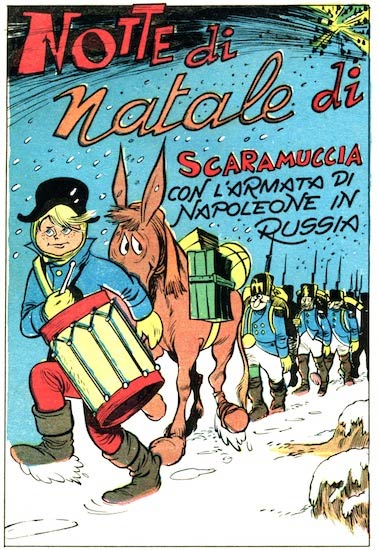
'Notte di Natale di Scaramuccia con l'Armata di Napoleone in Russia'.