


'Isebil' (In De Okeren Omelet, 1978).
René Meulenbroek was part of an Arnhem group of comic creators that launched the 1970s alternative comic magazine De Omelet and then founded Studio Arnhem. During the 1980s, the collective worked on both individual and group projects, with Meulenbroek participating in the comic features 'Ernst Vrolijk en Dick Hout' and 'Otto Raaf', as well as the game pages in Eppo magazine. He later turned to illustration and graphic design. He is also known under the pen name "Den Meul" or "Denmeul".
Early life
René Leonardus Marcellus Meulenbroek was born in 1956 in Arnhem and was the oldest child of a tax official. He spent four years at the Art Academy of Arnhem, and subsequently worked at an advertising agency for two years. In 1975, Meulenbroek teamed up with his artist friends Hanco Kolk, Ben Jansen, Aloys Oosterwijk, Rieuwert Catz, Diederick van Kleef and Frank Langedijk to launch the amateur comic magazine De Omelet. Generally, the magazine is referred to as "In The Colored Omelet", as each issue had a specific color in its title ("In De Blauwe Omelet", "In De Oranje Omelet", etc.). Between 1976 and 1978, seven issues of De Omelet appeared, the first two self-published, and the other five through Har van Fulpen's publishing house Drukwerk. Over the course of these seven issues, the group experimented graphically, while gradually improving their skills. Eventually, Meulenbroek, Jansen, Kolk and Oosterwijk were ready to turn professional, while Catz and Van Kleef pursued other career paths. Frank Langedijk had already left the Omelet project after its first issue. In 1978, De Omelet merged with the titles Tante Leny and Speedo into Talent, a new comic magazine published by Drukwerk.
Studio Arnhem
During the late 1970s, the remaining artists of De Omelet - Ben Jansen, René Meulenbroek, Hanco Kolk and Aloys Oosterwijk - continued to work and socialize together, and in 1981 they joined forces with former underground artist Evert Geradts to form Studio Arnhem. The initial funding of the group was provided through an assignment Meulenbroek and Geradts did for the Information Department of the Ministry of the Interior, the 1981 educational booklet 'Alle Stemmen Gelden' ("Every Vote Counts"). Written by Jan van Lieshout, artists like Theo van den Boogaard and Franka van der Loo also contributed.
After starting their studio in the house studio of Geradts, they quickly moved to a studio space at 6, 1e Wijkstraat and finally into an old school building at 31A Kastanjelaan. Over the course of the 1980s, other artists joined Studio Arnhem, such as Gerard Leever, Kees de Boer, René Uilenbroek and Jaap Stavenuiter, as well as colorists like Wilma Leenders, Ellen Klever and Trudi Klever. This legendary studio laid the basis for a new generation of comic artists that quickly received assignments from most of the leading publications of the time, including Donald Duck, Eppo, Robbedoes and Taptoe. During the early 1980s, Meulenbroek and the other Studio Arnhem members also continued to contribute occasional comic stories to alternative comic magazines like Talent and Coyote. Meulenbroek also contributed to the Dutch comic magazine Eppo, where he did the coloring of the early episodes of Hanco Kolk's 'Gilles de Geus' and provided the puzzle section 'Hersenschrobbers' (1984-1985). One of his most notable creations was the 1982 Knight's Game, which came with the magazine's thematic issue about the Middle Ages.


Puzzles for Eppo #13 and #27 of 1984.
Team projects
In its early years, Meulenbroek and Kolk were the driving forces behind the studio's commercial activities in its early years. Meulenbroek's ambition was to work as a collective on the same projects, in the tradition of the Toonder Studios. However, the rest of the group didn't share this vision, and the team worked mostly on individual assignments and only occasionally on a group effort. When in 1983 Robbedoes, the Flemish edition of the Belgian comics weekly Spirou, got its own independent Dutch section, Studio Arnhem contributed a couple of comic features. As a collective, they made the series 'Ernst Vrolijk & Dick Hout', for which Meulenbroek served as creator, co-writer (with Hanco Kolk), background artist and colorist. The characters were drawn by new group member Gerard Leever. Debuting in Robbedoes issue #2430 (8 November 1984), the feature is set in a two-man employment agency, where the proprietors take all kinds of wacky assignments. Although a studio effort, 'Ernst Vrolijk & Dick Hout' had a clear separation of each individual task. Kolk wrote the stories, while Gleever provided the artwork for the characters and Meulenbroek drew the backgrounds. A total of four stories were produced, but only three appeared in Robbedoes.
Another group production Meulenbroek participated in was the newspaper strip about photographer 'Otto Raaf', of which one story ('Concert voor Carras') was serialized in the Amsterdam newspaper Het Parool from 3 January until 26 March 1983. Scripted by Ger Apeldoorn, the comic had background art by Meulenbroek and Ben Jansen, with Aloys Oosterwijk and Gerard Leever penciling and inking the characters. During the early 1980s, Meulenbroek developed the concept for another newspaper strip, working title 'Aargh!', about a village inhabited by vampires, monsters and zombies. While the newspaper feature never came about, the idea was picked up by Gerard Leever, who turned it into the gag strip 'De Vloek van Bangebroek' for Robbedoes magazine (1984-1985).

'Ernst Vrolijk - Kookpotten en Klappen' (Robbedoes issue #2418, 1984).
Graphic designer
While most of his studio friends established themselves as the cream of comic art in The Netherlands, Meulenbroek decided to seek his luck in other fields. Around 1986, he left Studio Arnhem, and has since been successfully active in the fields of freelance illustration, graphic design and desktop publishing. He has worked with agencies like MUNTZ in Amersfoort, and eventually became a self-employed artist and designer under the banner Denmeul Illustratie, based in Zeist. His clients have included municipalities, the Park Sonsbeek in Arnhem and game producers like Amiga and MCM Software (providing artwork for the 1988 platform game series 'Joe Kowalski'). In his spare time, he has been creating etchings and linocuts.
As the unofficial photo archivist of Studio Arnhem, Meulenbroek has described its history on his website and on Facebook, and served as the graphic designer for the memorial book 'Terug naar Studio Arnhem' (Personalia, 2017). He has also been involved as a graphic designer and retoucher in other Personalia projects, for instance the reprint series of Pieter Kuhn's 'Kapitein Rob' comic.
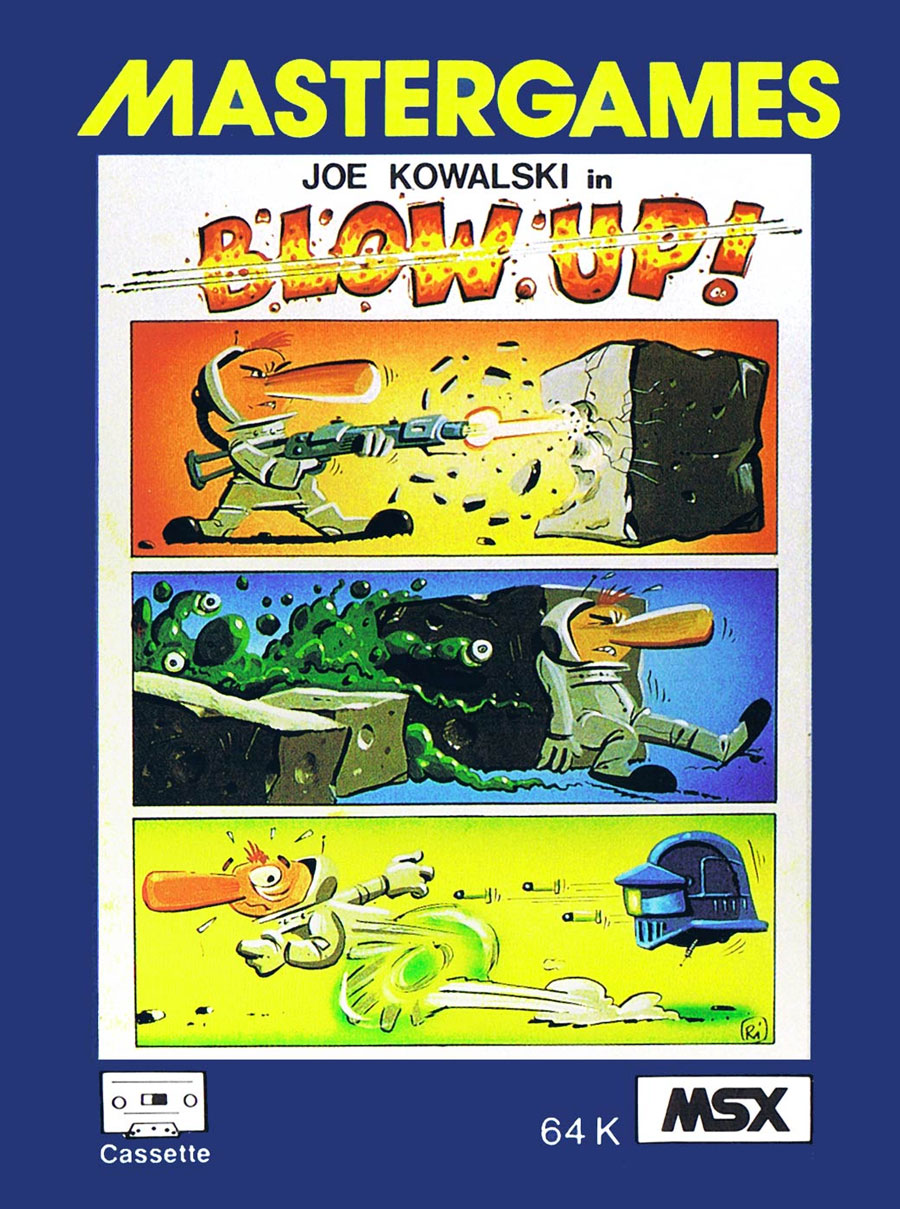
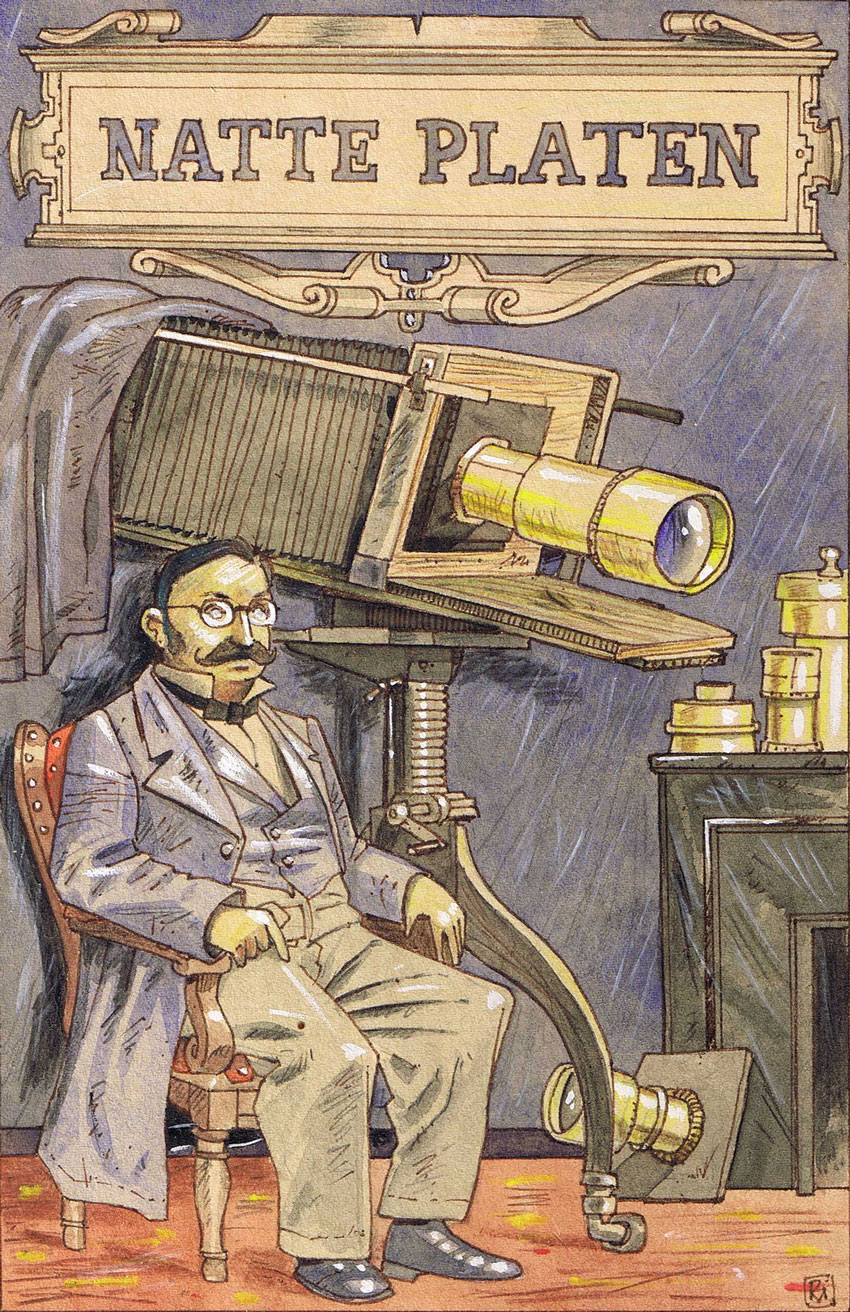
Illustration work by René Meulenbroek.
Actor
Besides his graphic arts career, Meulenbroek has also been an actor with several different theater groups. In April 2003, he appeared in 'Zonder Bijsluiter', and later in '8 Vrouwen' and 'Abigail's Party'. With the group Blikschade, he performed shows like 'Blikschade' (2004) and 'Vaste gasten' (2005).
Hal Foster Award
Despite his limited oeuvre in comics, Meulenbroek was part of one of the most influential and inspirational groups of Dutch comic creators of the 1980s. Its legacy also lives on in the so-called Hal Foster Award, a tongue-in-cheek prize created by Studio Arnhem for someone who has made himself useful in the "periphery of the comic industry". For his 1982 "Knight's Game" in Eppo magazine, Meulenbroek was the first to receive the prize, during one of Studio Arnhem's playful happenings. This challenge cup has since been awarded to artist Peter de Wit (1984), letterer Frits Jonker (2003), illustrator Pieter M. Dorrenboom (2004), graphic designer Shamrock (2005), graphic designer Vince (2007), Lambiek salesman Klaas Knol (2010), publisher Mat Schifferstein (2011), distributor Ron Poland (2012), journalist/editor Natasja van Loon (2014), editor Mara Joustra (2016), distributor/publisher Ann Jossart (2018) and graphic designer Rob Westendorp (2022).
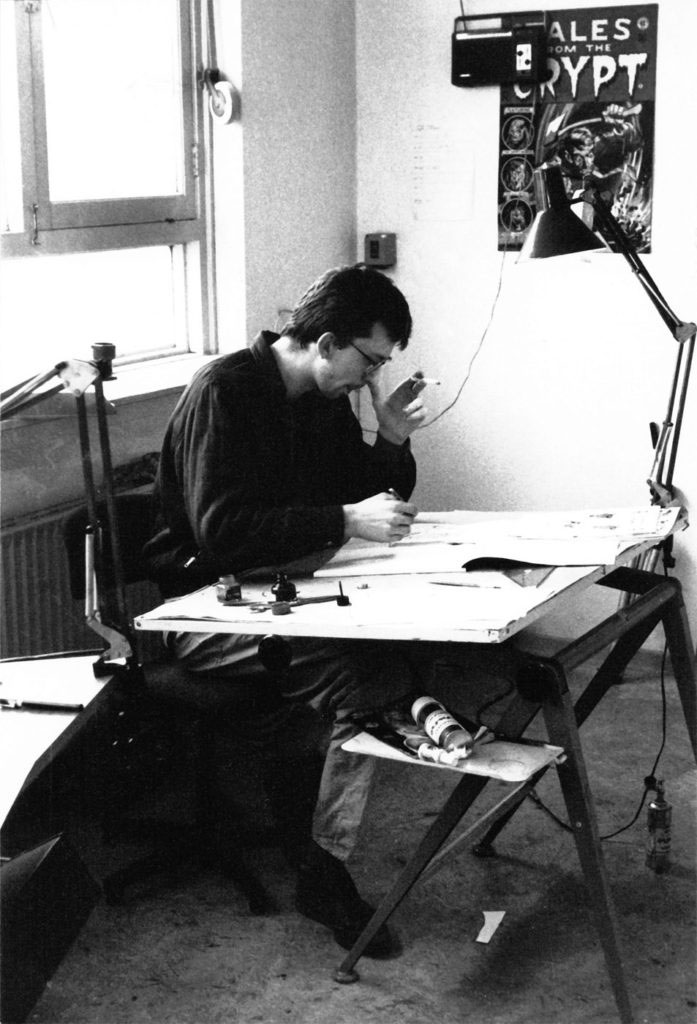
René Meulenbroek at Studio Arnhem (1980s).