


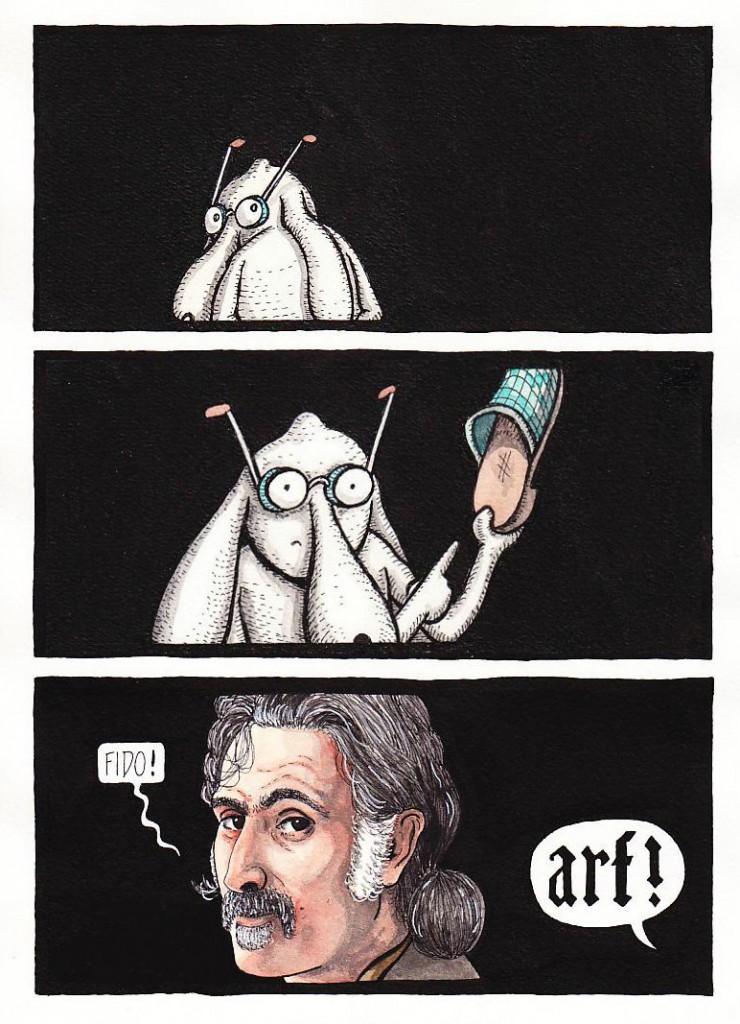
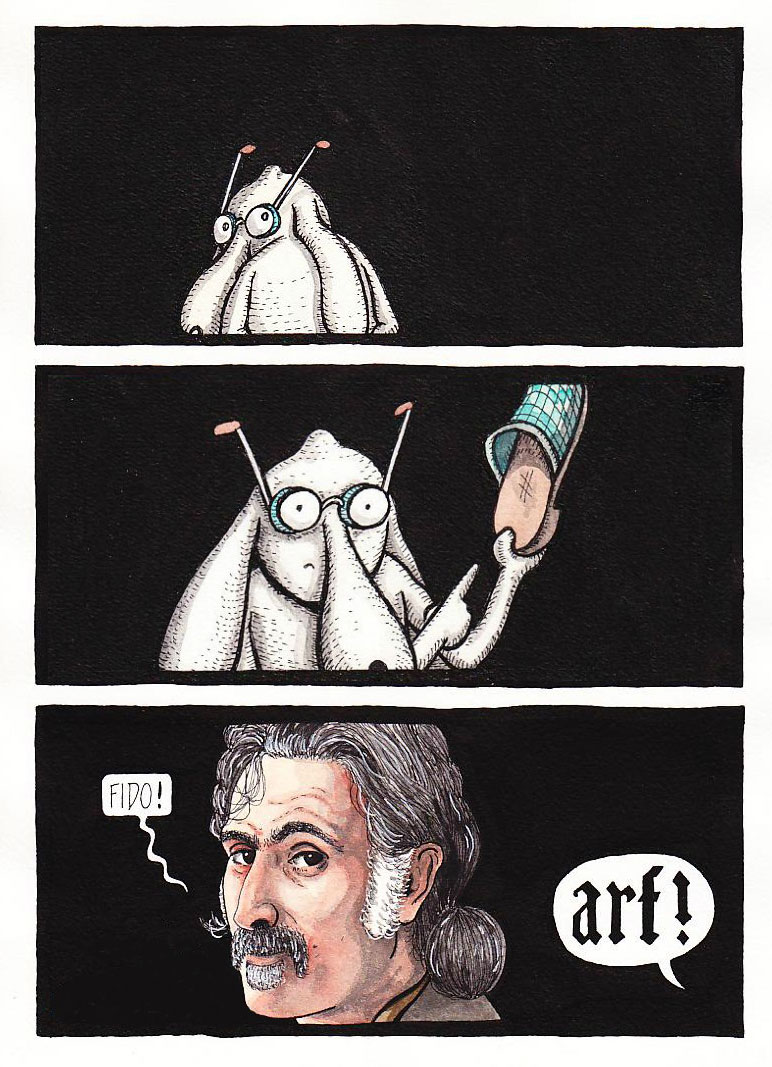
'Zappaesk' (2005). The Dog holds the slippers Frank Zappa ordered him to get (a reference to the song 'Stinkfoot'), while the dog barks 'Arf! (in reference to the song 'Evelyn, A Modified Dog'.)
Andreas Rausch is a German illustrator and writer, well-known within the German fanbase of U.S. rock composer Frank Zappa for his comic book 'Zappaesk' (2005) and, among a more global audience, his YouTube video series 'The Dog (Knows)...'. In both, he analyzes Zappa's music, while simultaneously delving into personal, humorous reinterpretations of the musician's lyrics, music and album iconography. Other comic artists who made Zappa-themed books have been Larie Cook, Nestore Del Boccio, Jean Solé, Brother A. West and Wittek.
Life and career
Andreas Rausch was born in 1963 in a little town close to Bamberg, Germany. His father worked as a mechanic for a postal service. Interviewed by Gerry Fialka (Innerviews episode #727, 29 November 2025), Rausch said that, as a boy, he was "terrible" in school and after finally graduating, he didn't really know what kind of job he wanted to do. He lived with his parents and siblings until age 28, as he had no money to move out. An avid collector of pottery herself, his mother encouraged him to become a ceramist. Rausch studied ceramics at the Staatliche Berufsachschule für Keramik, and worked in the field of ceramics for various companies from 1982 on.
By the mid-1990s, ceramics were less in demand, while new laws made it more complicated and expensive to run a pottery business. As a result, Rausch became a freelance illustrator, taking any graphic assignment he could get, from illustrating postcards, restaurant menu cards to beer bottle labels. At one point, he also made storyboards for a local German film director. Rausch's favorite illustrators are William Blake, Gustave Doré and Zappa album cover illustrators Neon Park and Cal Schenkel. His inspirational comic artists are Chester Brown, Charles Burns, Daniel Clowes, Dave Cooper, Robert Crumb, Kim Deitch, Will Eisner, Max & Dave Fleischer, Terry Gilliam, Jean Giraud, George Herriman, Satoshi Kon, Milo Manara, Alan Moore, Gary Panter, Roberto Raviola (Magnus), Gilbert Shelton, Art Spiegelman, Jim Woodring and animators Bruce Bickford, Heinz Edelmann, Ray Harryhausen and Henry Selick. He also admires the ceramist Shoji Hamada.
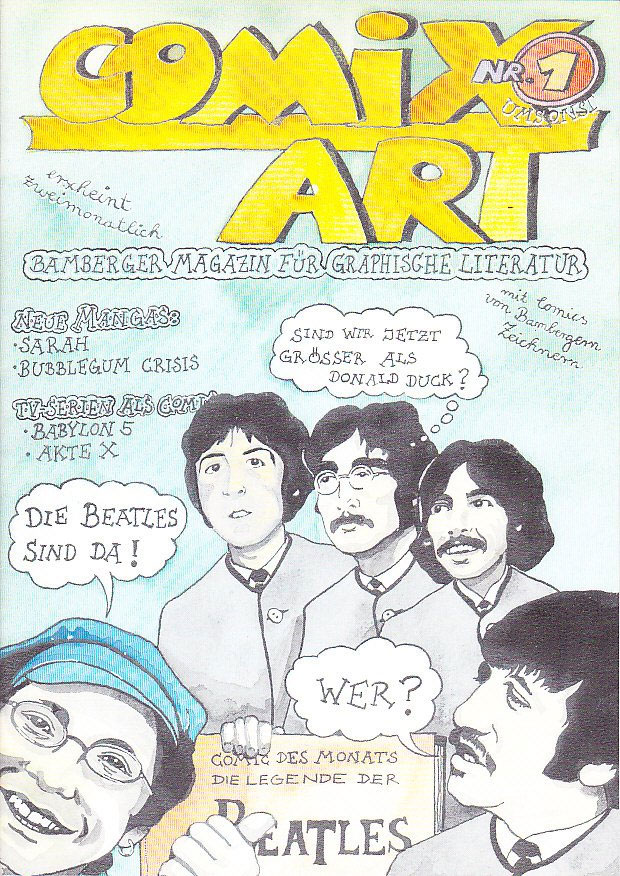
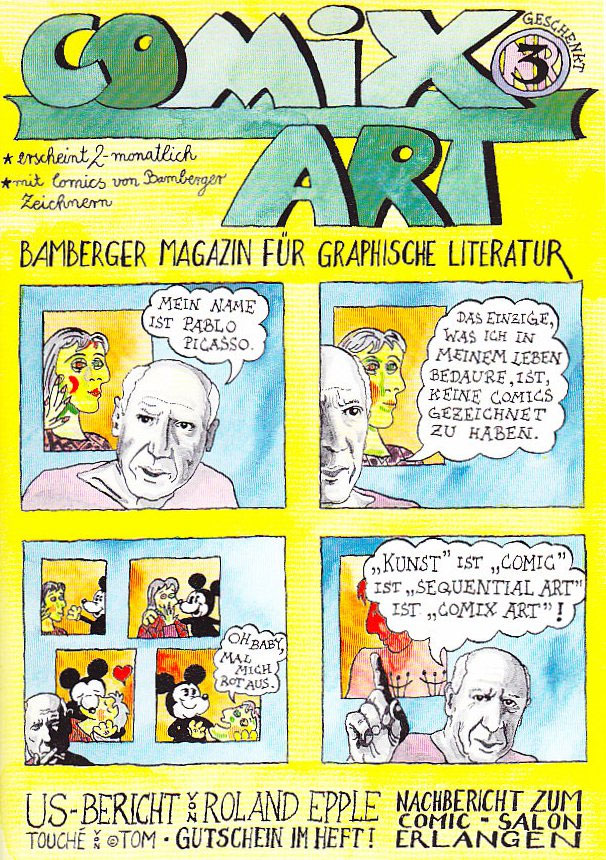
Cover illustrations for Comixart #1 and #3, depicting respectively The Beatles and Pablo Picasso.
Comics career
Between 1994 and 2009, Rausch worked for the small press underground magazine Comix Art, distributed by the Comixart comic store in Bamberg (which has an additional store in Bayreuth since 2017). He already designed postcards and promotional material for this store, while the magazine featured Rausch's comics and cartoons. Other cartoonists who appeared in its pages were Marc Buchner, Kim & Lutz, Peter Puck, Tom and Trippke.
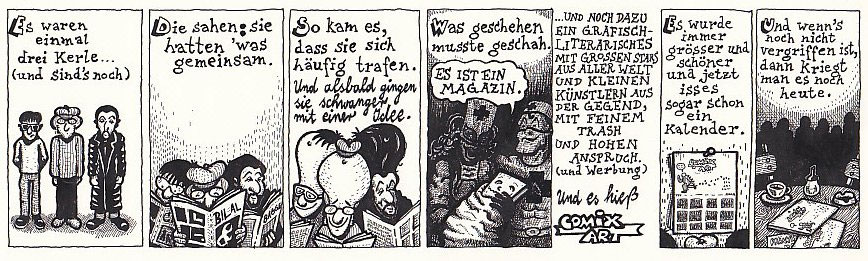
Promo strip for Comix Art.
Zappaesk
From a young age, Rausch was a huge fan of The Beatles and, after listening to 'Roxy and Elsewhere' and 'Over-Nite Sensation' at age 12, became an even bigger admirer of Frank Zappa. His teenage friends liked Zappa mostly for the bawdy comedy, but Rausch was far more intrigued by the artist's intellectualism. The sheer audacity of Zappa's eclectic music and provocative, yet also encyclopedic lyrics struck a certain chord. He started collecting his albums, which he originally bought on cassette tape. Rausch also bought any magazine or book about Zappa he could find, particularly the ones with an analytical approach to his music and persona. Through his love for Zappa, Rausch also became enamored with modern classical music, free jazz, blues, underground rock, outsider music and other counterculture media.
When Rausch became so well-versed in Zappa's life and oeuvre, friends suggested that he'd write a book about it, but Rausch went one step further and created a comic book, since Zappa's lyrics often conjure up colorful images that lend themselves well to visual interpretations. In his spare time, he worked on his book for seven years. In 2005, it was released under the title 'Zappaesk... eine Hommage an die Mutter der Erfindung: Eine frei erfundene Comicerzählung nach wahren Begebenheiten' (Ehapa Comic Collection, 2005). As the title implies, the book is an homage to Frank Zappa's life and career, but also a "fictional report based on true events."
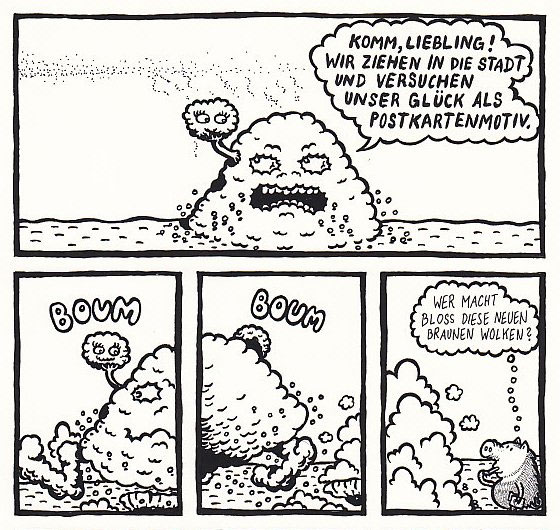
'Zappaesk'. The scene visualizes a pivotal moment from Zappa's song 'Billy the Mountain', while Greggery Peccary from 'The Adventures of Greggery Peccary' appears, wondering: "Who is making those new brown clouds?".
Part comic, part essay, 'Zappaesk' shows Rausch in full geek mode. Almost 240 pages long, it's a genuine doorstop, covering many events from Zappa's life, interweaving them with references to his lyrics, compositions, album sleeves and people important to his creative formation, like composer Edgar Varèse and comedian Lenny Bruce. The common thread throughout the book is a surreal comic. In some scenes, Zappa's strange lyrics are visualized in a straightforward manner, for instance, the ones for the songs 'Stinkfoot', 'Cheepnis' and 'Inca Roads'. In others, Rausch brings different elements together, often borrowing imagery from Zappa's album covers, particularly by the artists Neon Park and Cal Schenkel. For instance, the man who shaves himself with a weasel from the cover of 'Weasels Ripped My Flesh' turns up. When he leaves the room, his sink turns out to be the same one depicted on the cover of 'Waka/Jawaka'.
Rausch made his comic both for the fans and the uninitiated. For the latter demographic, he included a detailed appendix, explaining some of the references that might not be clear. But the book was mostly a treat for the hardcore Zappa fan, made in the spirit of his music. Just like the "king of underground rock" blended many different musical genres together, Rausch switches between literary and graphic styles.
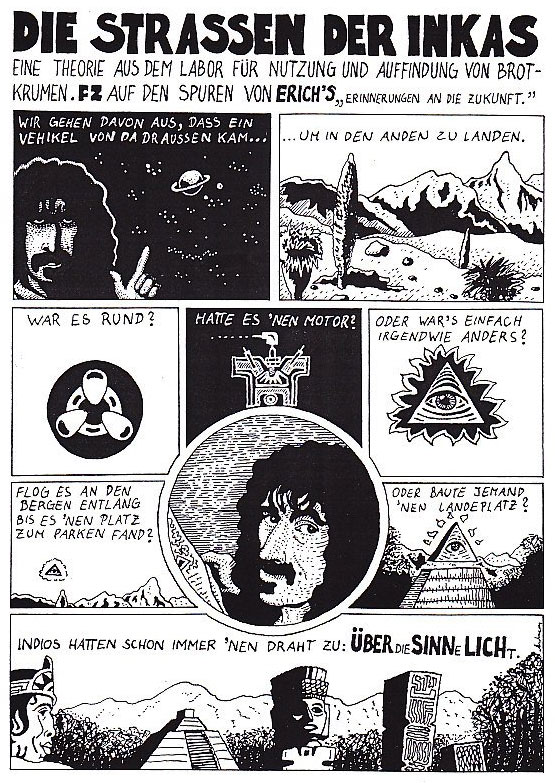
'Zappaesk'. A comic visualizing the song 'Inca Roads'.
Rausch also follows Zappa's "conceptual continuity", referring to the musician's remark that everything he ever made is part from the same overall concept, from music, album cover art, films, concerts to interview quotes. A lot of imagery, lyrical lines and musical quotes reappeared as inside jokes and running gags, for instance poodles, vegetables and the refrain of Richard Berry's 'Louie Louie'. Attentive loyal listeners might spot these little nods, which emphasize that Zappa's catalogue is very much interconnected. Interviewed by Don Menn and Matt Groening for a marathon conversation, published in a 1994 Guitar Player magazine special, Zappa revealed that he had a different vision about time than most people. To him, "everything is happening all the time, and the only reason why we think of time linearly is because we are conditioned to do it. (...) What something is depends more on when it is than anything else. You can't define something accurately until you understand when it is." Rausch constructs his comic book in the same, non-linear manner. There's no clear start, middle or end, more an eternal loop, beyond the measurements of space and time. Rausch also moved beyond Zappa's fun little universe, making associations with ancient mythology, Socrates' philosophy and the writings of William Shakespeare and Goethe.
'Zappaesk' was originally only published in German, so many of Zappa's English-language lyrics in the book are also translated into German. In 2023, Rausch translated his book into English as an e-book, reworked some of the info and added extra artwork, which he also colorized.
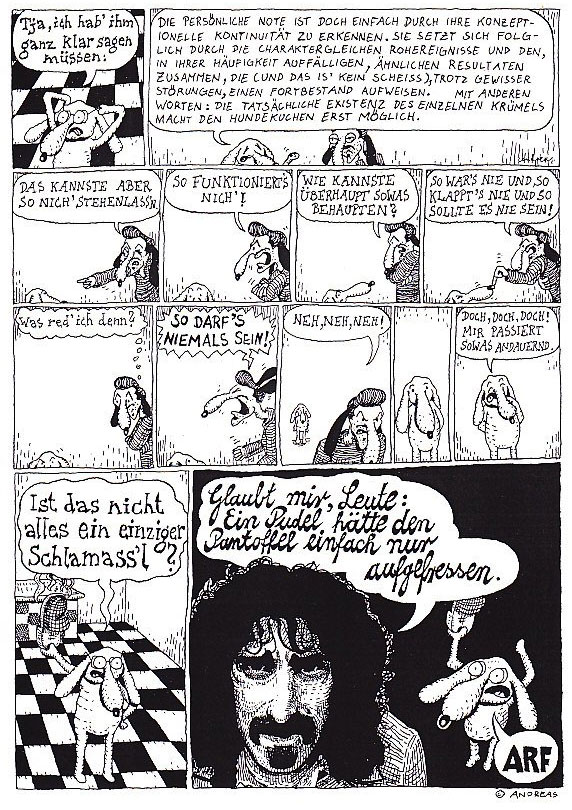
'Zappaesk'. The scene in the center features one of the dog musicians from Zappa's album cover 'Cruisin' With Ruben and the Jets' (designed by Cal Schenkel) reciting the dialogue between Zappa and Fido the poodle from the song 'Stinkfoot'.
The Dog (Knows)
In 2011, Rausch established his own YouTube channel. In mid-2025, he made himself more noticeable when he started posting a weekly vlog series featuring essays about Frank Zappa. The series has no official title, but is sometimes referred to as 'The Dog (Knows)', after the anthropomorphic dog with glasses featured in each episode. Its design is partially based on Cal Schenkel's dog-nosed characters and Rausch's own dog character from 'Zappaesk'. Dogs are incidentally also recurring elements in Zappa's music.
Just like Rausch's book 'Zappaesk', the videos have a stream-of-consciousness approach. In each video, Rausch picks out a general theme or question, but goes back and forth between topics, pointing out interesting possible connections and references within Zappa's music, album cover art, his life events and the times he lived in. The narration is accompanied by rudimentary stop-motion animation and video collages. At the same time, despite the serious discussion, the videos have a tongue-in-cheek element, since the viewer is, in essence, watching a goofy-looking dog talking in a semi-ironic, refined British voice. The dog's voice is the only element made with artificial intelligence, but Rausch has announced that he is planning on finding a better vocal solution.
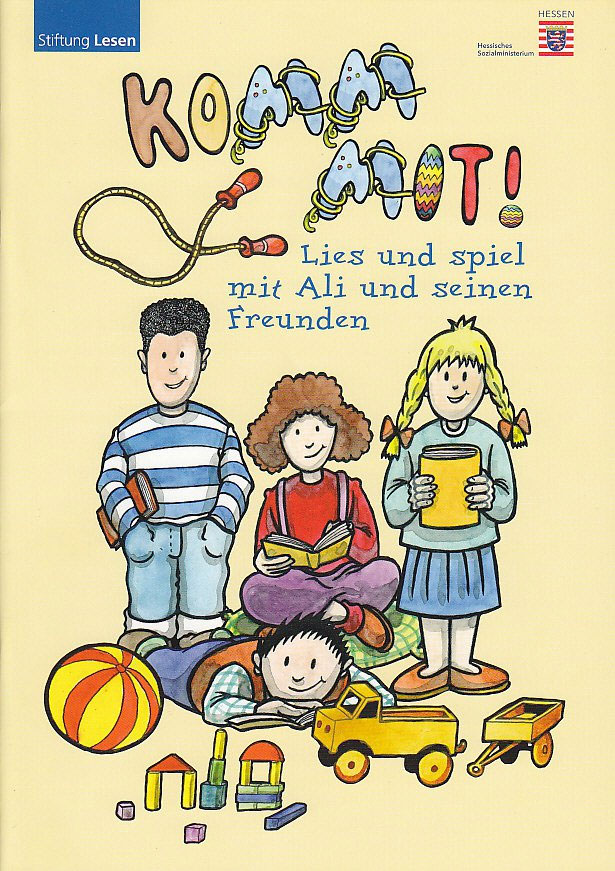
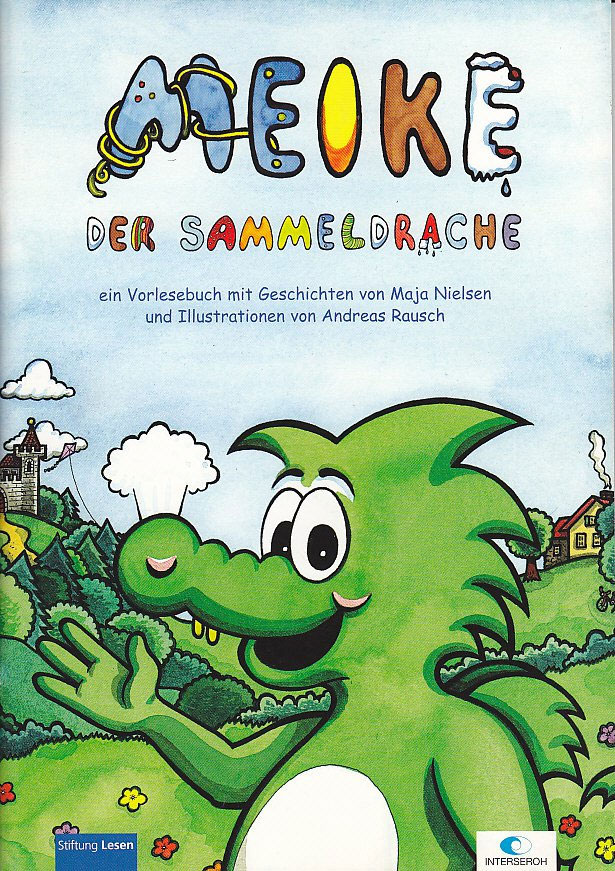
Cover illustrations by Andreas Rausch for 'Komm Mit!' and 'Meike, Der Sammeldrache'.
Graphic contributions
In 2004, Andreas Rausch illustrated Maja Nielsen's children's book 'Meike, Der Sammeldrache' (Plugin Mediendesign, Uelversheim, 2004). In 2008, Rausch contributed to the volume 'Ombinus: Madness' (Boom! Entertainment, 2011) in the series 'Cthulhu Tales' (Boom! Entertainment, 2011). The comics are based on the mythical colossal monster Cthulhu from H.P. Lovecraft's horror stories. In 2022, Rausch designed the cover of 'Workdogs', a musical album by Workdogs in Hell. For the group's lead singer, Robert Kennedy, Rausch also livened up his book 'The Comedie of Robert Kennedy' with illustrations.
In addition, Andreas Rausch has been active in collage art and animation.
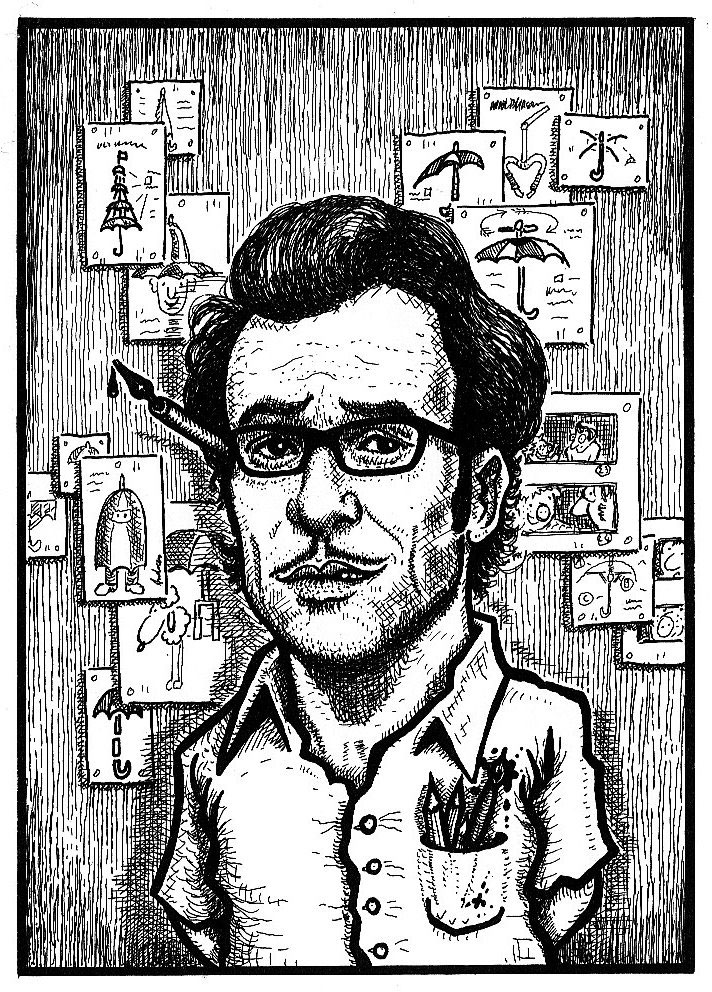
Self-portrait.