


'De Avonturen van Prik en Prak'.
Joop Geesink was one of the major players in the Dutch post-World War II entertainment industry. Early in his career, he was a set designer for prominent stage shows, and created comics like 'Prik en Prak' for Doe Mee! magazine (1941), and later the first set of 'Fokkie Flink' booklets' (1945). From 1942 on, Geesink's talent truly came to blossom as the head of a successful studio for stop-motion animated films. From the 1950s through the 1970s, his Dollywood company produced groundbreaking puppet films for clients like Philips, and developed popular and iconic characters such as 'Dutchy', 'Rick de Kikker', 'Dusty de Mooimaker' and, most notably, 'Loeki de Leeuw' ('Loeki the Lion').
Early life and career
Johan Louis Geesink was born in 1913 in The Hague as the third son in a family with six children. His father Willem Jacobus Geesink (1878-1942) was a trumpet player in the Royal Military Band and in the evenings a cellist at the local Princesse Theatre. At high school, he spent most of his time drawing, so after two years, the teachers advised him that he'd better go and find a job. In the 2012 documentary 'De Duivendrechtse Disney', Joop Geesink's daughter Louise mentioned her father had his first job as a cabin boy on an ocean liner to Australia. During his short stint as a bellboy in the Hotel Des Indes in The Hague, the stylish red uniform fuelled Geesink's sense for show and glamour. Interviewed by Simon van Collem for Dutch television in 1983, Geesink said he later had a job as an office boy, using his bravado to work his way up to assistant of the accountant. As it turned out, his talent for this profession was non-existent, and the firm's financial administration turned into a mess. However, the young man used to scribble away on the covers of the accounting folders, leading him to consider a career in arts.
At age nineteen, Joop Geesink teamed up with his oldest brother Wim (1908-1992), who was an accountant, to begin a firm for painting posters and façade advertisements, working mostly for cinemas. In the same Van Collem interview, Geesink mentioned that during this period he briefly attended the Art Academy in The Hague, but quickly left because he saw himself as a practical guy, averse to the artistic pretensions of his teachers.
After a while, the young entrepreneurs also received assignments for the decoration of cinemas, dance halls and theaters, such as Scala in The Hague. In 1935, Geesink was hired to create promotional billboards for the humorous cabaret shows of Dutch comedian Lou Bandy, at the time the biggest star of the Rob Peters Nationale Revue shows. This resulted in jobs for designing stage sets and costumes for new Bandy shows, for instance for 'Schep Vreugde in het Leven' (1937) and 'Lach Iederen Dag' (1938). In reviews, Geesink's sets were regularly praised for their cartoony playfulness and modern approach to colors and linework. His characters revealed influences from the American cartoon shorts from the Disney Studios.
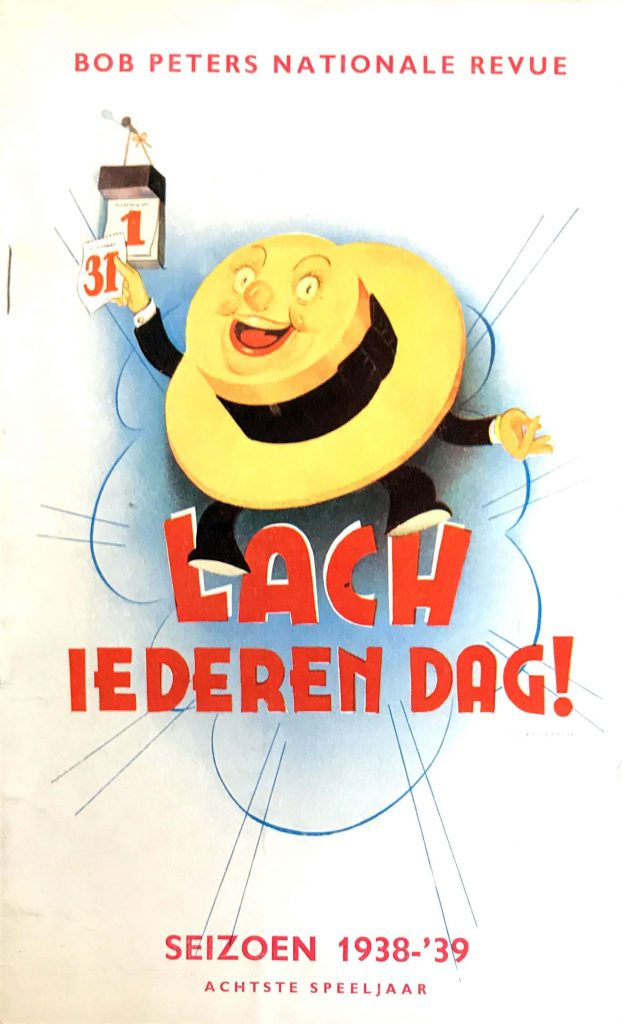
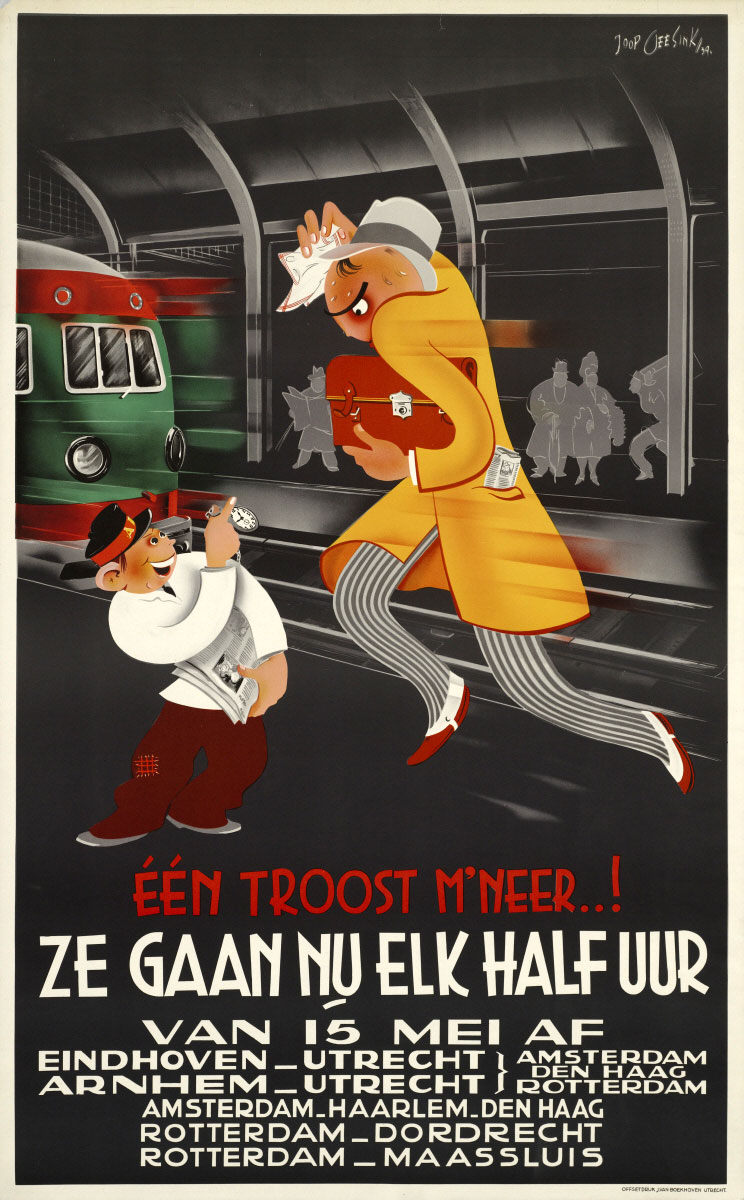
1938 posters by Joop Geesink for a Lou Bandy show and the Dutch Railways.
After a while, Geesink headed for Paris, where until 1939 he worked for the renowned international costume and set design firm Wendy, known for its work for the 'Folies Bergère' shows in Paris and London. According to newspaper reports, the French experience made Geesink a man of the world, with a cosmopolitan flamboyance he maintained for the rest of his career. Back in the Netherlands, Geesink began his own studio at the Singel in Amsterdam, and was hired by producer René Sleeswijk to design sets for the comedy duo 'Snip en Snap', an association he held until their 1942-1943 show. In addition, he lent his services to the young Dutch film industry, creating sets for the 1939 thriller film 'De Spooktrein', starring Fien de la Mar. Starting in 1938, Geesink also worked regularly for the Dutch Railways, creating informational posters. On the occasion of the centennial of railways in the Netherlands, Geesink designed the sets for the 1939 'Spoorwegrevue' stage show in Utrecht.

Illustration for Doe Mee.
Comics and illustrations
In the late 1930s, Joop Geesink was also contributing illustrations to the tabloid-sized Dutch comic magazine Doe Mee, a juvenile publication of the newspaper Algemeen Handelsblad. While the magazine originally ran translated American newspaper comics, the early years of World War II ushered in a period of mostly local comic artists, among which Auke Tadema, Marten Toonder and Pax Steen. In 1941, Geesink drew the humor comic 'De Avonturen van Prik en Prak', about two mischievous boys whose sole purpose in life seems to be pranking the local police officer Krelis Snor. In the 1939-1940 period, he also drew cartoony postcards with military humor for the publisher EMNA, as well as illustrations for sheet music of popular songs.
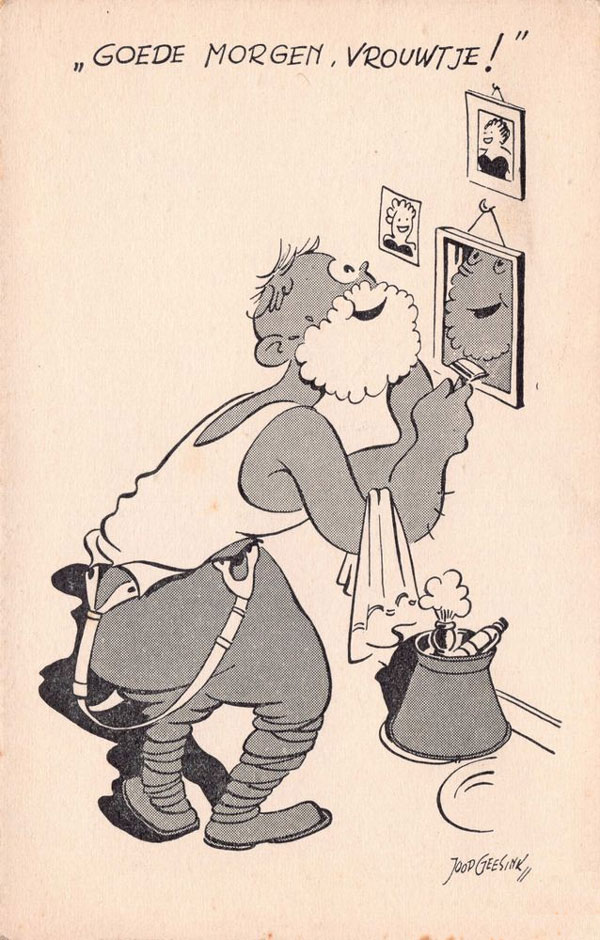
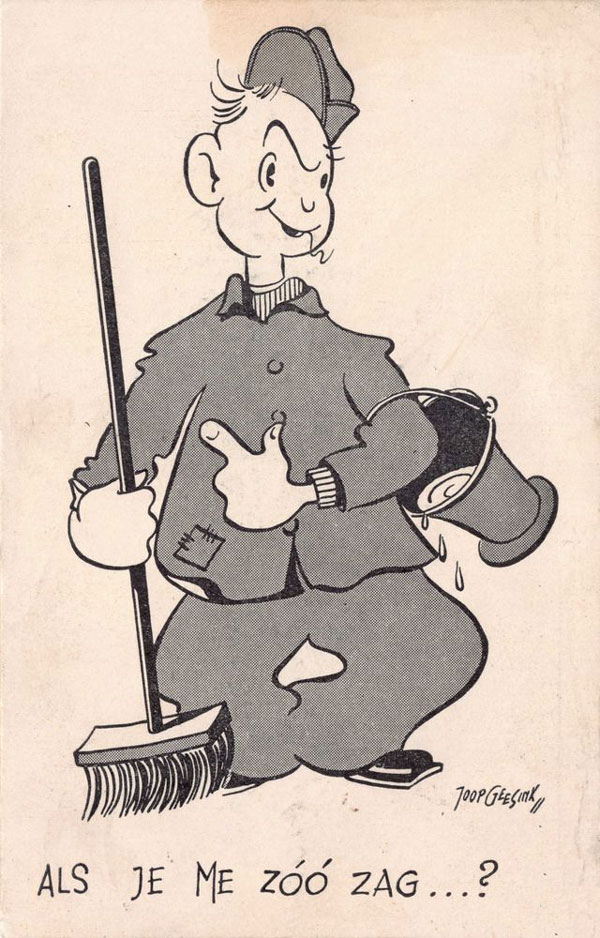
Military humor for the "Soldier Series" of postcard publisher EMNA (1939-1940).
For the Dutch novelist A.D. Hildebrand (famous for the children's book series 'Bolke de Beer'), Geesink created the fairy tale picture book 'De Reuzen Belfloor en Bonnevu in het Land van Koning Kaskoeskilewan' (Van Holkema & Warendorf, 1941). While staying with King Kaskoeskilewan and his jester Krokeledokus, the good-natured giants Belfloor and Bonnevu unintentionally prove to be difficult guests. For breakfast, they eat six meters of bread, three hundred eggs, a few barrels of butter, and three tubs of milk for breakfast - and when Belfloor laughs, the goldfish bowl in the throne room wobbles. It was the second installment in the book series about the two gentle giants, the first (1936) and third (1941) volumes had artwork by George van Raemdonck.
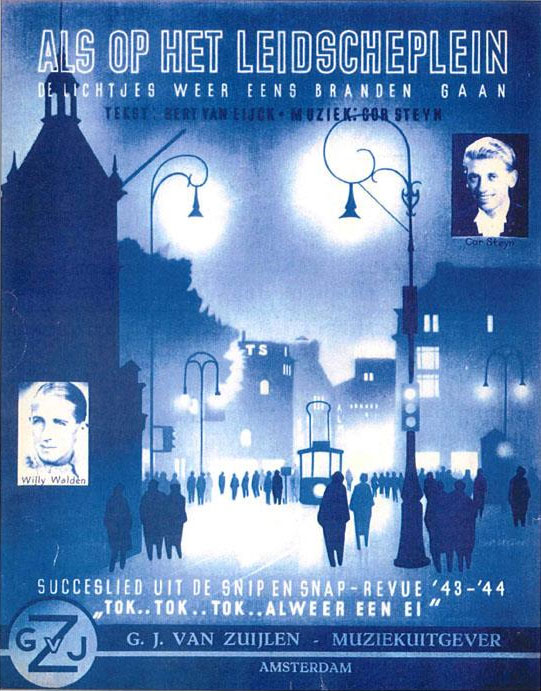
Sheet music for the Snip & Snap song 'Als Op Het Leidscheplein De Lichtjes Weer Eens Branden Gaan'.
Switch to animation
In 1942, Joop Geesink ventured into animation, following an assignment from one of his regular customers, the Dutch Railways. In March 1942, he started his firm Joop Geesink Filmproducties at 15 Reestraat, assembling a team of about fifteen co-workers. Among his earliest employees were director Lou den Hartogh and the artists Henk Kabos, Geertje Knoef, Frans van Lamsweerde, John van der Meulen, Mary Oosterdijk, Carol Voges and Henk Zwart. They initially worked in Geesink's house apartment at 22 Vijzelstraat in Amsterdam, beginning production on their promo film for the Railways. However, Geesink lacked experience and professional material, so by June of that year, he joined forces with Marten Toonder and his business partner Jan Bouman, who had just begun an animation studio at the Keizersgracht with employees like Jan Scheffer, Wim Lensen and Cees van de Weert. Leaving his day job as manager of the Cineac Damrak cinema, Geesink's brother Wim became the new firm's chief of staff and finances. The newly founded "Geesink-Toonder Teekenfilmproducties" expanded and attracted new employees like Henk Albers, Albert van Beek, Wim Bijmoer, Wim Bodewes, Wim Boost, Jan Dirk van Exter, Piet Gertenaar, Richard Klokkers, James Ringrose and Henk Sprenger, while moving into a larger building at 230-232 Nieuwezijds Voorburgwal.
During the Nazi occupation of the Netherlands, both Joop Geesink and Marten Toonder registered with the Nederlandsche Kultuurkamer, a Nazi-controlled institution that supervised all cultural and artistic productions in the Netherlands. Without registration, artists, architects, writers, journalists, musicians, film actors and stage performers were no longer allowed to work in their profession. While many artists refused to work under Nazi control, artists who did register were generally penalized or at least criticized for doing so after the war. Especially for Marten Toonder, this choice has remained a topic of controversy. However, by registering with the Kultuurkamer, Geesink and Toonder could continue their animation firm, safeguarding their 100 employees from deportation to Germany for the forced labor program. According to Geesink biographer Tjitte de Vries (Het Vrije Volk, 8 September 1984), Geesink had an intense hatred for the Nazis. Not necessarily out of political conviction, but mostly because his personality made him unwilling to tolerate any authority above him.
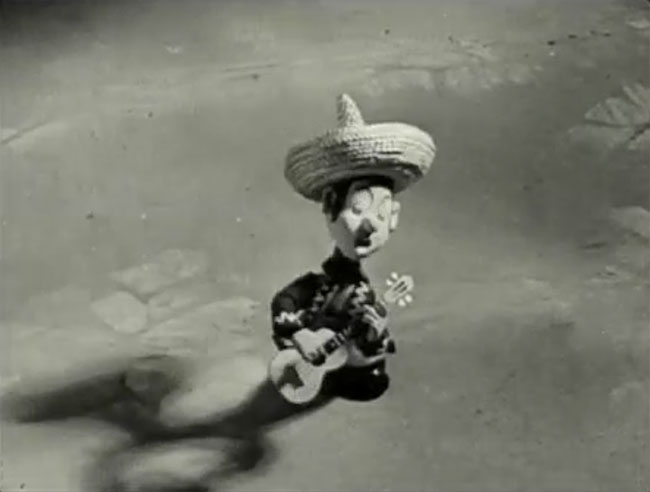
From: 'Serenata Nocturna' (1942).
Geesink-Toonder productions
While the Toonder team had already begun on an animated feature film starring Marten Toonder's signature character 'Tom Puss', Geesink brought in his Dutch Railways assignment. This short film, known as 'Pierus in de Contramine' or 'Pierus Peddelaar Dérailleert', was about a man inconveniently walking against the flow of passengers on a crowded train. The message was that passengers should board at the front and disembark at the back of crowded trains. The film was shown in cinemas during the war years, but is nowadays lost. New orders for advertising films followed, including ones from Peja baking powder ('Mina Bakgraag'), Andrélon shampoo and the Boffie coffee brand of Albert Heijn grocery stores.
One day, co-worker Jan "Dopey" Scheffer came with the suggestion of making animated puppet films. Before the war, the Netherlands-based Hungarian film producer George Pál had pioneered these types of films, only with the labor-intense procedure of creating a new puppet for every frame of a movement. At Geesink-Toonder, Scheffer developed a new technique of plaster masks that could be interchanged on the character's faces. Coming from the world of theater, Joop Geesink was instantly captivated. And so was Sies Numan, advertising manager for Philips, who ordered a promotional film for their radios from the studios. In the end result, 'Serenata Nocturna' (1942), a Mexican man tries to seduce a woman with a serenade on her balcony. Nothing works, until a Philips radio provides the solution. Also for Philips, was the team's second puppet film, 'Phi-Garo in het Woud' (1943), promoting the Philishave.
Post-Toonder years
After about a year, the Geesink-Toonder team-up fell apart, due to a clash of personalities and ambitions between Joop Geesink and Marten Toonder. While Toonder wanted to make hand-drawn animated films, Geesink had become captivated by stop-motion and puppet films. To him, these types of films were more glamorous than 2D animation, and also allowed him to continue his initial work as a set designer. Character-wise, Toonder was quiet and inward, and Geesink a jovial extravert and showman, nicknamed "the Bulldozer". In March 1943, the joint venture was dissolved, with Toonder's part of the firm continuing as Toonder-Bouman Filmproducties, while Geesink found his niche in the world of puppets. A gentleman's agreement was made that the two former business partners would avoid stepping on to each other's territory as much as possible. Joop and Wim Geesink relocated to a new studio at the Amsterdam Beursstraat, taking with them the studio members Jan Scheffer, Jaap Pronk, Corrie Hazendonk, Jan Woldering and Wil van der Pol.
In 1944, Marten Toonder used his experiences with Joop and Wim Geesink as inspiration for his comic story 'Tom Poes en De Superfilmonderneming' (1944), in which Tom Poes and Bommel get involved in movie production. The looks of the shady businessman Bul Super were largely based on Joop Geesink.

Cover illustration for Okido #5, 30 January 1943.
Fokkie Flink
During the remainder of the Nazi occupation, the animation industry had a severe shortage of production material, so Geesink largely returned to his old business, designing sets for stage shows. In late 1942, he also tried his luck in toy manufacturing, as was highlighted on a spread in Okido magazine on 9 December 1942. For that same magazine, Geesink provided the 30 January 1943 cover illustration. Near the end of the war, he also returned to creating comics and picture stories. For publisher De Boekerij in Schiedam, he made the picture books 'In het Rijk van Koning Leeuw' (De Boekerij, 1944) and 'Bolletje Dam' (1946), both with texts in rhyme by Henk de Wolf.
In early 1945, he also returned to comics, creating the text comic series 'Uit het Veelbewogen Leven van Fokkie Flink, de Groote Speurder' ("From the Eventful Life of Fokkie Flink, the Great Detective"), again with Henk de Wolf as writer. Each story was released in ten weekly installments of 8 strips each, printed in landscape-format booklets by the Bureau of Administration in Amsterdam. Coming with a letter of recommendation by Dr. C.R. van Paassen, headmaster of the Barlaeus Gymnasium in Amsterdam, the young readers were encouraged to subscribe to the booklets and become a member of the Fokkie Flink Club. This club organized excursions and prize riddles, as well as coloring and drawing contests. Appearing shortly after the Dutch Hungerwinter famine, the publisher said the profits would be used to provide warm meals for poor children. Upon its launch, the 'Fokkie Flink' series was compared to the pre-war Doe Mee! magazine, which came with a Popeye Club.
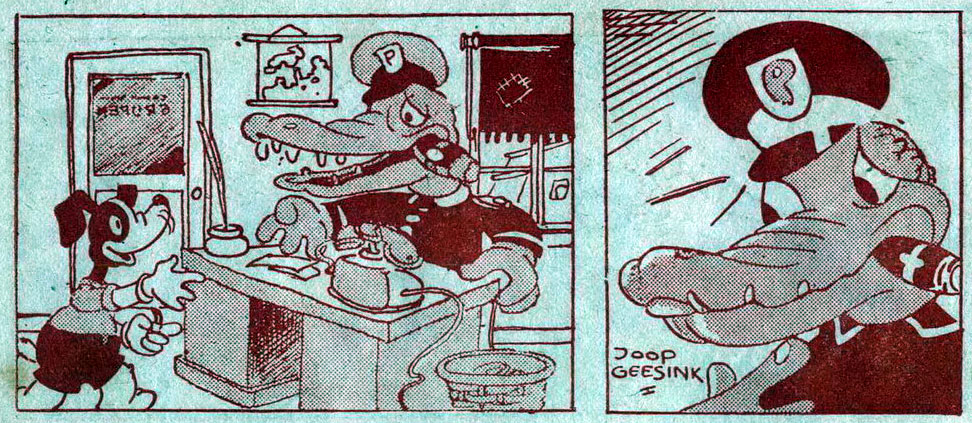
'Uit het Veelbewogen Leven van Fokkie Flink, de Groote Speurder' (1945).
However, the booklets did not go without criticism. On 28 March 1945, the regional newspaper Dagblad voor Leiden en Omstreken denounced the high subscription money of 7.50 guilders every three months (or 30 guilders a year), and also expressed dissatisfaction with writer De Wolf's spelling mistakes. On 15 April 1945, the student paper Onder de Loupe had researched the makers, and slammed Geesink for having worked on German films and propaganda store facades for the Wehrmacht, and De Wolf for collaborating on Nazi-supervised radio shows. Nonetheless, six series with adventures of the funny animal detective dog were published. Geesink was responsible for drawing the first story, 'De Mannen van het Geheimzinnige Kasteel' (1945), and part of the second, 'Heliopolis, de Verdwenen Stad' (1945), after which Henk Zwart took over the drawing pencil until 1946.
Shortly after the Liberation of the Netherlands, the Dutch Purification Commission banned Geesink from working on any film productions for a period of one year, a result of his registration with the Kultuurkammer. Instead, Geesink returned to doing decoration work. In Brussels, Geesink and his friend Bertus Outmayer developed decorations for the American Leave Center, a recreational facility for US military during downtime. By May 1946, Geesink was back in the Netherlands, resuming his work in the field of stop motion animation.
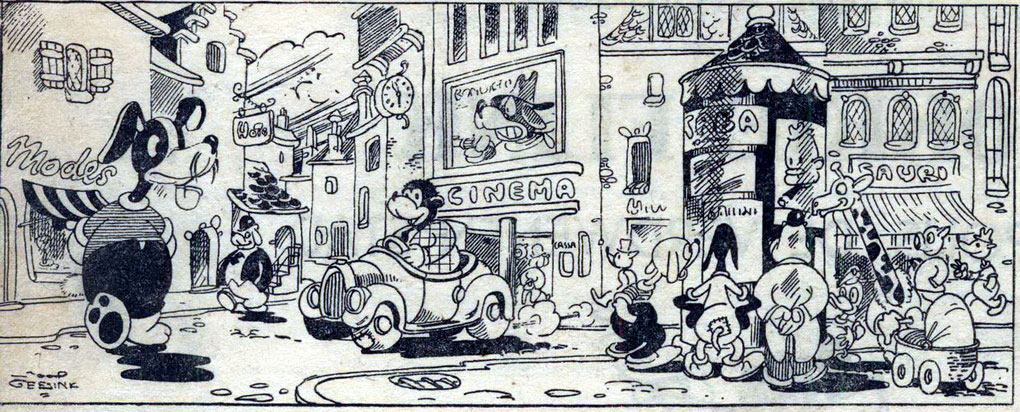
Start of the second 'Fokkie Flink' story. Along the way, Henk Zwart will take over.
Dollywood BV
Geesink's first post-war production was 'The Big Four in Conference' (1946), a three-minute film in which the leaders of the four major powers come together to agree on the fact that Van Nelle tea is the best there is. Other early clients were Honig, Bols gin, Persil detergent and the Dutch National Recovery Foundation, for which Geesink produced the 1946 short about the always complaining 'Mijnheer Jansen', written by Toon Hermans. A renewed association with Sies Numan of Philips quickly established Geesink as a market leader. As he discovered that foreign clients couldn't pronounce his name correctly, Joop Geesink named his new studio Dollywood BV, a name registered in 1947. Like before, his brother Wim Geesink was in charge of the firm's business management. As the company expanded quickly, Dollywood relocated to the more spacious lots behind the Cinetone Studio in Amsterdam-Duivendrecht, resulting in Joop Geesink's nickname "The Disney of Duivendrecht". In the previously mentioned 2012 documentary film, former co-workers described the new studio complex as a cosy mishmash, with several barracks, interconnected with corridors, lofts, studios and offices criss-crossing each other.
Among Geesink's earliest puppet makers were Bertus Outmayer, Jan Duyfvetter and Wil van der Poll. The main soundtrack composer was Hugo de Groot. By 1949, Marten Toonder's studio cancelled many of its commercial film activities, resulting in staff to cross-over. Notable transfers were Henk Kabos, who became Dollywood's longtime art director, cartoonist Mary Oosterdijk, and Han van Gelder, who did special effects.
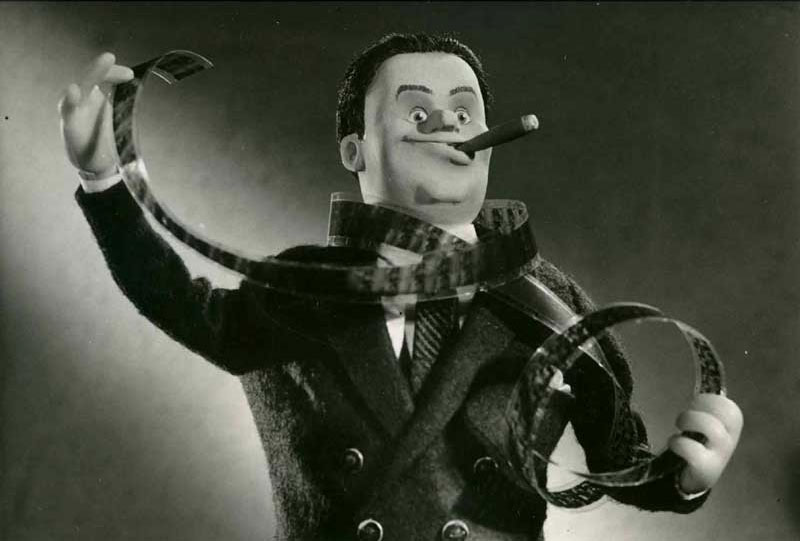
Puppet version of Joop Geesink.
When in 1951 the major British puppet film studio Signal Film closed down, Dollywood was able to recruit several of its staff, including former co-workers from animation pioneer George Pál. Among them were the designer Jan Coolen and animator József Misik, as well as Geesink's own former team member Jan "Dopey" Scheffer. From Signal, the team brought along a new technique of operating puppets for stop motion animation. With copper wires in plastic arms and legs, the team could mold characters in new poses much easier, resulting in a higher production speed. Eventually, the Dollywood Studio's had over 150 employees, further including producer Bert Kroon, art director Max Keuris, scriptwriter Harrie Geelen, puppetmaker Harry Tolsma, animator Cor Icke, props producers Theo Doreleijer and Ton Foederer, and costume designer Lya Sten. Other artists and writers with shorter or longer stints at Dollywood were Piet de Groot, Lo Hartog van Banda, Georges Mazure and Koos Schadée. Active for the studio's comic strip department were Frits Kloezeman, Jan van Haasteren and Ton Beek.

'Flip en Flap'
Comics and picture books
Even though it wasn't their prime focus, Geesink's Dollywood Studios also remained active in print media, producing comics and picture books for advertising purposes. For the coffee brand Douwe Egberts, Joop Geesink and writer Han Hoekstra made four collectable sticker books starring the two dogs 'Flip en Flap' (1950-1951). Years earlier, in 1930, these characters had already appeared in a couple of similar books by Daan Hoeksema. Also for Douwe Egberts, Hoekstra and Geesink collaborated on pop-up books based on the fairy tales 'Little Red Riding Hood' (1958) and 'Cinderella' (1959). In 1953, the Dollywood studios released several landscape-format picture booklets with 'Pukkie Planta' (1953) for Planta margarine (Unilever). Written by Johan Veeninga, the booklets were illustrated with stills from Dollywood's 'Pukkie Planta' films, with additional artwork by Henk Kabos. Also in 1953, the Dollywood team made a 60-episode picture story about 'Piet Spriet en Ko de Koe', which appeared on the labels of Friesche Vlag coffee milk bottles.
In 1973, Joop Geesink's Artists produced the illustrated educational book 'Zij Maakten Geschiedenis' (Deltos Elsevier, 1973). Based on the section of the same name in the TV show 'NOS-Kiosk', the chapters contained comical anecdotes about Dutch history, written by Eli Asser and Patty Klein, and with illustrations by Frits Kloezeman and Jan van Haasteren.
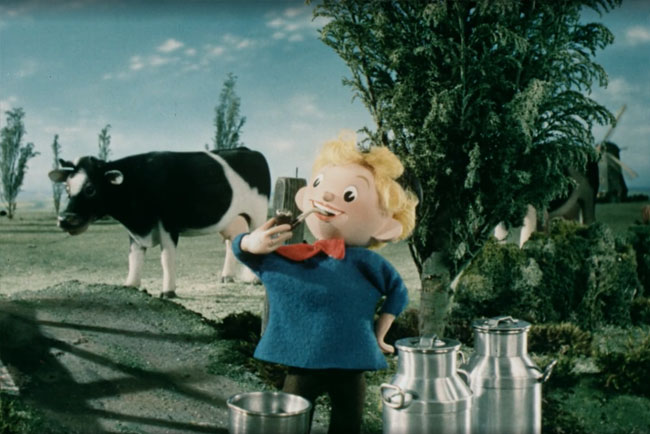
'Dutchy'.
Pioneering puppet animations
During the 1950s and 1960s, the Dollywood studios acquired assignment after assignment, and constantly upped the level of puppet animation. Among their clientele were companies and brands like Heinz, Campari, Ballantine, Mackeson, Otto Versand, Pril, Pré, Knorr, Peter Stuyvesant, North State, Goebel, Coca-Cola and Heineken. However, their most important client remained Philips, who often ordered promotional advertising films up to ten minutes long. This resulted in innovating productions like 'Kermesse Fantastique' (1951), 'Light And Mankind' (1954), 'Het Verhaal Met De Baard' (1958), 'Piccolo', 'Saxo & Company' (1960) and 'Philips Cavalcade: 75 Years Of Music' (1966). In the Philips film 'The Travelling Tune' (1962), the studio pioneered animation with figures made of paper. For their eight ten-minute advertising films for the Dutch Dairy Company (Nederlands Zuivelbureau), Geesink created the mascot character of Dutchy, a stereotypically Dutch farmer man, with traditional costume and clogs. With the rise of TV advertisements, the studio specialized in short films of 20-60 seconds, working for clients from the United States, Germany, Great Britain, Italy, the Middle East and other countries. A key player in a distinctive and original field, Geesink's company won around 80 international film awards for their puppet films. At the start of TV advertising in the Netherlands in 1967, the Geesink team was responsible for no less than 12 of the 38 advertising spots.
Starfilm
As the company mostly worked for international clients, Geesink opened agencies in two of his major sales markets, Germany and Italy. During the 1950s, Geesink and his team also began producing live-action documentaries, advertising spots and instruction films, for which in 1955 the separate division Starfilm was established. In addition to commercial assignments, Starfilm was also the production company behind the feature film 'Het Wonderlijke Leven van Willem Parel' (1955), a film directed by Gerard Rutten and based on the popular comedy character Willem Parel, played by Dutch comedian Wim Sonneveld. However, the film was a commercial flop. According to former Dollywood employees in the 'De Duivendrechtse Disney' documentary, there was always much competition between the live-action and puppet animation teams, with both feeling disdain for the work of the other.
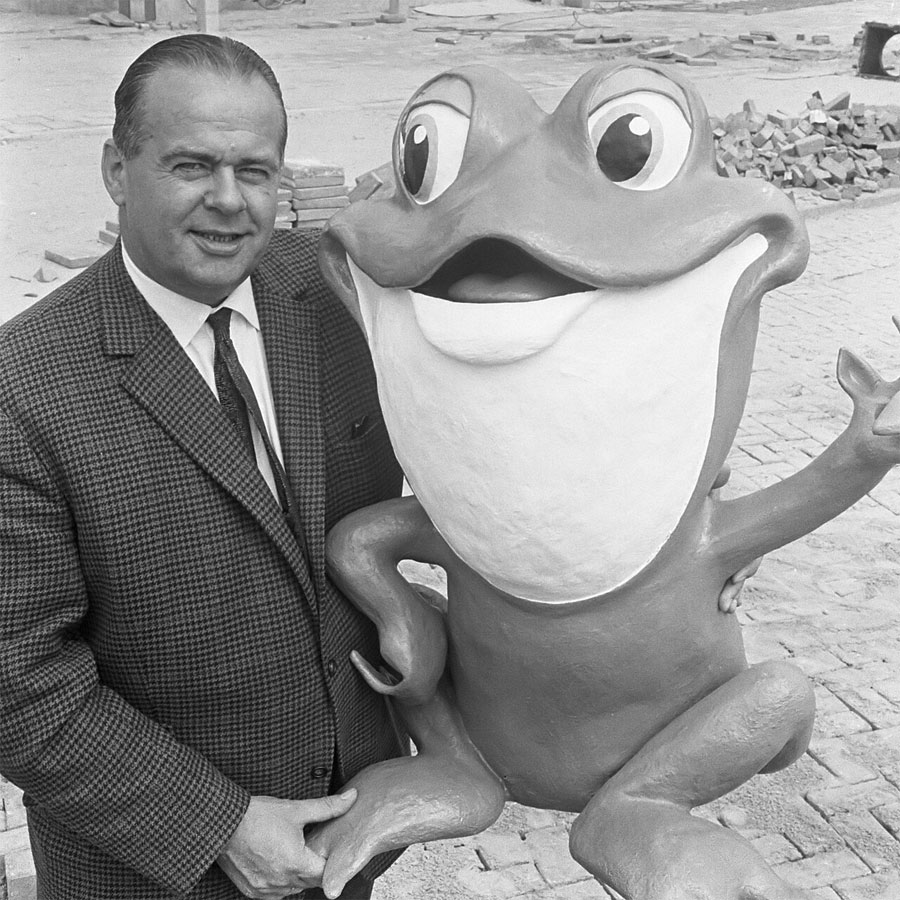
Joop Geesink with Rick de Kikker (1966).
Rick de Kikker
In addition to commissioned films, Geesink's Dollywood also developed an original series for public television. Between 7 October 1967 and 28 December 1968, 18 episodes of their puppet series 'Rick de Kikker' were broadcast by the brand new TV network TROS. A series for toddlers, the adventures about a happy-go-lucky frog were heavily merchandized by Geesink, who hoped to compete with popular international TV puppet series like 'Thunderbirds'. The studio released puzzles, key rings, handkerchiefs, figurines and postcards with the character. Prior to the TV series, in 1966 and 1967, the character appeared in a series of comics in Heintje, the comic paper of supermarket chain Albert Heijn, and later also in the newspaper De Telegraaf. Production of the comic was overseen by Frits Kloezeman, who also penciled the backgrounds, while the characters were drawn by Jan van Haasteren and the inking was done by Ton Beek.
There is no relation between Geesink's 'Rick de Kikker' and the frog mascot of the same name of amusement park Duinrell in Wassenaar.
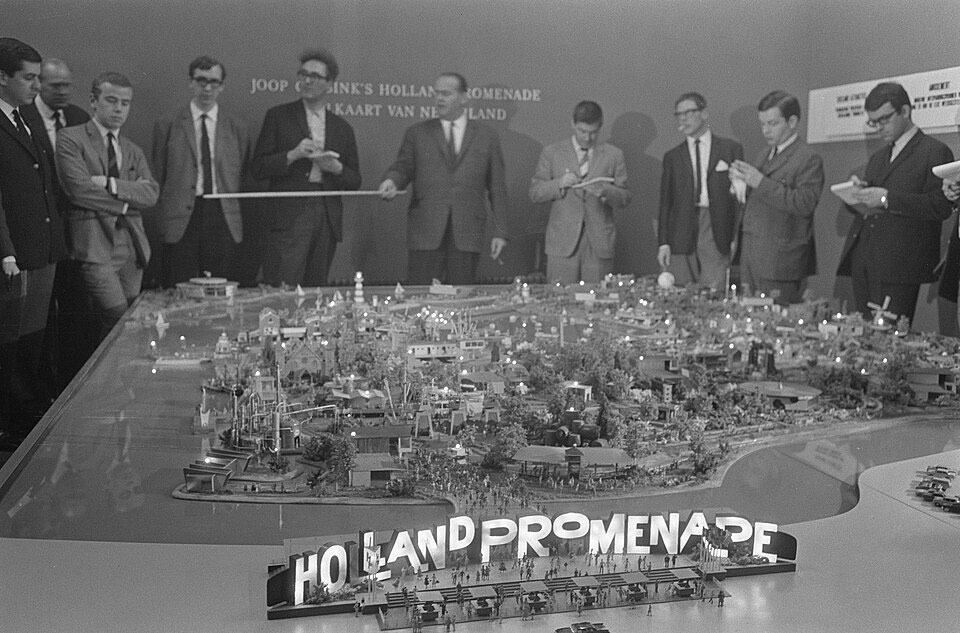
Joop Geesink presenting a maquette of his Holland Promenade park (1966).
Holland Promenade: the end of Dollywood
Besides a TV series and merchandising, the 'Rick de Kikker' character was also intended to have a prominent role in Geesink's Holland Promenade project. From 1963 on, Joop Geesink had been working on the concept of an educational theme park, where visitors could learn about all facets of Dutch trade, industry and crafts. For many years, the plans for this tourist attraction were stalled, because the city of Amsterdam refused to participate and no investor was interested, nor could another location be found. In the end, there was no return on investment, and the project turned into a financial disaster. Other plans for theme parks also fell through, for instance the Caribbean Festival on Curaçao. By the time construction began in 1969, an uprising broke out in Willemstad and the new Antillean government decided to "postpone" the plans.
Unfortunately, things went downhill for Dollywood even further. In 1966, the studio had relocated from 83-87 Duivendrechtsekade to the nearby 169 K.J. Wenckebachweg, where a brand new studio complex had been built. While the studio was top of the bill, it was also far too costly. On top of that, the Dollywood Studios were lucrative in terms of artistry and originality, but in TV advertising they couldn't compete with several smaller TV production companies that offered similar but faster services for a more affordable sum.
By 1971, Dollywood went bankrupt, and the animation studio made room for Philips offices. However, Geesink wasn't completely out of business. A trimmed down version of his studios, now named Joop Geesink Filmproduktie, began a partnership with Cinetone (part of Cinecentrum Hilversum) and the Toonder Studio's, allowing production to continue. Of the 150 puppet film staff, only 15 remained, and were relocated from Amsterdam to the Castle Nederhorst in Nederhorst den Berg, where the Toonder Studio's were based. While the new joint venture continued under the name Toonder-Geesink Studio's, Geesink was no longer personally involved in the company. In fact, he never even met his former business partner Marten Toonder in person again, since Toonder had moved to Ireland and left his studio to others.
From then on, Joop Geesink continued to work from his Amsterdam home under the banner Joop Geesink's Artists BV, aided by his stepson Rob Lissaur, daughter Louise Geesink and two freelancers. While Geesink remained creatively involved in concept development, realisation was outsourced to the external production company. It quickly became clear that Geesink's career was far from over, as it wasn't until 1972 before he created his best-known character, 'Loeki de Leeuw'. Following the renewed success, he was able to move his business into the prestigious Rivierstaete office building, near the Amstel river in Amsterdam-South.
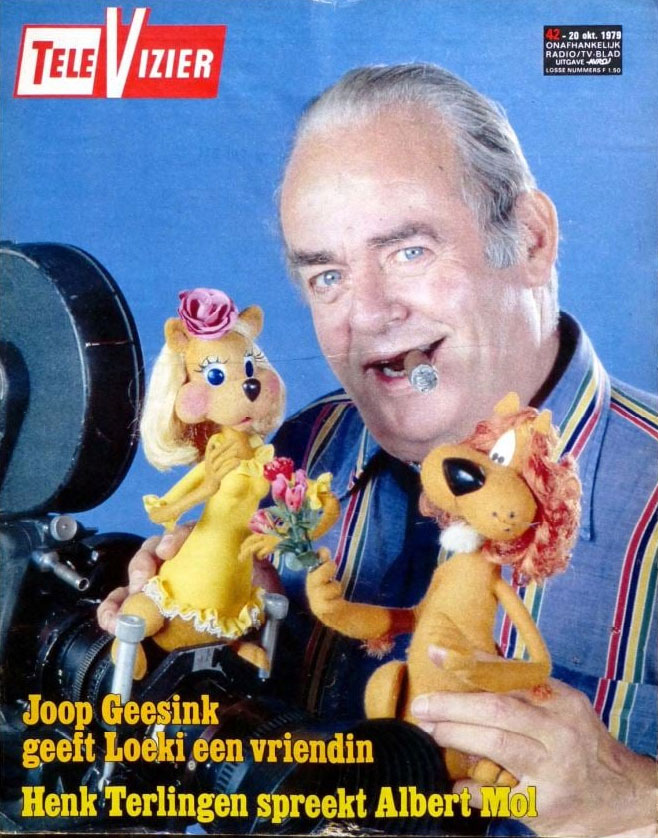
Joop Geesink with Loeki and Roosje on the cover of Televizier magazine (20 October 1979).
Loeki de Leeuw
Taking inspiration from the 'Mainzelmännchen' characters that interconnected the commercials on German television, Geesink developed a Dutch counterpart. A reference to the Dutch national symbol, 'Loeki the Lion' (1972-2004) is a cheerful orange lion who appeared in stop-motion animated bumpers during commercial breaks. Each five-seconds short featured Loeki in an absurd situation, which usually left him befuddled. When something went above his head, he uttered his catchphrase "Asjemenou!" ("Well I never!"), an expression studio member Han van Gelder often tended to use. Only occasionally, Loeki managed to put a situation to his hand, and then he triumphantically declared "Voila!" ("There you go!"). Other shorts featured a synchronized interpretation of the jingles that opened and closed off each commercial break. While Loeki was the protagonist, the shorts also featured side characters, like Loeki's lioness girlfriend Roosje, Welpie the lion cub, Piep the mouse, Guusje the duck and Filiep the blue elephant.
A small team of about ten animators worked on the shorts, including Henk Kabos and Cor Icke. For a staggering period of 32 years, over 7,000 'Loeki' shorts were made, running non-stop on the Dutch small screen. However, the 'Loeki' shorts were also broadcast in Austria, France, Japan, the United Kingdom and the United States. Despite the short run of each individual 'Loeki' cartoon, the character was very beloved with three generations of viewers. In 2004, the final 'Loeki' short was broadcast on television. Distributor-producer STER (Stichting Ether Reclame) discontinued the production because it became too costly. An icon of Dutch culture, Loeki has lived on as the Dutch TV award De Gouden Loeki ("The Golden Loeki") for "Best TV Commercial", first awarded in 1995. The prize also has a Belgian counterpart named De Gouden Welp ("The Golden Lion Cub") and a pejorative counterpart for the "Worst TV commercial" named De Loden Leeuw ("The Lead Lion"). In Japan, Loeki has been the mascot of the theme park Huis ten Bosch, near Nagasaki.

'Dusty', from De Telegraaf.
Dusty
In 1974, Joop Geesink developed yet another international cross-media concept, which he first pitched to a Berlin client: 'Dusty the Mooimaker' ("Dusty the Beautifier"). A kangaroo-like animal with a tail ending in a broom, Dusty appeared in animated TV shorts aimed at creating environmental awareness. His main adversaries were Dirty the Polluter, Stinky the Sleazebag and Noisy the Noisemaker. Starting in 1977, Geesink's Artists BV also launched a daily comic strip with the 'Dusty' character, sponsored by Sorbo cleaning products and printed in the newspaper De Telegraaf. A color comic with 'Dusty' ran in Troskompas, the TV guide of broadcasting organization TROS. One of the Dutch artists involved in the strip was Frits Kloezeman.
In addition to the Netherlands, 'Dusty' also appeared on Italian, Spanish, French, English and Austrian television. The Italian broadcasts on RAI Due especially were a tremendous success. Among the many merchandising items that were produced was Dusty's own monthly comic magazine. Published in Milan by Epierre Edizioni, Dusty magazine ran for 24 issues between November 1978 and December 1979. In Italy, the comics were produced by the Biereci Studios, which included such creators as Carlo Chendi, Luciano Bottaro, Giorgio Rebuffi, Enzo Marciante, Tiberio Colantuoni and Maria Luisa Uggetti.
Recognition
On top of the many awards for his individual film productions, Geesink was named a Knight in the Order of Orange-Nassau (1966). Not far from his original Duivendrecht studio, a road was named after him, the Joop Geesinkweg. His name also lives on in the Joop Geesink Prize, an annual award distributed during the Holland Animation Filmfestival.
Final years and death
Unlike many other studio chiefs, Joop Geesink always continued to draw and create himself, even until the very end. His final project was designing the Carnaval Festival attraction in De Efteling, a theme park in Kaatsheuvel based on designs by Anton Pieck. In 1981, Geesink was first approached by the park to come up with ideas for new attractions. After some first attempts, Geesink came up with a ride inspired by Disneyland's 'It's A Small World': a tour through festive scenes from different cultures around the world, depicted through music, colorful sets and about 280 puppets. It was his final project. Diagnosed with lung cancer, he continued to work non-stop. He single-handedly built a model of the attraction. Even when he was hospitalized, his pencils and crayons were never far away. On 1 June 1984, the 'Carnaval Festival' was opened to the public, but unfortunately Geesink didn't live to witness the event. He had died in Amsterdam only a few weeks earlier, on 13 May 1984, at the age of 71.

The looks of Bul Super, a shady businessman from Marten Toonder's 'Tom Poes' comic, were largely based on Joop Geesink. The character's first appearance was in the story 'De Superfilm-onderneming' (1944), in which Toonder reworked his disappointment over the failure of their joint studio. It must be said that the two men ended their business relationship on good terms, though.
Legacy and influence
A true tour de force in Dutch media, Joop Geesink was in many ways an innovator and a visionary, starting early in his career with his modern view on set design. Through his Dollywood studio, Geesink pioneered the artform of stop-motion animation in the Netherlands. With its reputation for good storylines, well-directed and tightly animated films with a high entertainment value, American advertising agencies began to speak of the "Joop Geesink Technique" to indicate the level of quality they desired. Even though his career was a bumpy ride at times, Geesink's legacy lives on in the iconic 'Loeki de Leeuw' character. But also with his ill-fated plans for theme parks, he was far ahead of his time. The man himself was equally colorful, thanks to his larger-than-life personality, characterized by bravado, English phrases and his trademark cigar. A born salesman with an unstoppable work ethic and flow of ideas, his former co-workers described him as a spirited and inspiring character, who knew exactly what he wanted, and was always able to bring out the best in his co-workers.
Since Joop Geesink's death, his daughter from his third marriage, Louise Geesink (b. 16 June 1954), has taken over the family business. After training his niece, Wim Geesink, by then 75 years old, retired as commissioner from the remaining Geesink companies. At Geesink Studio, Louise Geesink has continued to expand the 'Loeki de Leeuw' franchise. Hiring Wil Raymakers as house illustrator, a 'Loeki de Leeuw' pantomime comic strip was introduced on the pages of the pre-school magazine Okki. Starting in 1986, it ran for over thirty years. After Loeki's disappearance from Dutch television in 2004, Loeki received a permanent spot in the Beeld en Geluid Museum in Hilversum. Between 2006 and 2010, he was the mascot for an advertising campaign by Edah supermarkets. Through the mediation of former STER director Chris Smeekes, 'Loeki de Leeuw' made his long-awaited comeback in the commercial breaks on Dutch television on 10 May 2021. In addition to the 'Loeki de Leeuw' projects, Louise Geesink and Wil Raymakers have also been responsible for the artwork in the 'Woezel & Pip' booklets, created by the late actress/author Guusje Woesthoff-Nederhorst.
Joop Geesink's son was the figurative painter Robert Geesink (29 January 1943-23 November 2016). After studying in Paris, he travelled through Asia and eventually settled in the Indian state of Karnataka, where he painted scenes from the life of the Lambani people and the remains of the ancient city of Hampi.
Books and documentaries about Joop Geesink
After the death of Joop Geesink, Tjitte de Vries and Ati Mul wrote the lengthy article 'Joop Geesink, Poppenfilmproducent', that formed the core of the sole issue of the quarterly magazine Animatie (Kersten Realisaties, 1984). In 2012, NGN Produkties released the documentary 'De Duivendrechtse Disney: A Businessman's Idea of an Artist', which chronicled the life and work of Joop Geesink through interviews with his relatives and former co-workers.
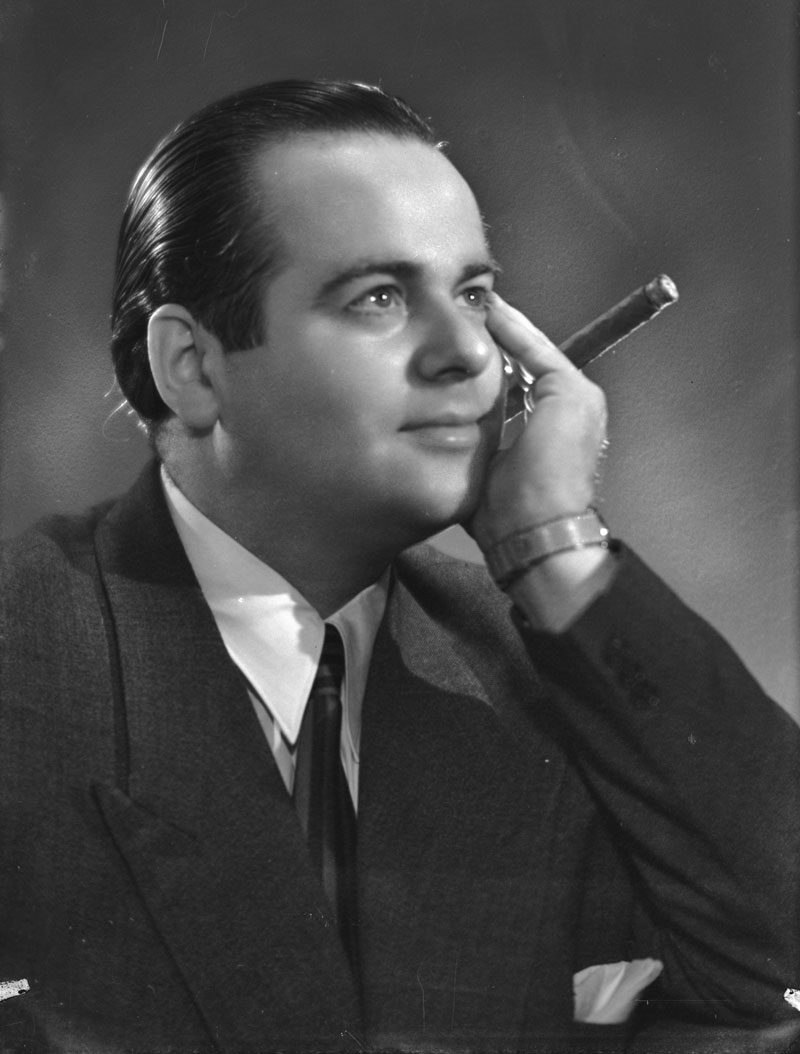
Joop Geesink portrayed by the Atelier J. Merkelbach.