


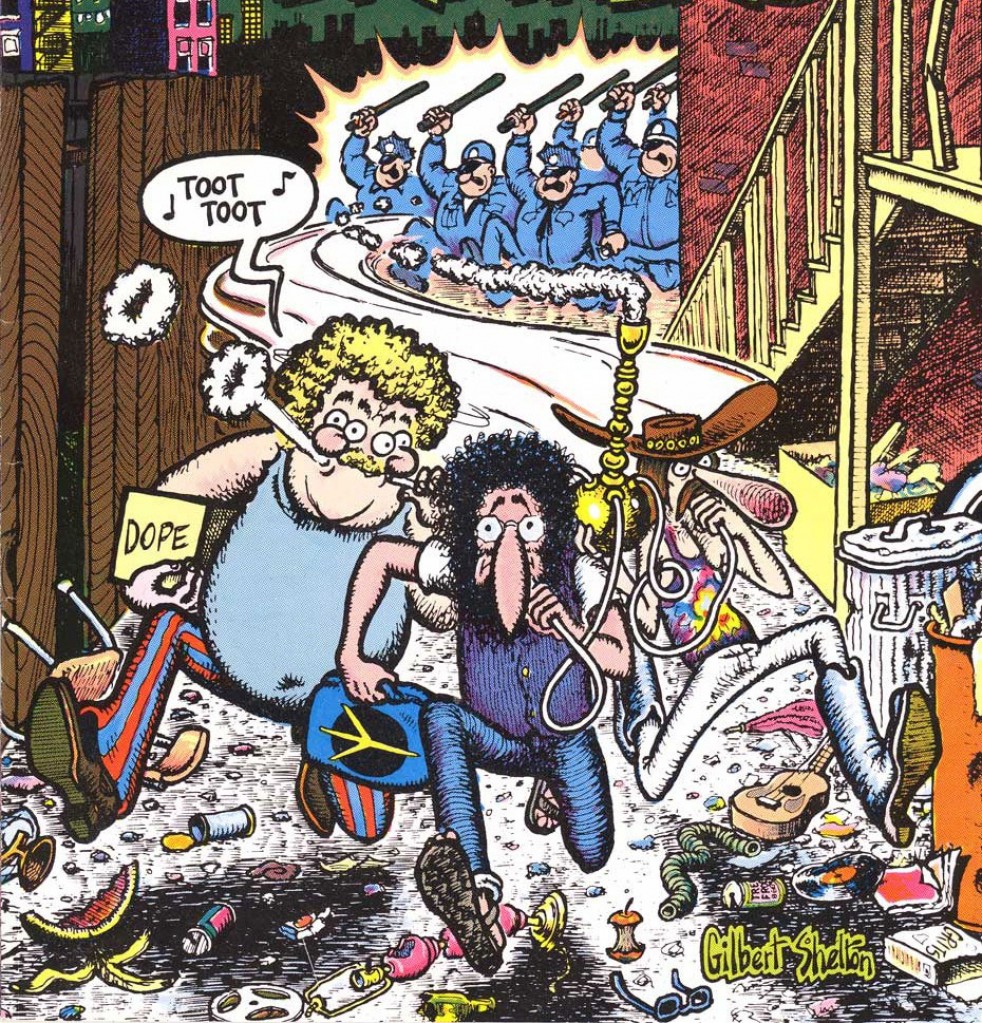
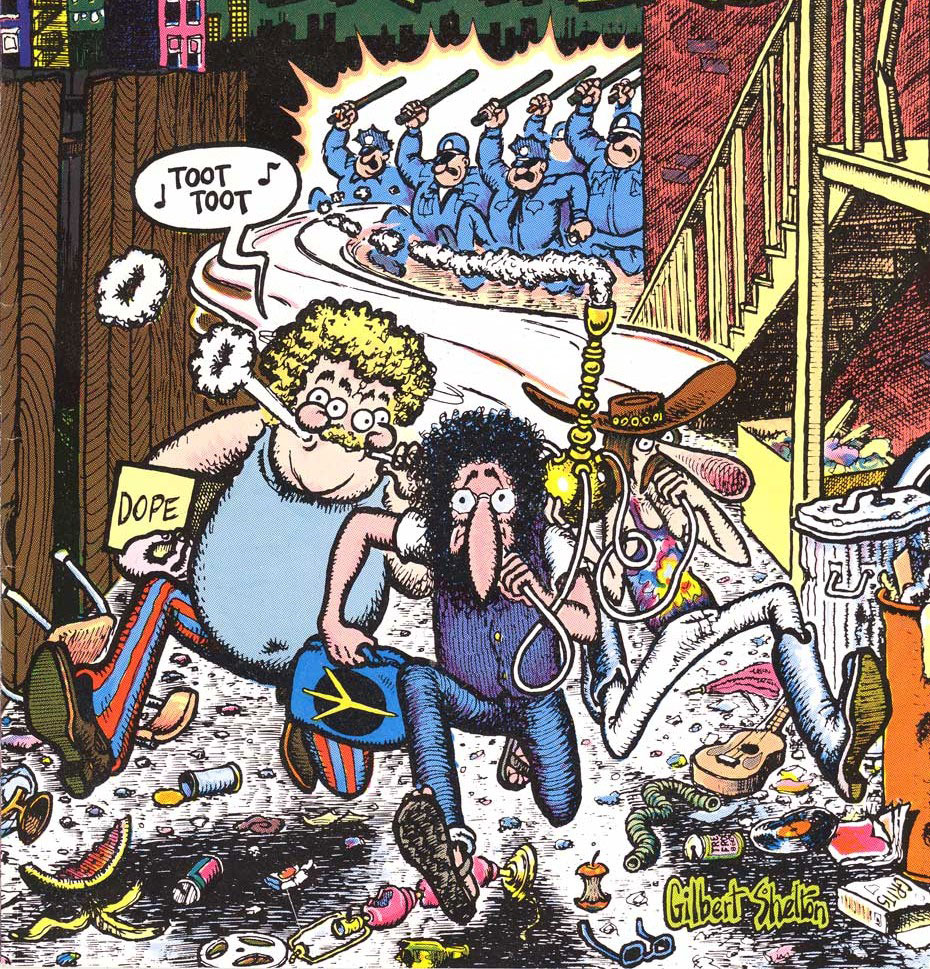
Cover art for 'The Collected Adventures of the Fabulous Furry Freak Brothers' #1 (1971).
Gilbert Shelton is one of the foremost artists of American underground comix. He gained a cult following in the 1960s with his superhero parody 'Wonder Wart-Hog' (1962-1993) and the drug-obsessed hippies 'The Fabulous Furry Freak Brothers' (1968-1997) and their pet cat. Particularly the latter became countercultural icons. In some countries and U.S. states, the comic was even banned. Subversive, but never cynical, Shelton is a witty, engaging storyteller. His work captured the zeitgeist of the hippie era, yet proved to have equal timeless appeal with many later and different youth subcultures. In 1969, Shelton was also co-founder of Rip Off Press, a publishing company responsible for giving many underground and alternative comic artists a platform for their work. After moving to France, he scripted the humor comic 'Not Quite Dead' (1988-1997), drawn by French cartoonist Pic.
Early life and graphic career
Gilbert Shelton was born in 1940 in Dallas, Texas. His father worked for the Firestone Tire and Rubber Company, and his job required the family to move around a lot, until they finally settled in Houston. Shelton studied social sciences at Washington and Lee University, Texas A&M University and the University of Texas in Austin, receiving his bachelor's degree in 1961. In 1959, during his university years, he began drawing his early cartoons for the college magazine The Texas Ranger. Among his main graphic influences were Tex Avery, Ernie Bushmiller, Carl Barks, Al Capp, Chester Gould, Harold Gray, Don Martin, Zack Mosley, Willy Murphy, Virgil Partch, Ronald Searle, John Stanley and particularly Mad Magazine's Harvey Kurtzman and Will Elder. Later in his career, Shelton also expressed praise for the French artists Yan Lindingre and Frank Margerin. In addition, he had a strong interest in architecture and cars, taking great pleasure in drawing these down to the tiniest details.
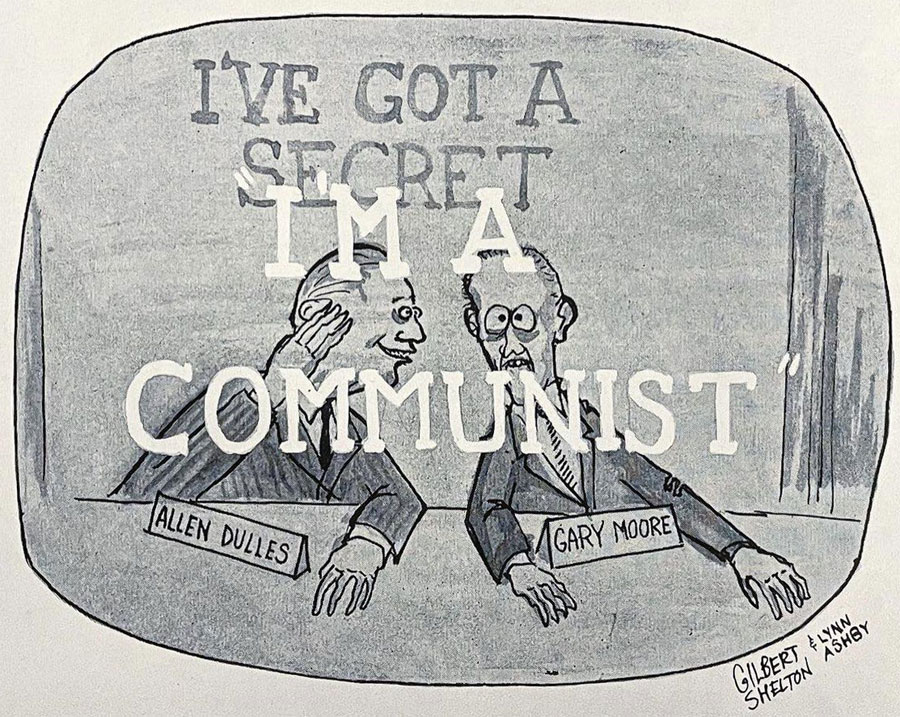
Illustration for The Texas Ranger (October 1960).
After graduation, Shelton moved to New York City, where he became an editor for various automotive magazines, frequently enriching the pages with cartoons and comics. In interviews, Shelton often downplayed the quality of these magazines, as, according to him, the good automobile magazines were made in California, adding "what the hell do people in Manhattan know about cars?". Other early work by Gilbert Shelton ran in Harvey Kurtzman's satirical magazine Help! at Warren Publishing. To avoid being drafted, Shelton moved back to Texas to start another university course, in the process returning to the college magazine The Texas Ranger as an editor. He eventually switched from graduate school to art school, where among his college friends were future rock singers Janis Joplin and Johnny Winter. By this point, Shelton had built up many contacts with writers, editors and cartoonists of other college magazines. This not only provided him with a large network, but also insights in how to run and distribute these publications. For instance, he helped fellow Texas University student Frank Stack publish a zine collection of his The Texas Ranger strip 'The Adventures of Jesus' (1964), one of the earliest underground comix. Due to its blasphemous content, Stack released this book under the pseudonym "Foolbert Sturgeon".
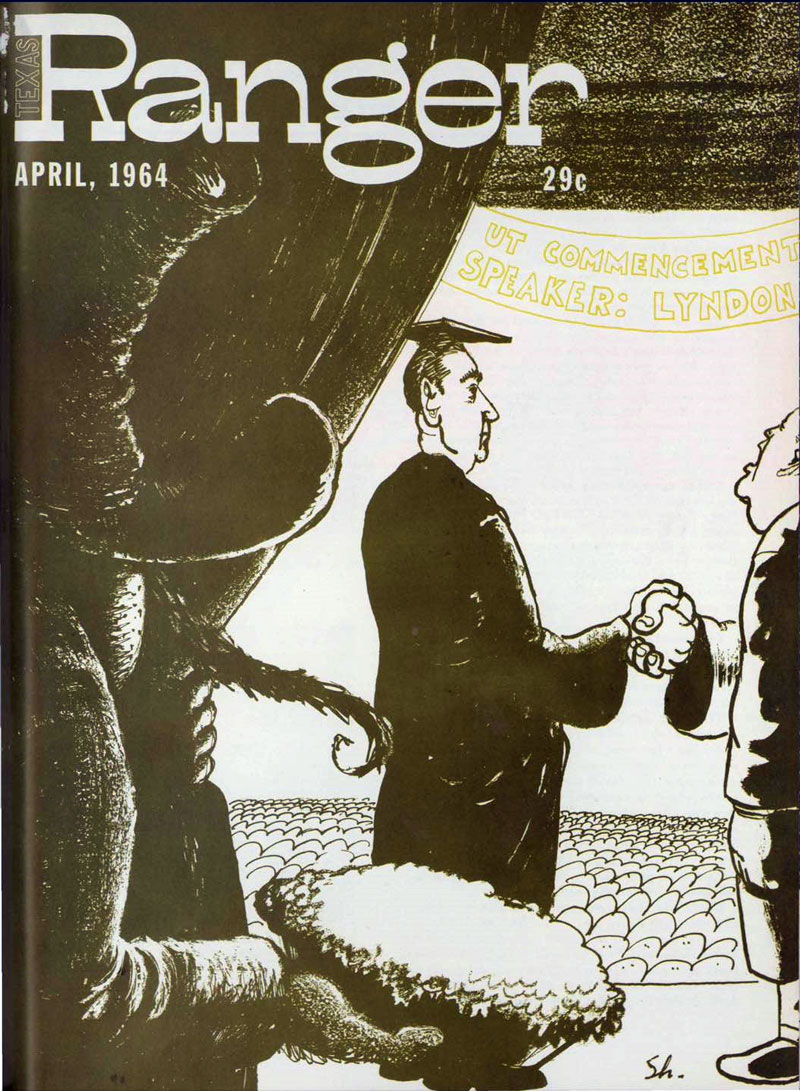
Cover art for The Texas Ranger (April 1964).
Wonder Wart-Hog
In March 1962, Shelton's first enduring character made his debut in the short-lived college magazine Bacchanal: 'Wonder Wart-Hog' (sometimes spelled 'Wonder Warthog'). The pig was created out of his disinterest in superhero comics, a genre he enjoyed as a child, but found boring and formulaic by the time he reached young adulthood. Inspired by Harvey Kurtzman's ridicule of 'Superman', 'Batman' and 'Wonder Woman' in Mad, Shelton wanted to make a similar spoof. In an encyclopedia, he found a photo of a warthog, an animal so ugly that it would be the perfect anti-hero. Just like Superman, Wonder Wart-Hog is an extraterrestrial sent to Earth when his parents' home planet is about to explode. Found and raised by a farmer's family, the anthropomorphic swine gets a job as reporter at the Muthalode Morning Mungpie. His Clark Kent-like secret identity name is Philbert DeSanex. The stories are witty, frequently absurd pastiches of the average superhero comic. The so-called "Hog of Steel" often shows off never-before-mentioned super powers that just happen to help Shelton write the plot out of a corner when needed. The anti-hero faces villains that are deliberately wacky, from the Granny of Gruntville to the Elusive Chimerical Chameleon.
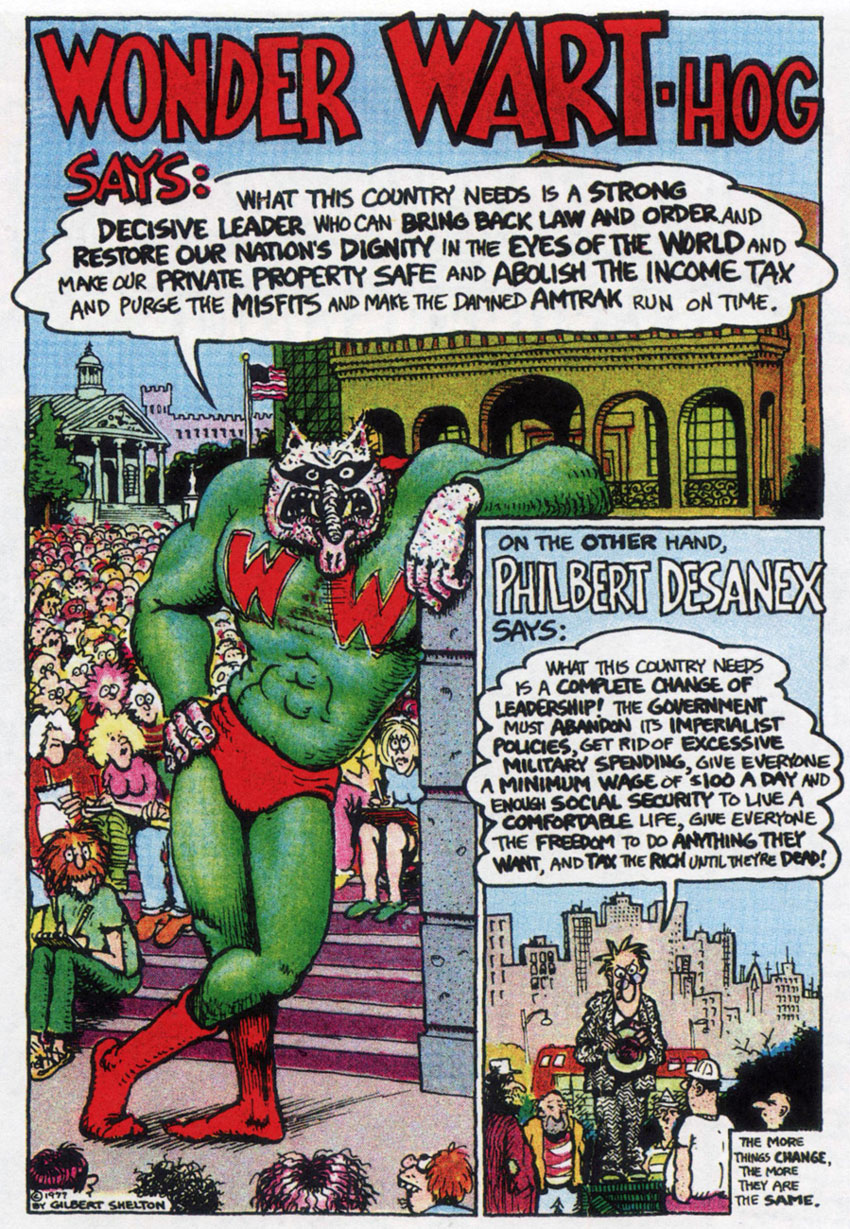
'Wonder Wart-Hog'.
In the early 1960s, 'Wonder Wart-Hog' ran in college magazines like Bacchanal, Mademoiselle, The Texas Ranger and Charlatan, reaching a wider audience in Harvey Kurtzman's satirical magazine Help! from 1962 to 1965. Between 1966 and 1968, they were also a staple in Pete Millar's Drag Cartoons magazine, for which Shelton also created the feature 'Bull O'Fuzz'. In 1967, the Millar Publishing Company published two issues of 'Wonder Wart-Hog' comic book. Once 'Wonder Wart-Hog' appeared in countercultural magazines, Shelton could be more explicit and subversive. He redesigned his character with an erect snout and hairy chin, mimicking a penis and hairy ballsack. Since superhero comics are so associated with mainstream media, Wonder Wart-Hog represented everything that is lame, shallow and hypocritical about the establishment. The "heroic" hog fancies himself a defender of the "American Way", yet always uses excessive violence and dubious methods to achieve this goal. People are beaten to bloody pulp for minor offenses. In 'Wonder Wart-Hog Breaks Up the Mutholode Smut Ring' (Zap Comix #4), for instance, the Hog of Steel beats up underground cartoonist "Robert Scrum" for "corrupting innocent American kids", all while shouting vulgarities at him, with young children cheering to "kill him". The patriotic pig has strange morals, siding with corrupt politicians, police officers and the US Army, while stealing, murdering and raping people for his own benefit.
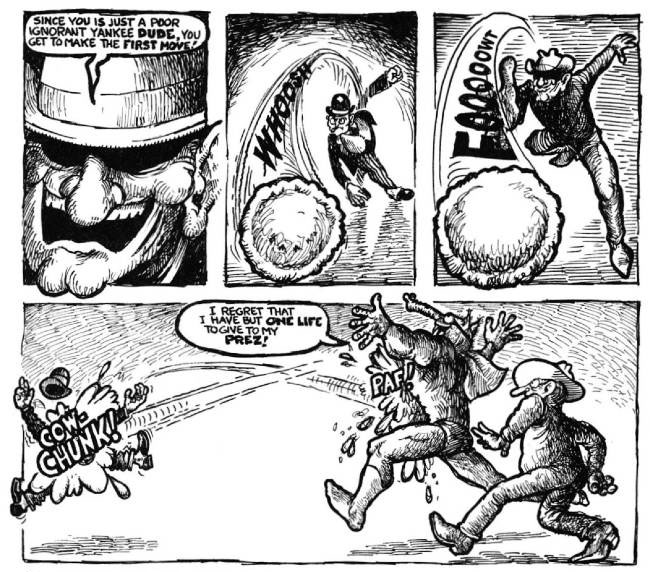
Wonder Wart-Hog meets President Lyndon B. Johnson.
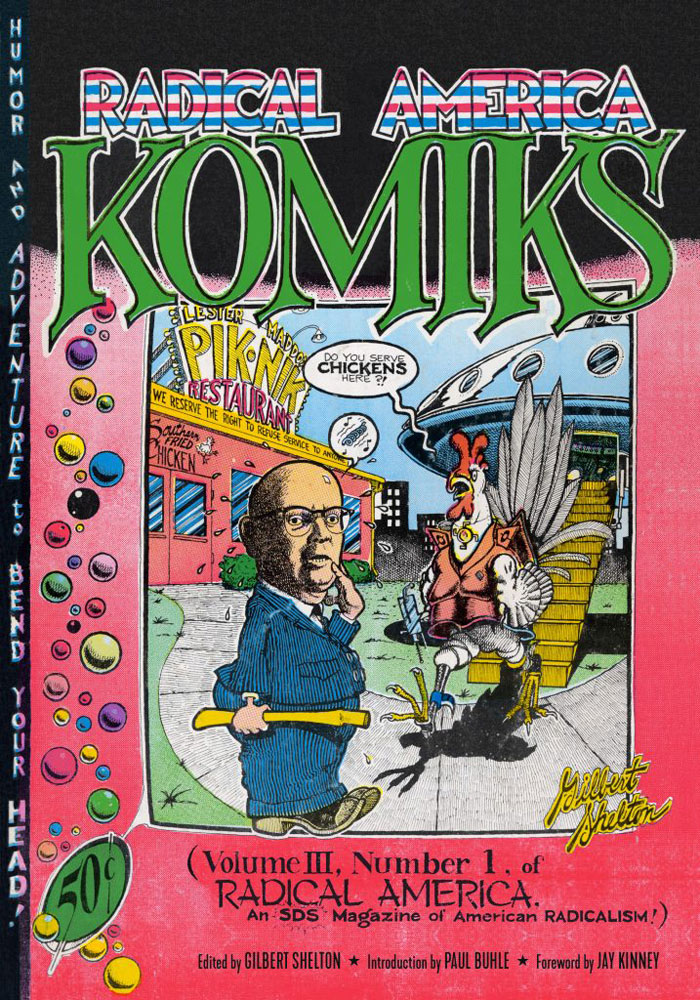
In various adventures, the nefarious swine meets the Mafia, Nazis, poverty(!), beatniks and US Presidents Lyndon B. Johnson, Richard Nixon and US Vice President Spiro Agnew. Blasphemous comedy is thrown in the mix too, with Wonder Wart-Hog encountering God, the Devil and televangelist Billy Graham. The hog also attends race riots and fights in the Vietnam War. From 1969 on, the swine appeared in Zap Comix and other underground comix titles, while the publishing company The Print Mint made them available in the successful 1973 three-volume compilation book series '(Not Only) The Best of Wonder Wart-Hog'. Shelton also drew an exclusive 'Wonder Wart-Hog' story for Radical America Komiks (1969), a comic book supplement of Radical America, the house magazine of Students for a Democratic Society. Starting in 1977, Gilbert Shelton's own Rip Off Press became the permanent homebase of new 'Wonder Wart-Hog' content, both in its Rip Off Comix series (1977-1984) and several new book collections. In 2013, Knockabout released the most comprehensive collection, 'The Best of Wonder Wart-Hog'.
While Shelton was the main scriptwriter and artist, some stories were written by friends like Joe E. Brown, Jr. and Bill Killeen, while the artwork was assisted by Tony Bell, a college friend during the Drag Cartoons years.
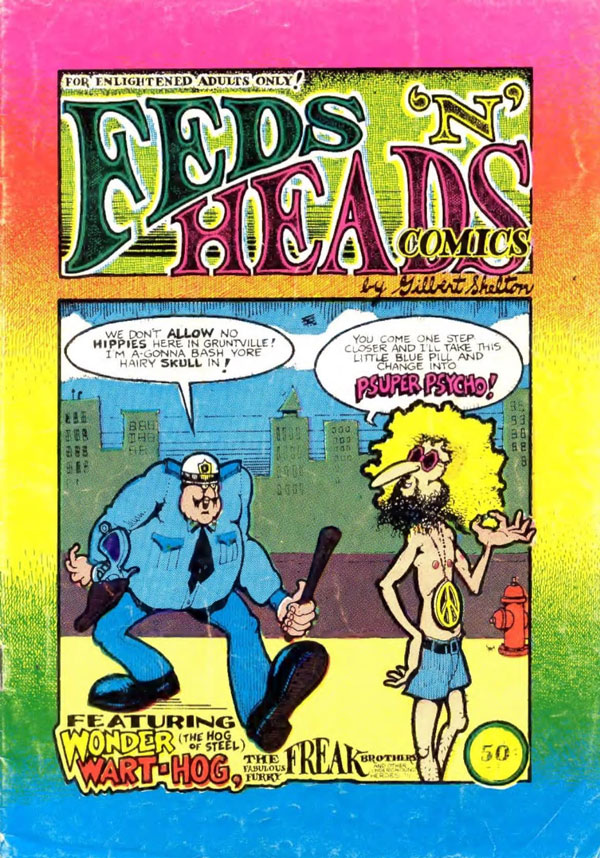
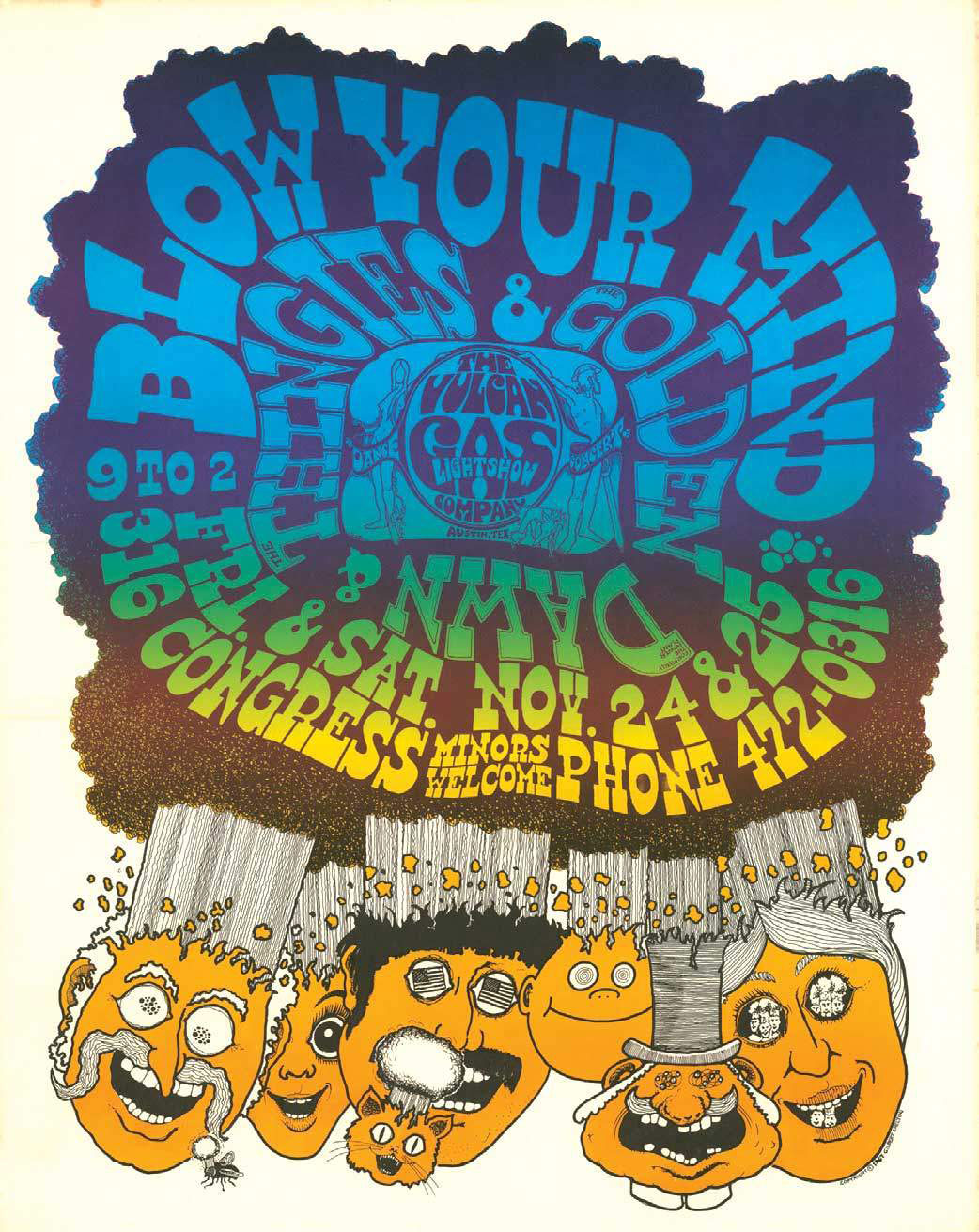
Cover art for Feds 'n' Heads Comics (1968) and poster art for the Vulcan Gas Company (1967).
Underground comix
By 1964, Shelton couldn't postpone his military draft any longer and went to the required medical examination, where he managed to be declared "medically unfit", after confirming he used psychedelic drugs. After moving to Cleveland, Ohio, Shelton applied for a job at the American Greeting Card Company, but was rejected. Instead, he went back to New York City, working for the counterculture magazine The East Village Other. As California became a magnet for the emerging hippie subculture, Shelton moved to the West of the USA, where, through a friend, he got a job as art director at the rock music venue Vulcan Gas Company in Austin, Texas. He was in charge of their decoration and marketing, designing many psychedelic concert posters, inspired by the work of Victor Moscoso and Rick Griffin. He discovered a printer who used split fountain ink, a multi-color printing technique with separate ink "reservoirs" allowing him to let different colors flow into each other, giving an overall funky end result. The downside was that after a 100 of these prints, the ink became too mixed to continue, which explains why the posters are highly sought-after due to their rarity value. At this club, he also met fellow underground cartoonist Jim Franklin. Around the same time, Shelton's comics also appeared in other counterculture magazines like The Los Angeles Free Press and The Rag (from Austin, Texas). By 1968, Shelton was living in San Francisco, California, in the hope of finding more poster work.
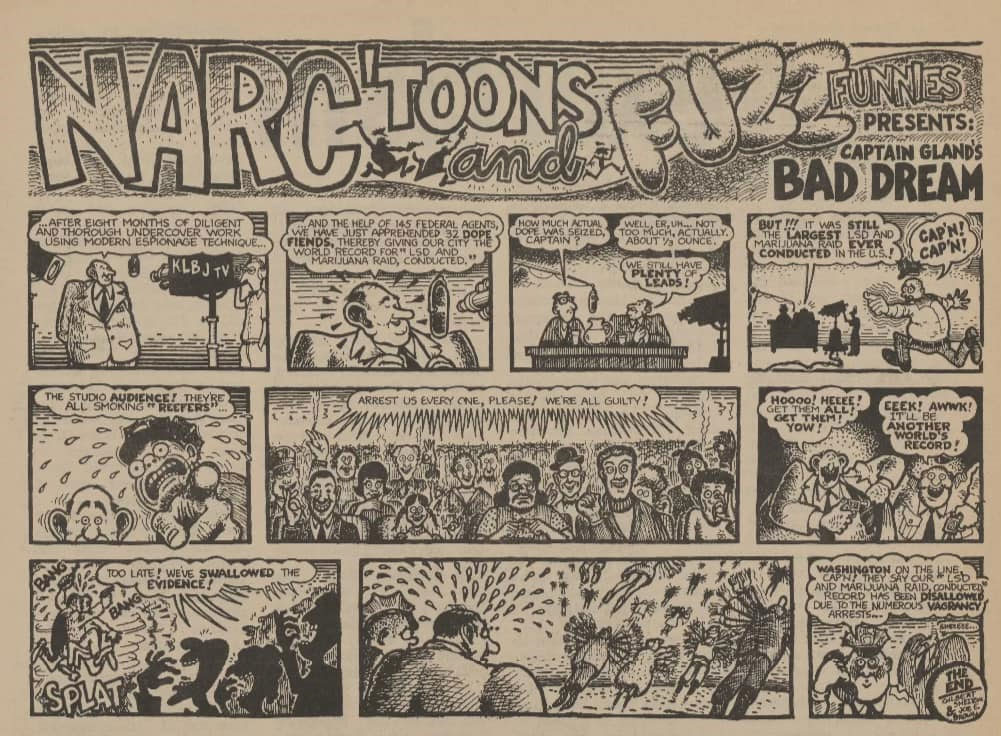
Comic strip for The Rag of 15 August 1968.
Active as an underground comix artist since 1962, Shelton can be considered one of the movement's pioneers. Finding its ideal target audience in the hippie press, the cartoonist never considered any other outlet for them, apart from these serializations. It wasn't until he discovered Robert Crumb's self-published and successful underground comic book Zap Comix (1968) that Shelton realized he could release independent comic books. That very same year, he brought out Feds 'n' Heads Comics, a collection of his strips from The Rag, which became a bestseller too. Finding regular spots in several other underground comic books, for instance Jay Lynch's Bijou Funnies, Shelton even became part of Zap Comix' very exclusive core team.
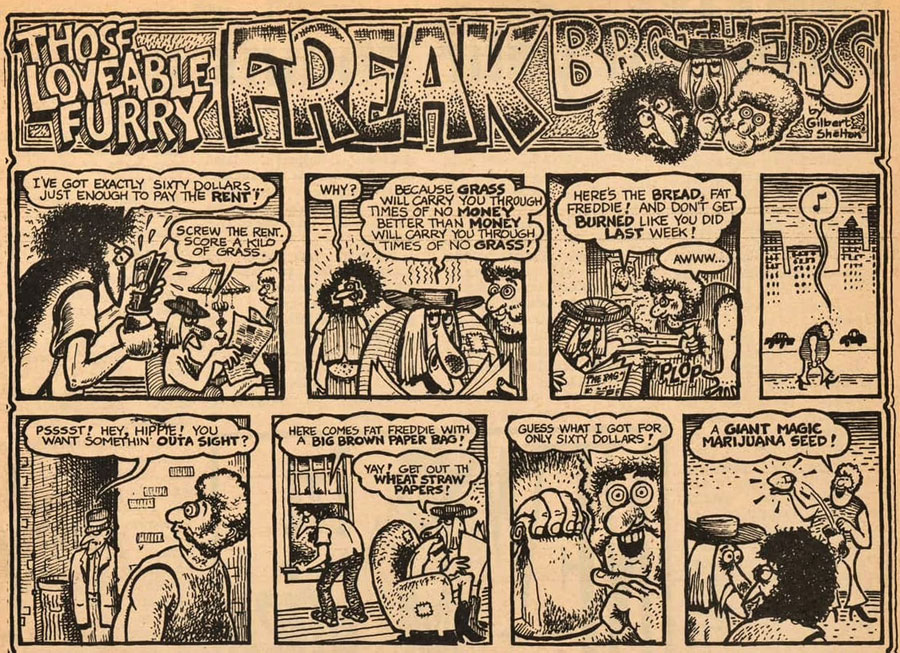
'Those Loveable Furry Freak Brothers' (debut episode).
The Fabulous Furry Freak Brothers
Gilbert Shelton is most famous as the creator of 'The Fabulous Furry Freak Brothers' (1968-1997), a trio of hippie friends whose entire existence revolves around money, sex and especially drugs. The artist was inspired by a double feature film show at the Vulcan Gas Company in Austin, with The Three Stooges and The Marx Brothers. Together with his film student friend Renée Tooley, he made a twenty-minute film, 'The Texas Hippies March on the Capitol', starring his newly-created characters, with a comic strip in The Rag to advertise the movie. However, everyone told Shelton that the comic was funnier, motivating him to just turn his concept into a full-blown gag comic (the film is nowadays lost, although in 2025 outtakes were found during the cleaning of Shelton's archives). Since his local Austin underground paper, The Rag, lacked a comic strip, Shelton told the editors that they would probably reach more readers if he drew one for them. And so, on 6 May 1968, 'The Fabulous Furry Freak Brothers' debuted in The Rag, symbolically the same month as the May '68 student uprisings.
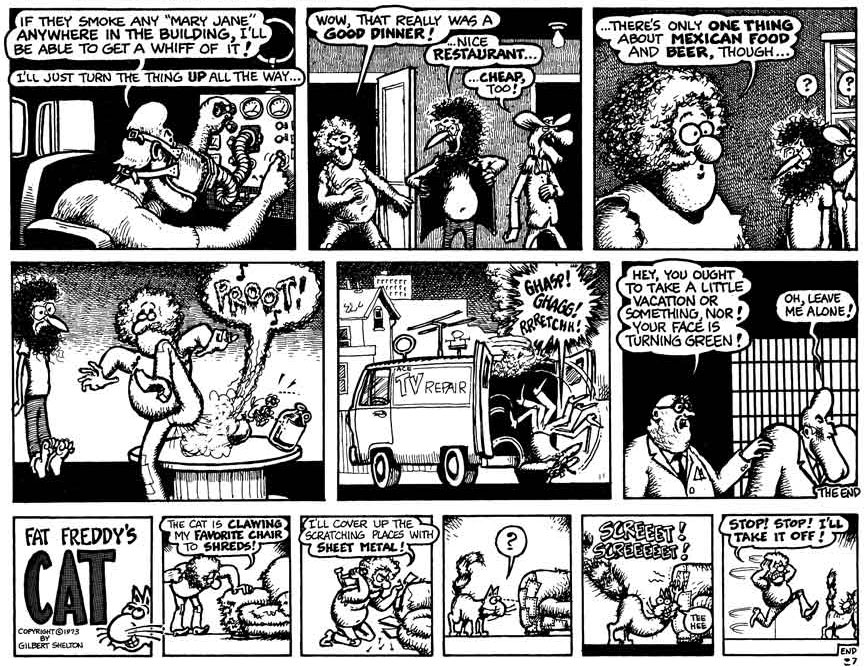
'The Adventures of the Fabulous Furry Freak Brothers', with 'Fat Freddy's Cat' "topper" (1973).
Contrary to what the title suggests, the Freak Brothers aren't related to one another. They are more brothers in spirit, sharing shaggy hairstyles and names starting with a "f" or a "ph". Freewheelin' Franklin is the oldest and so acts as their unofficial "leader". He is recognizable by his mustache and Stetson cowboy hat. He was also the first to say their iconic catchphrase, "Dope will get you through times of no money better than money through times of no dope". In their debut episode, he spouted the variation: "Because grass will carry you through times of no money better than money will carry you through times of no grass." The second Freak Brother, Phineas T. Freak, is an intellectual. The pointy-nosed, bespectacled, black-bearded geek is well-informed about politics, advocates radical social change, but also crafts chemical concoctions suitable for drug consumption. Finally, Fat Freddy is a complete oaf. The corpulent, pot-bellied nincompoop often makes unwise decisions that cause gargantuan problems. One time, for instance, he stole radio-active waste under the idea that it would be a good drug. Though, it must be noted that all three Freak Brothers blunder about. The friends share a flat, sometimes referred to as 372 East Trashview Court, in a town that is a mixture between Austin, San Francisco and New York, all cities where Shelton has lived at certain points in his life.
The friends are frequently supplied by weed farmer Hiram Cowfreak and Dealer McDope, a drug dealer who originated from Dave Sheridan's underground comic of the same name. Shelton also created two recurring nemeses, namely Norbert the Nark, a DEA agent obsessed with jailing "drug fiends", and governor Rodney Richpigge, a corrupt politician whose son is nevertheless a cocaine dealer. Norbert is a complete loser, whose mission to catch the Freak Brothers red-handedly always ends with him being humiliated or jailed himself.
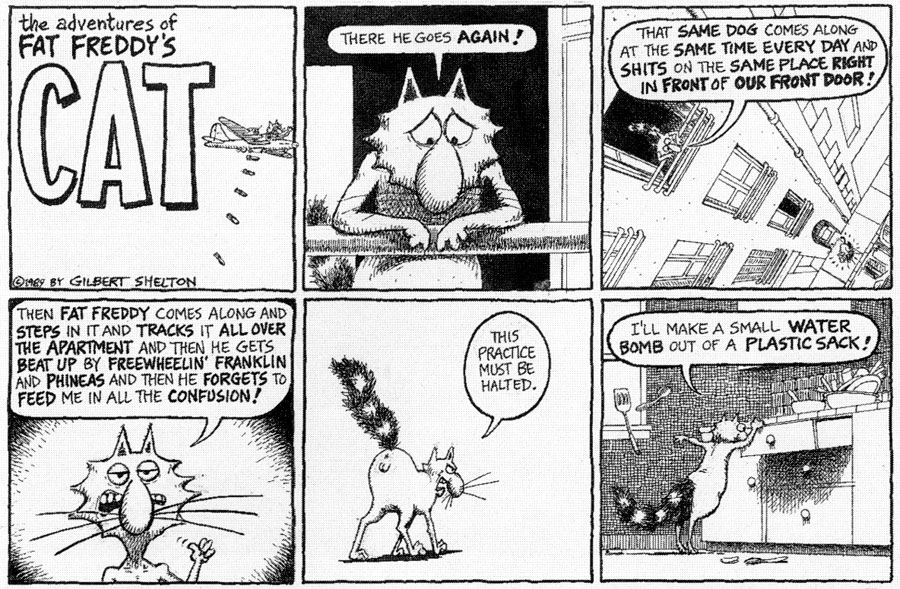
'Fat Freddy's Cat'.
Fat Freddy's Cat
A fourth inhabitant in the Freak Brothers household is Fat Freddy's Cat, a feline that never received a permanent name (though in the 2020 animated adaptation, he is named Kitty, with a gender change). The grinning pet is much smarter than his owners, though more a hindrance than a help. He often eats their provisions or shits on their dope stash. Whenever characters are in a hurry, the cat crosses their path, causing them to trip. Even though Fat Freddy's Cat is presented as an anthropomorphic animal, humans are unable to understand him. Shelton also made him behave like a real cat, moving on all fours and only occasionally acting like a human. He also drew him with visible genitalia, not shying away from showing his little asshole whenever depicted from the back.
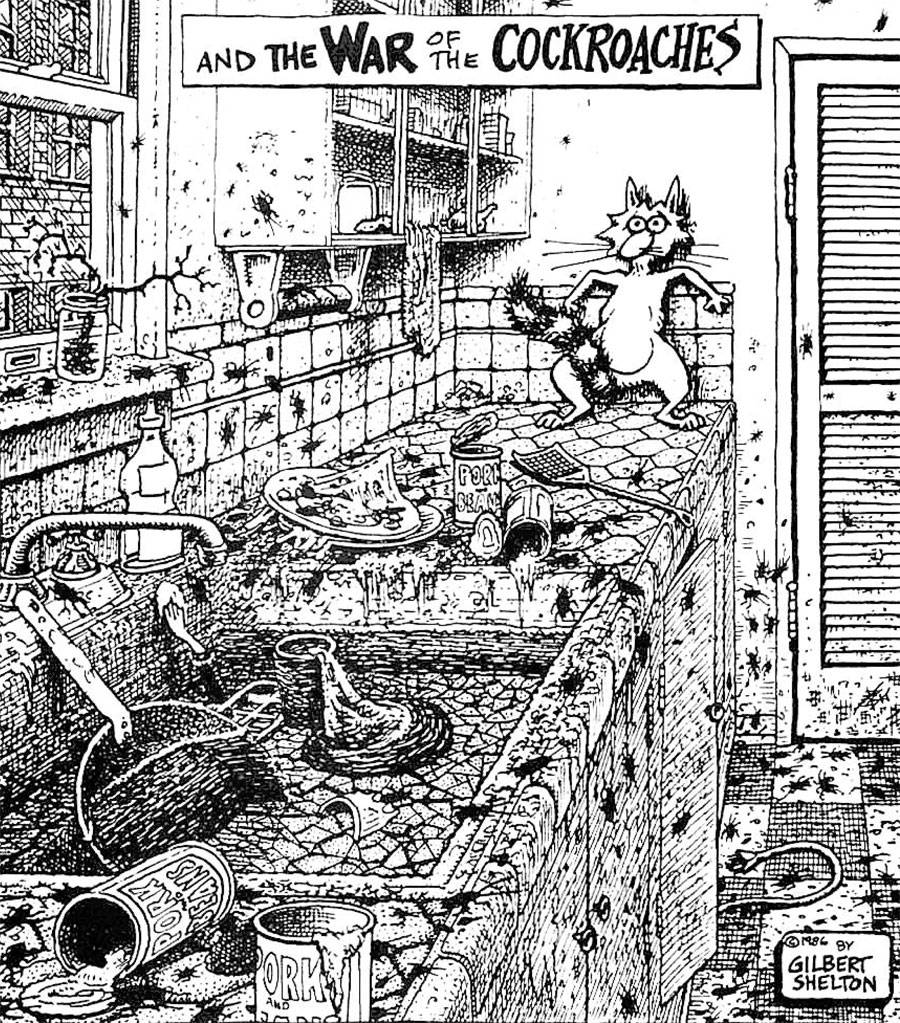
The Adventures of Fat Freddy's Cat #6 - 'The War of the Cockroaches' (1986).
In 1969, Shelton created a spin-off around the sneaky pet, 'Fat Freddy's Cat', which often ran underneath that week's 'Furry Freak Brothers' episode, as a parody of the "topper comics" that in newspaper comics accompanied the main feature. Interviewed by John May (NME, 20 October 1979), Shelton cited Al Smith's topper comic 'Cicero's Cat' as a direct inspiration. The spin-off features the cat holding inner monologues and talking with other animals. As a running gag, he often fights epic battles against the cockroaches in the Brothers' building. The insects act more like ants, though, militarized to such a degree that generals command their troops. Between 1977 and 1993, 'Fat Freddy's Cat' comics were published as separate books by Rip Off Press (seven issues), because Shelton found out "comics about cats always sell well." He once compared his creation to that other famous newspaper feline, Jim Davis' Garfield, and snarked: "Contrary to Garfield, Fat Freddy's Cat still has his balls...".
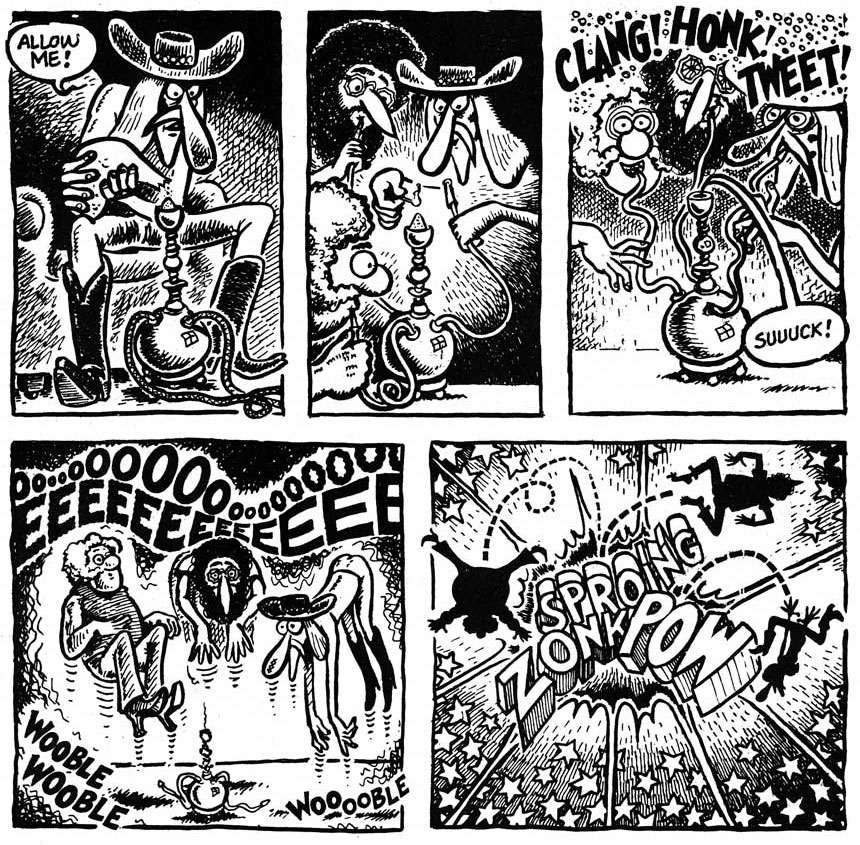
'The Freaks Pull a Heist!' (Radical America v3#1, 1969).
Faboulous Furry Freak Brothers: style
'The Fabulous Furry Freak Brothers' is perhaps the most emblematic of all underground comix created in the 1960s. Franklin, Phineas and Freddy are genuine hippies, not bound by social conventions and expectations. The bachelors share the same flat and live off welfare. In their commune, they enjoy the secret thrills of reading countercultural magazines and taking drugs. They face off against conservative citizens, corrupt police officers, condescending preachers and opportunistic politicians. Violence, drug use and corruption are widespread. Characters speak in uncensored vulgar language. Political satire, blasphemous comedy and explicit depictions of sex, nudity and drug trips only prove that Shelton's comic would never run in a mainstream newspaper. The influence from Mad magazine shines through in depraved cameos of real-life politicians like Richard Nixon and Spiro Agnew, as well as subversive guest appearances from iconic comic book characters like Harold Gray's 'Little Orphan Annie', Ernie Bushmiller's 'Nancy' and Charles M. Schulz's Charlie Brown. The Freak Brothers even enjoy a comic-within-a-comic, 'Tricky Prickears', which spoofed Chester Gould's 'Dick Tracy', and 'Little Orphan Amphetamine', which parodied Harold Gray's 'Little Orphan Annie' (much like Al Capp parodied 'Dick Tracy' in his 'Li'l Abner' comic as 'Fearless Fosdick').
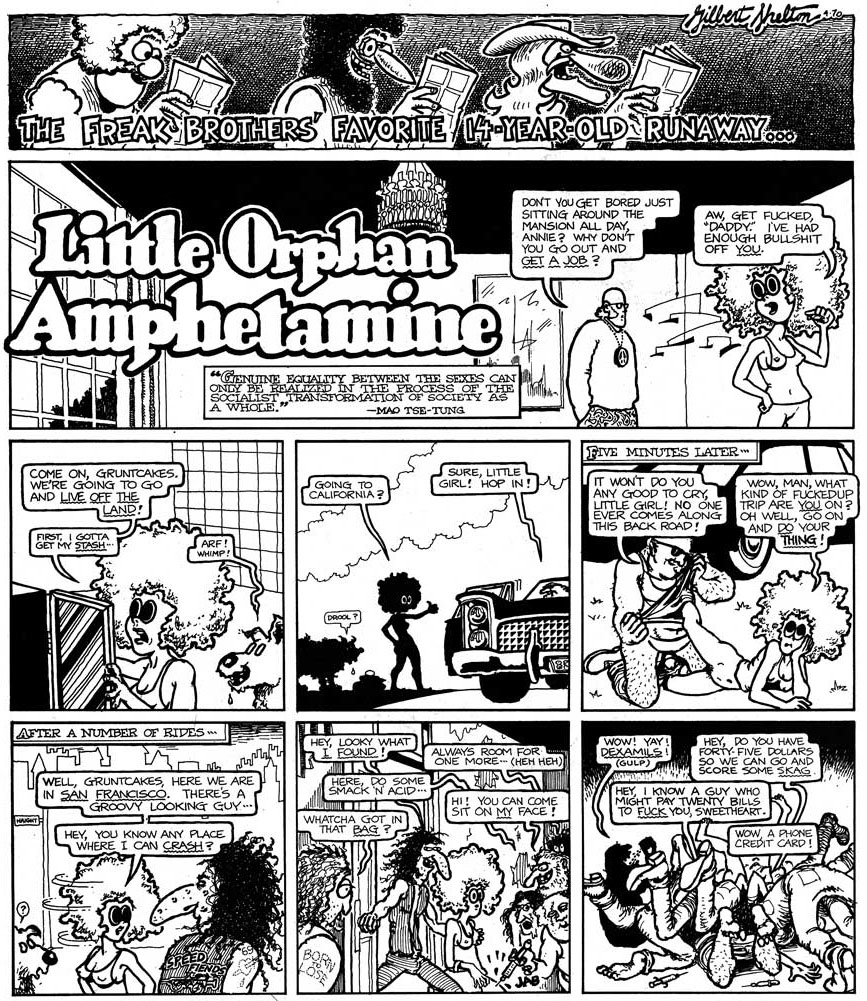
'Little Orphan Amphetamine' (Hydrogen Bomb Funnies #1, 1970).
Simultaneously, Shelton satirized hippies, stoners and counterculture itself. The Freak Brothers are outsiders, but don't do much with this freedom beyond chasing hedonistic pleasures to escape reality. They go through absurd, obsessive lengths to either buy, grow or just steal drugs. The people they buy it from are often just as shady as the policemen who arrest them. Their addiction often leaves the Freak Brothers flat broke, living in a cockroach-infested house, with their welfare check as their own legal income. This clash between the old-fashioned, square, law-obsessed "silent majority" and the more free-spirited generation that defies them, makes 'The Fabulous Furry Freak Brothers' an interesting, satirical time capsule. And still, of all the lowlifes ridiculed in this comic strip, Franklin, Phineas, Freddy and the cat are easily the most sympathetic.
Even though Gilbert Shelton is an underground comix legend, his stories differ from his colleagues in a few aspects. Despite his gritty depiction of modern-day America, the Freak Brothers' hijinx have a happy-go-lucky atmosphere. They simply try to make the best of an unfair world. While other underground cartoonists sometimes drew stream-of-consciousness comics that were more weird than comprehensible, Shelton's stories have easy-to-follow, accessible narratives. He was also less concerned with breaking taboos or telling autobiographical stories. Interviewed by Patrick Rosenkrantz (intended for Comics Journal, but unpublished, 6 June 2012), he summarized: "My primary aim was to be funny." Indeed, 'The Fabulous Furry Freak Brothers' follows the same structure of a well-oiled humor comic built around the contrasting personalities of wacky cast members. Shelton proved a master in setting up hilarious farces, with funny slapstick and perfectly timed punchlines.
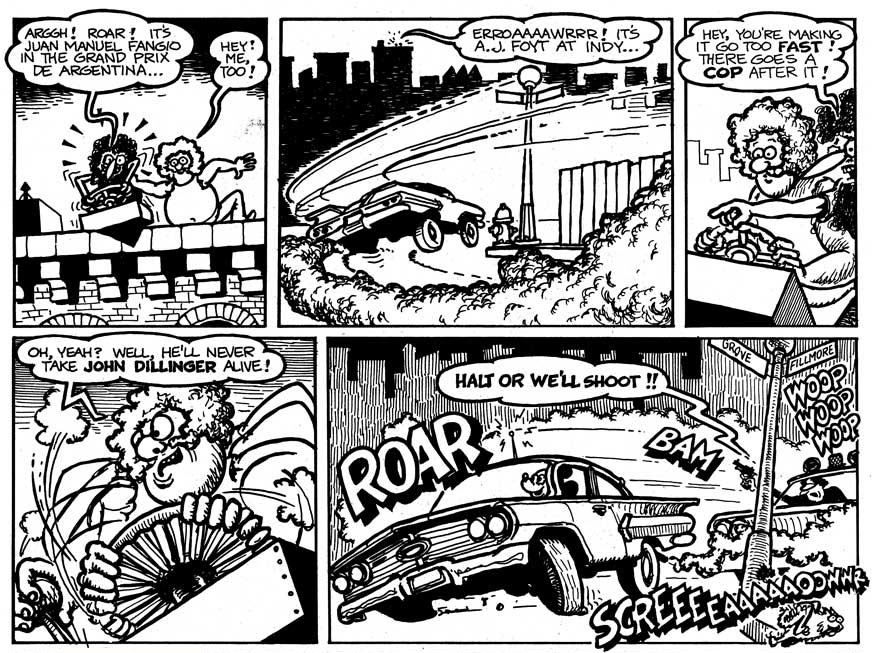
'Fabulous Furry Freak Brothers'.
In the early years, each 'Fabulous Furry Freak Brothers' gag was one page long. Gradually, as other publications began carrying their shenanigans, the stories became longer, some serialized over several weekly installments, complete with cliffhangers. Their constant craving for dope, sex and money gave Shelton and his co-workers a perfect set-up for many wild narratives and psychedelic trip scenes. In 'The Fabulous Furry Freak Brothers Go To College' (1969), for instance, Fat Freddy goes to university to "educate" radical students about revolution, while in another story from the same year, they visit Disneyland. In 'Chariot of the Globs' (1975), their cat is abducted by aliens. In 'The 7th Voyage of the Fabulous Furry Freak Brothers: A Mexican Odyssey' (1975) they end up in a Mexican jail, while the cat's storyline happens simultaneously with the main narrative. Their most bizarre story featured the brothers staying sober for a while and being bored to death. To highlight the dreariness of their reality, three people were dressed up like the characters, photographed and presented as a photo comic. The Freak Brothers' most epic tale is 'The Idiots Abroad' (1984-1987), a three-volume story made by Shelton and Paul Mavrides, with the anti-heroes each getting stuck in faraway countries.
Fabulous Furry Freak Brothers: success
Right from its conception, 'The Fabulous Furry Freak Brothers' gained a cult following. From the late 1960s through the 1970s, their adventures were printed in countless counterculture magazines and underground comic books, including The East Village Other, The Los Angeles Free Press and Zap Comix. Stories were translated and reprinted into many languages, including French ('Les Fabuleux Freak Brothers'), German, Italian, Spanish, Portuguese, Dutch ('De Vermaarde behaarde Freak Brothers'), Norwegian ('Feite Freddy og Vennene Hans' and as 'De Fabelaktige Frynsete Frikebrødrene'), Swedish and Finnish ('Friikkilän Pojat'). Together with Robert Crumb's 'Fritz the Cat' and 'Mr. Natural', it became arguably the most famous underground comix series.
For the young adults of the hippie generation, the Fabulous Furry Freak Brothers became anti-heroes, capturing something of the zeitgeist. In the 1960s and 1970s, quite a number of decent "upstanding" citizens regarded long-haired teens as filthy, work-shy scum. In many countries, marijuana possession was a punishable offense. The Freak Brothers' quest for dope and paranoia regarding the authorities was something many youngsters could relate to.
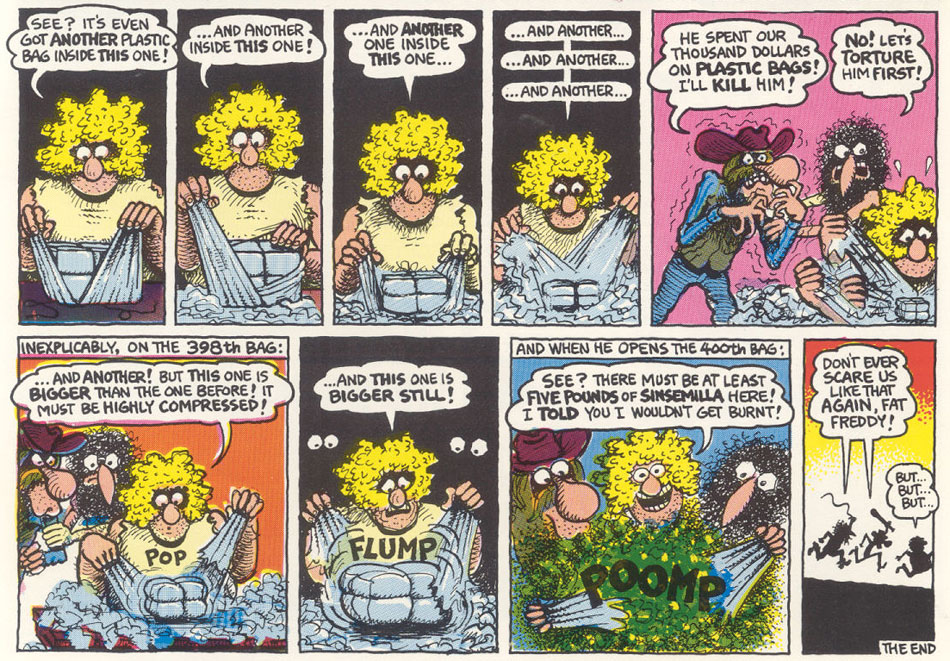
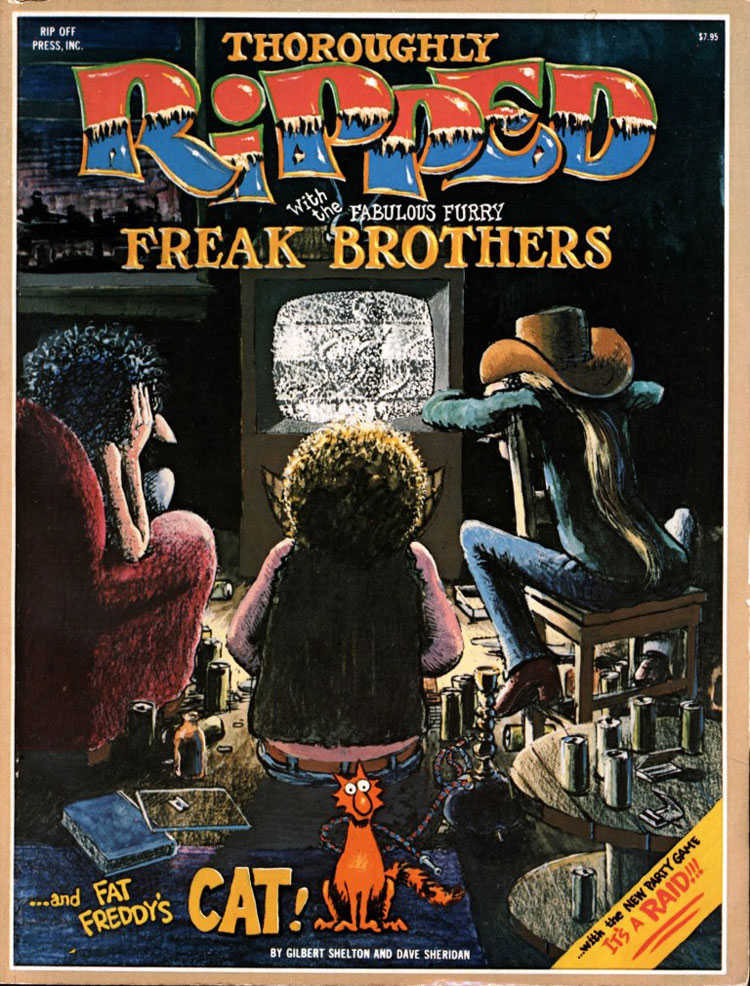
From: 'Thoroughly Ripped with the Fabulous Furry Freak Brothers' (1978).
In 1968, 'The Fabulous Furry Freak Brothers' first appeared in book format in Gilbert Shelton's self-published 'Feds 'n' Heads' - later reprints were released through The Print Mint from Berkeley, California. From February 1971, they had their own separate book series from Shelton's own Rip Off Press, remaining the imprint's major seller for decades: at the time, they sold half a million copies. While 'The Fabulous Furry Freak Brothers' were the main feature, issues also offered room for comics by other artists, like Ted Richards ('Dopin' Dan') and Bobby London ('Doctor Dope'). Originally, the books were compilations of previously published episodes, but by the third issue Shelton already discovered that he could only offer 36 new pages instead of the usual 52. They were released anyway, but to avoid giving his loyal fans the feeling of not getting their money's worth, he had to create more new material.
Around this time, the underground comix movement came to a standstill. In 1973, the US Supreme Court ruled that local communities could decide for themselves whether they would allow distribution of pornographic material. Many US states banned underground comix or threatened stores that sold them with legal harassment. Several underground cartoonists either quit or toned down the shock comedy and sex scenes. Shelton was one of the lucky ones: 'The Fabulous Furry Freak Brothers' kept in production and remained popular with new generations of young adults. With help from a new assistant, Dave Sheridan, Shelton drew a fourth (1975) and fifth (1977) volume of his hit series. Now able to divide the workload, the artwork of 'The Fabulous Furry Freak Brothers' became richer, while the stories became longer. 'The 7th Voyage, A Mexican Odyssey' (Fabulous Furry Freak Brothers, volume #4, 1975) was, for instance, 24 pages long, while 'Grass Roots' (volume 5, 1977) even offered 36. In 1977, Sheridan left for a while and was succeeded by Paul Mavrides, who had grown up with 'The Fabulous Furry Freak Brothers' and knew the characters inside out. Meanwhile, in 1977, Rip Off Press also released an anthology series, Rip Off Comix, which featured several new 'Freak Brothers' stories, written and drawn by Mavrides and Shelton, with some written contributions by Joe Brown and Don Baumgart. These were compiled into the 6th volume (1980) and 7th volume (1982) of 'The Fabulous Furry Freak Brothers'.
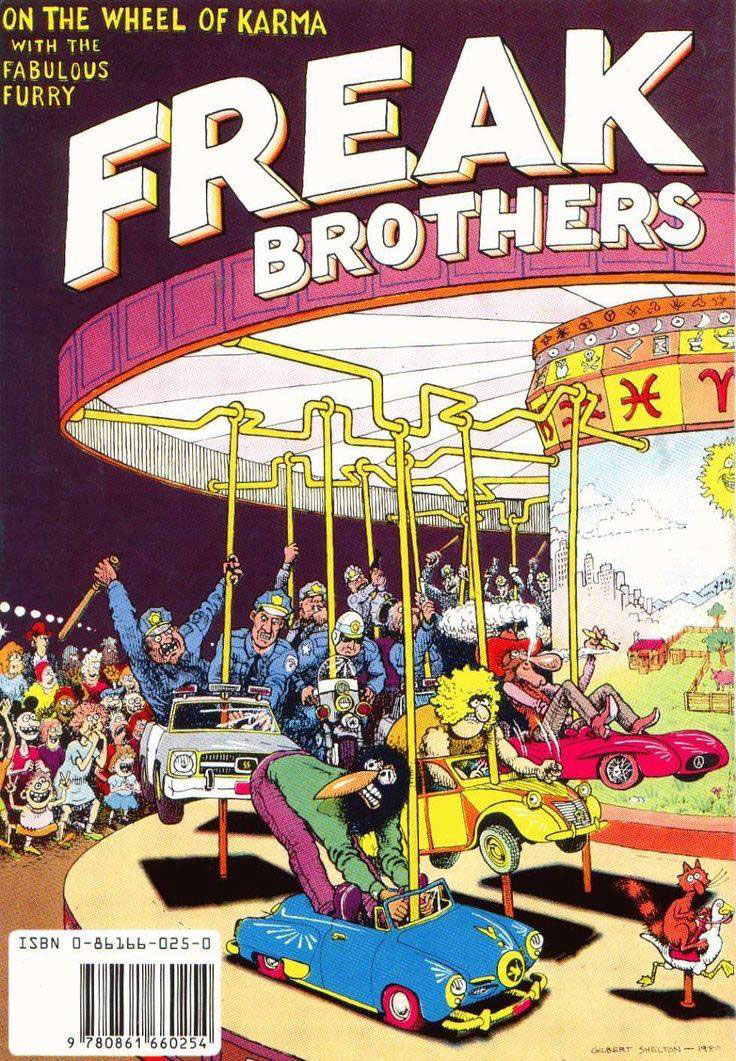
'On the Wheel of Karma with the Fabulous Furry Freak Brothers'.
In the 1980s, Shelton's wife Lora Fountain became the business partner of Shelton's agent, later turning into an independent literary agent herself. Dave Sheridan, who by the early 1980s joined in again as co-contributor, died in 1982 from a brain haemorrhage. To cope with this loss, Shelton and Mavrides created the ambitious 'The Idiots Abroad' serial, which ran in three successive volumes of 'The Fabulous Furry Freak Brothers', namely #8, #9 and #10 (1984-1987). In 1992, the final 'Fabulous Furry Freak Brothers' book with new material was published. Another issue came about in 1997, but this 13th volume was a compilation of rare episodes previously published in the magazines High Times and Hugh Hefner's Playboy.
Much to everybody's surprise, 'The Fabulous Furry Freak Brothers' has turned into a relic of "the golden 1960s", but has kept being rediscovered and enjoyed by new generations. Shelton co-worker Paul Mavrides recalled visiting a punk concert in the late 1970s, where the crowd expressed their hatred of "hippies", but went ecstatic when they heard that he was the co-creator of 'The Fabulous Furry Freak Brothers', one of their favorite comics! The cross-generational aspect of Franklin, Phineas and Freddy can be attributed to Shelton's witty scripts, but also to the timelessness of three roommates trying to keep financially afloat and hating the police. Stoners are naturally the series' most enduring fans, but the Freak Brothers also appeal to students, punks, squatters and slackers. It helps that their designs and personalities could match any person from these demographics.
Controversy
Like many other underground comix, Shelton's work was suspicious in the eyes of some police forces that held raids in local head shops, where the owners sold marihuana and comics under the counter. Interviewed by Goblin Magazine (2013), Paul Mavrides attributed this to the public misconception that comics are for children, "so if you have comics in a head shop that meant you were trying to lure kids in to buy drug paraphernalia." For a number of years, 'The Fabulous Furry Freak Brothers' couldn't be legally sold in Canada, since the local law prohibited any material that proselytized or didn't attack marijuana in print. Eventually the law got overturned. In the early 1980s, the British importer Hassle Free Press (later Knockabout Comics), was frequently hassled by police raids, due to national obscenity laws. British Customs eventually decided that 'The Fabulous Furry Freak Brothers' could no longer be imported into Great Britain. Rip Off Press allowed Hassle Free Press (Knockabout) to publish their own editions of the comic instead. Eventually, the judge ruled in the publisher's favor, overturning the interference of the police force.
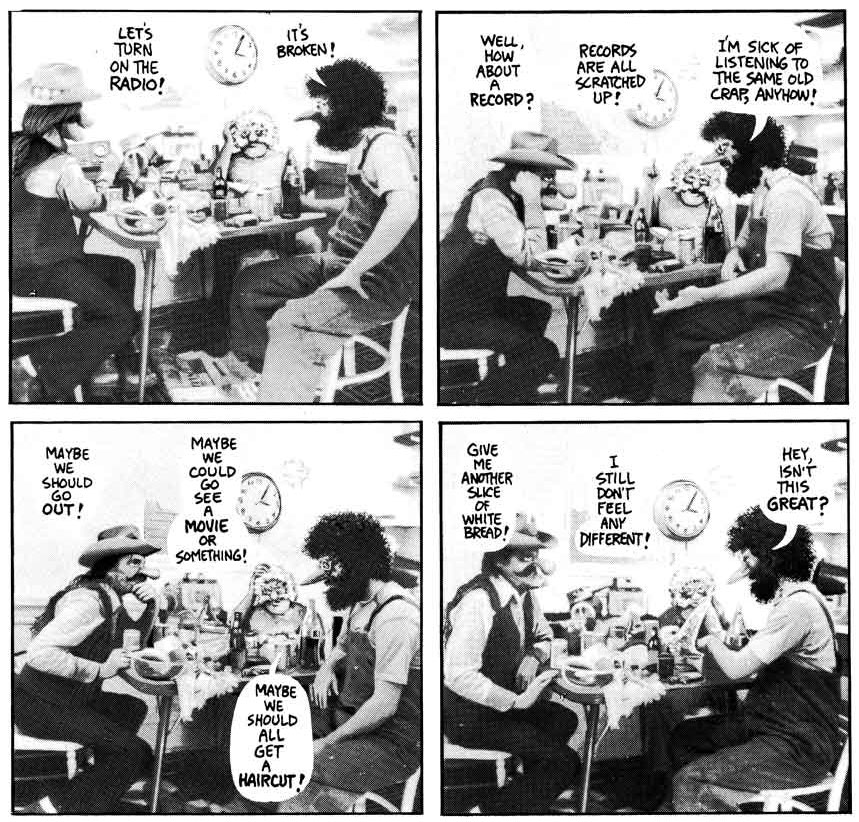
Photo comic with the Fabulous Furry Freak Brothers.
Fabulous Furry Freak Brothers: film and TV
As one of the more recognizable underground comix, 'The Fabulous Furry Freak Brothers' has inspired several media adaptations. In 1978, John Seeman made a porn parody movie, 'Up in Flames', featuring The Fabulous Furry Freak Brothers and Robert Crumb's Mr. Natural. The film was made without Shelton or Crumb's knowledge or permission, so the characters appeared in an only vaguely recognizable incarnation. In 1979, Universal Studios and Gilbert Shelton spoke about a live-action film version. A script was written, but never went into production. In 2006, Dave Borthwick and Aardman Animation cinematographer Dave Alex considered a clay-animated version of the comic, produced by Celluloid Dreams, Bolexbrothers and X Filme, but apart from a few test scenes, the required budget could not be raised. Even Matt Groening (of 'The Simpsons' fame) once considered producing a 'Fabulous Furry Freak Brothers' film, but this plan also went nowhere.
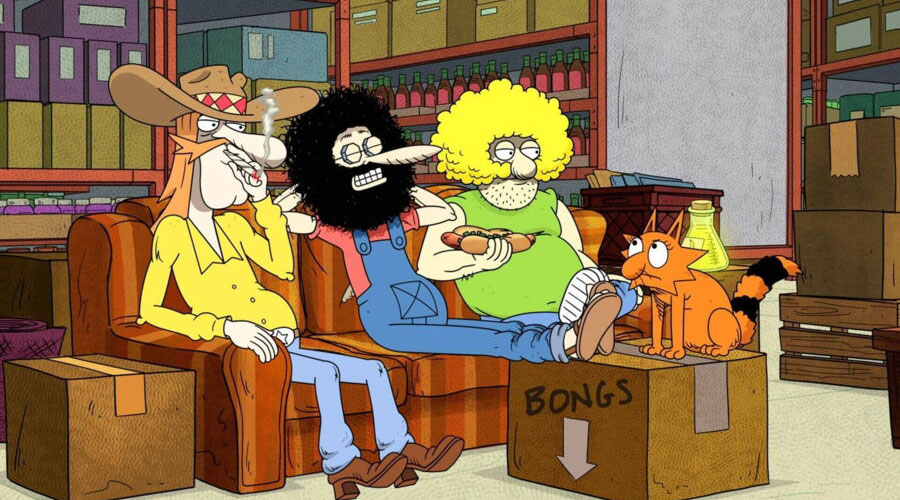
Animated version of the Fabulous Furry Freak Brothers.
After more than half a century of waiting, Gilbert Shelton had seen so many cinematic projects based on his characters get stuck in development hell that he lost interest. He comforted himself that it would at least not ruin his comic's reputation. But in 2021, against all odds, 'The Fabulous Furry Freak Brothers' finally received an animated TV series, broadcast on the streaming service Tubi. With directors Alan Cohen, Alan Freedland, Daniel Lehrer, Jeremy Lehrer-Craiwer and Courtney Solomon, it featured the voice talents of Pete Davidson (Phineas), Woody Harrelson (Franklin) and John Goodman (Freddy). Fat Freddy's Cat became female, listening to the name Kitty and voiced by Tiffany Haddish. In the pilot episode, the quartet gets high during the 1969 Woodstock Festival ending up in a catatonic state from which they only recover in the 2020s. This alternative storyline gave the show's creators a chance to contrast the Freak Brothers' hippie attitude with contemporary satire, making it a "fish out of water" comedy. The brothers are confused by smart phones, the Internet and Taylor Swift, but delighted with the legalisation of marijuana in some US states. Episodes have also featured political satire, like a memorable episode in which they meet Donald Trump in the White House. Although 'The Fabulous Furry Freak Brothers' TV show had to compete with other mature animated TV shows like 'The Simpsons', 'South Park' and 'Family Guy', it received mixed reviews, but high ratings. Shelton himself said he was "mostly happy" with it, but otherwise had a "hands off" approach, giving the creators the chance to do their own thing with it.
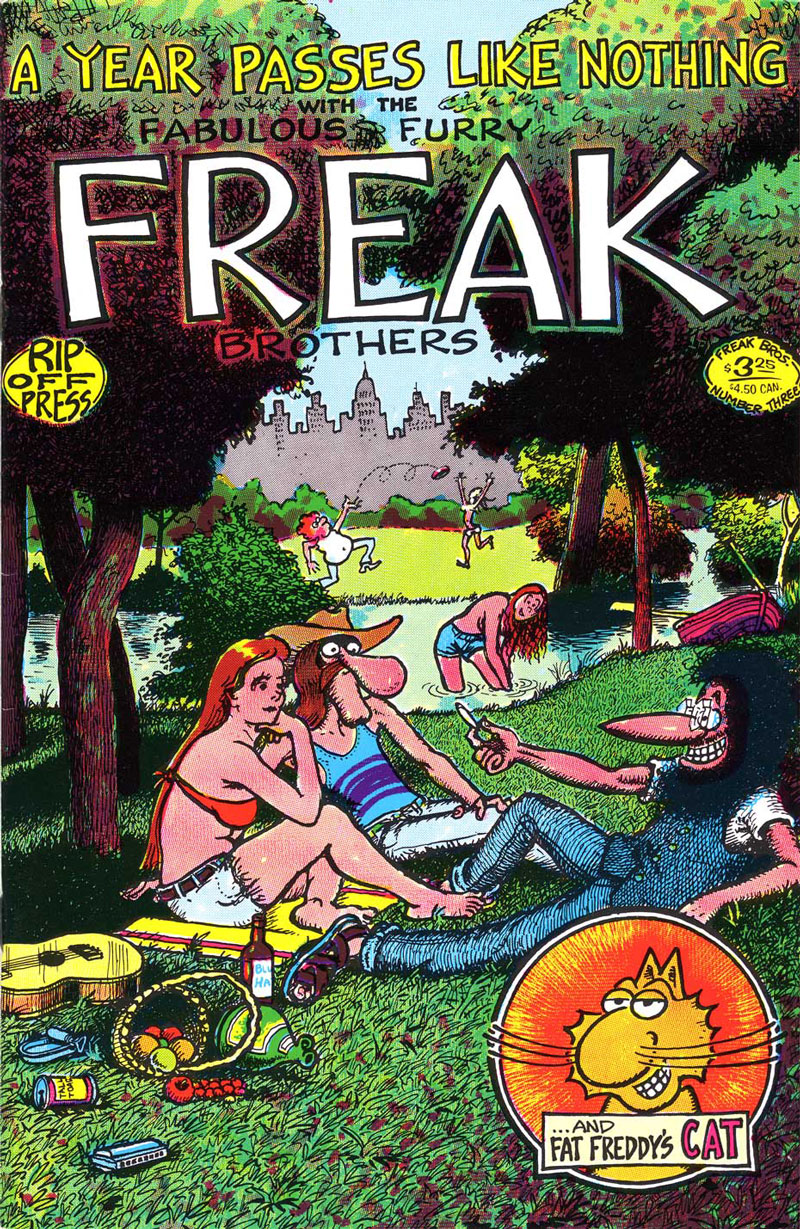
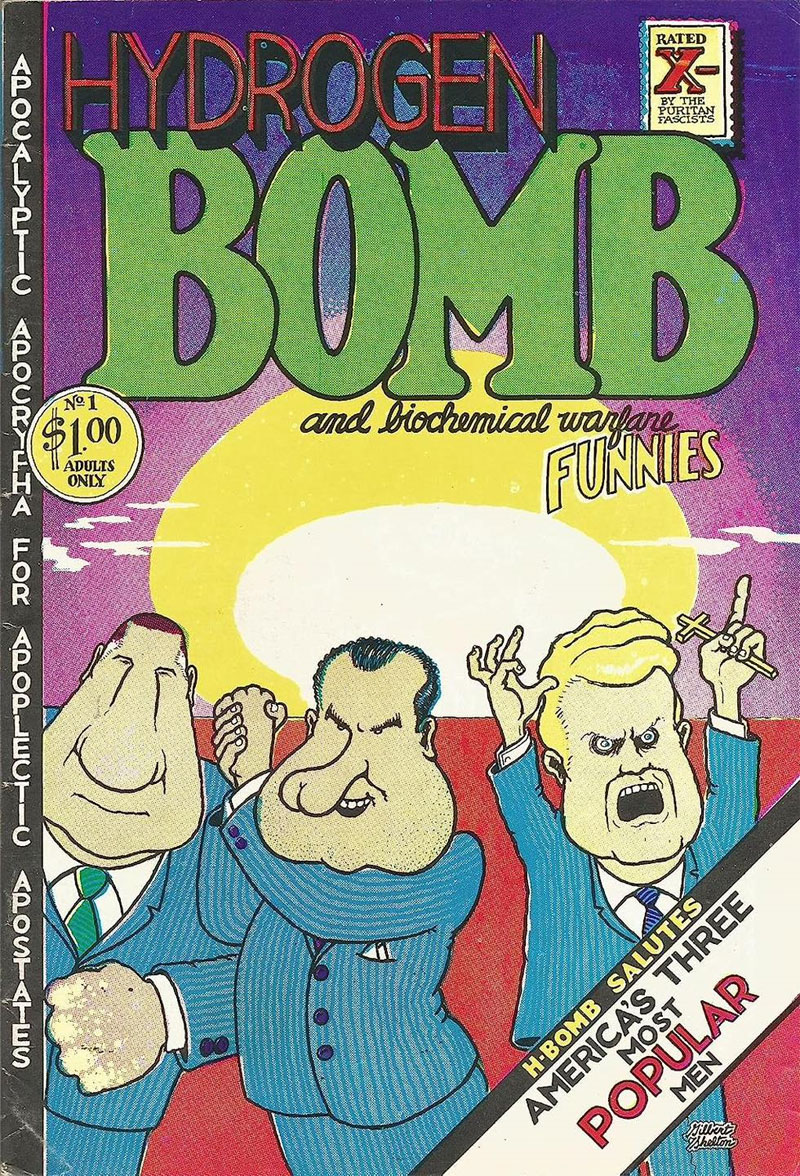
Rip Off Press
By the time he was based in California, Gilbert Shelton became an important player in the field of underground comix. Together with his college buddies Jack Jackson (AKA Jaxon), Dave Moriarty and Fred Todd, he established his own independent publishing company on 17 January 1969: Rip Off Press. They originally had their headquarters in San Francisco's former Mowry's Opera House, which also housed another publisher of underground comix, Don Donahue's Apex Novelties. Their offices were not far from San Francisco's Haight-Ashbury neighborhood, at the time the epicenter of the hippie counterculture, where they sold most of their books. However, on 17 July 1970, the building caught fire and nearly burned to the ground. After that, Rip Off Press relocated to 1250 17th Street, where they remained until 1985.
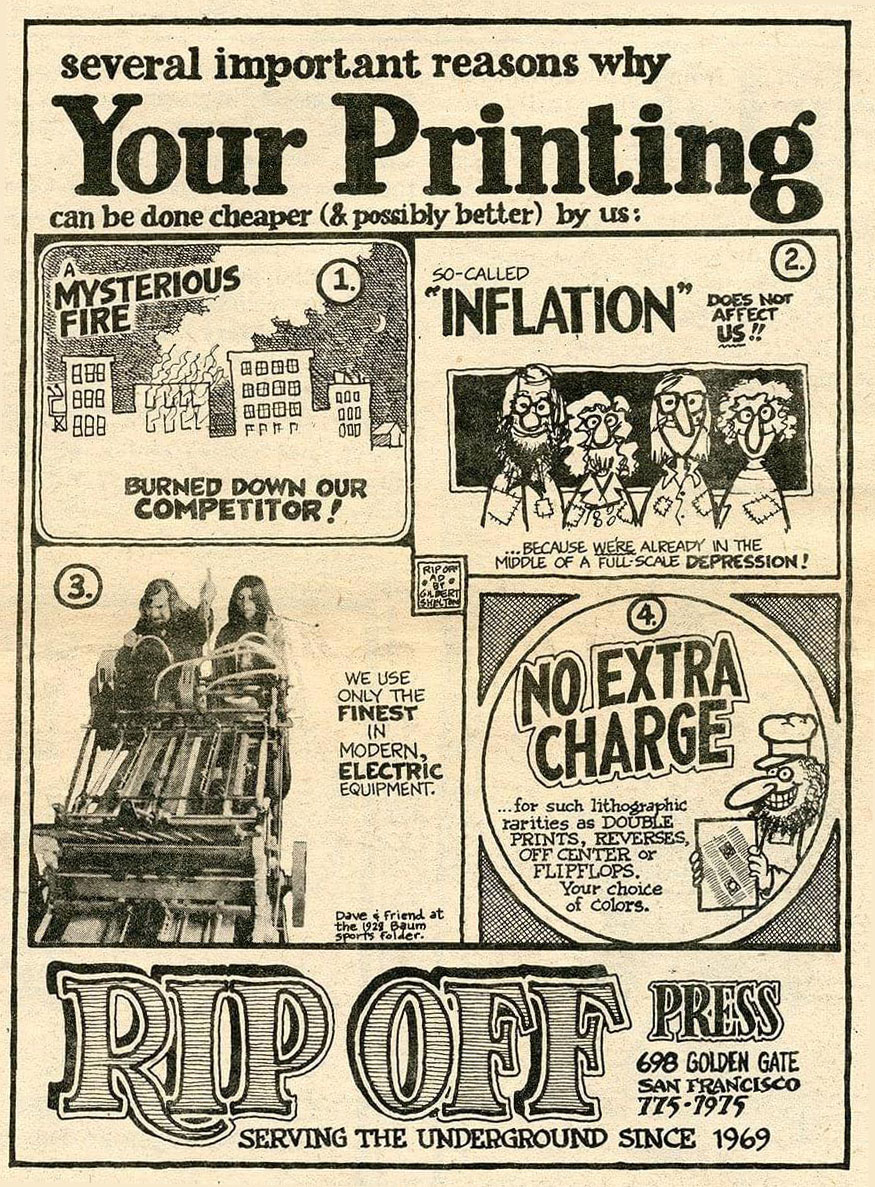
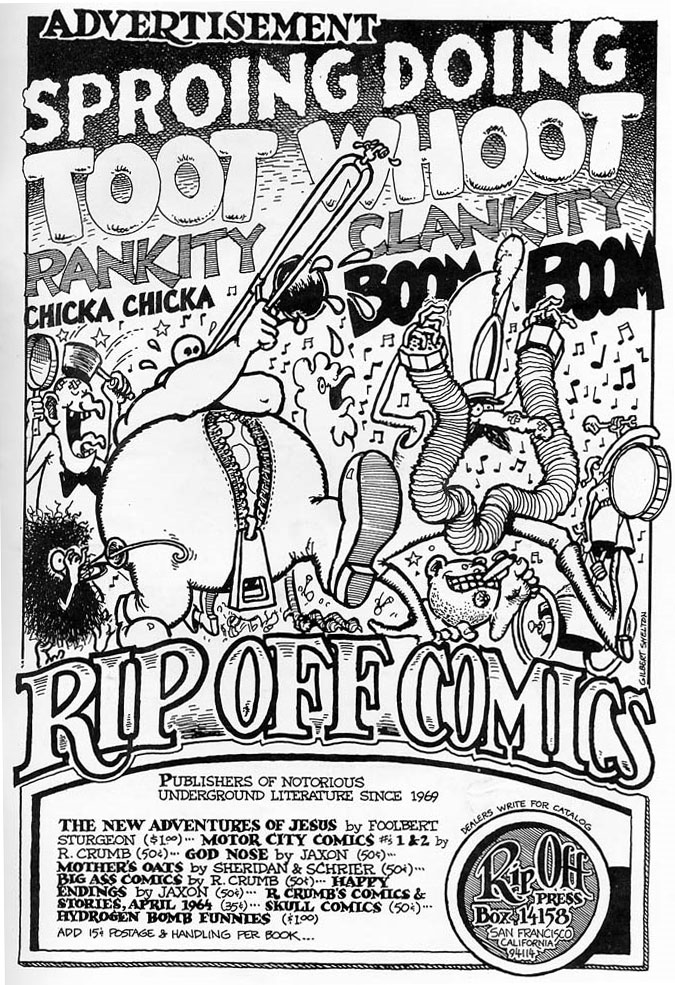
Rip Off Press advertisements by Gilbert Shelton.
Originally, Rip Off Press was mostly an outlet to release and distribute the group's own comics. Besides comic books, the company had its own syndication service that distributed their comics to college magazines and weekly alternative newspapers. Managed by Gilbert Shelton, the Rip Off Press Syndicate was in operation between 1969 and 1979. Over the years, several underground and alternative cartoonists joined Rip Off Press, for instance Joel Beck, Robert Crumb, Justin Green, Bill Griffith, Paul Mavrides, Ted Richards, Spain Rodriguez and Fred Schrier. In addition, they also promoted alternative cartoonists from later generations and from Europe, including the United Kingdom, France, Spain, The Netherlands, Belgium and Denmark. Apart from comics, Rip Off Press also published Michael Valentine Smith's "cook book" 'Psychedelic Chemistry' (1973), on how to make your own drugs, and reprints of the 1973 pseudo-spiritual pamphlet 'Principia Discordia' by Greg Hill and Kerry Wendell Thronley.
In June 1972, Rip Off Press made an attempt to launch a genuine cultural magazine, with articles, interviews, columns and photographs, but deliberately as few ads as possible, to remain independent. Titled The Rip Off Review of Western Culture, J. David Moriarty was chief editor, Robert Follett editorial director, with Dave Sheridan serving as art editor. The magazine also featured comics by Gilbert Shelton and other established underground artists like Joel Beck, Tullio DeSantis, Jim Franklin, Kerry Fitzgerald (AKA Kerry Awn), Gary Frutkoff, Monjett Graham, Jaxon, William Klapp, Victor Moscoso, Phil Romero, Pat Ryan, Vin Scheihagen, Fred Schrier, Frank Stack, Larry Welz, S. Clay Wilson and Kim Verstraten. However, before the end of the year, the magazine had folded. Between 1977 and 1983, Rip Off Press released twelve issues of their anthology book series Rip Off Comix. Between 1987 and 1991, nineteen more issues appeared.
In 1986, an explosion in an illegal fireworks factory also made a large part of their headquarters (now in San Jose Avenue) go up in flames. By then, the company was managed by the last remaining original partner Fred Todd, who was joined by his wife Kathe. In 1987, the Todds relocated Rip Off Comix to Auburn, California, where they eventually left the publishing business and switched to retailing, eventually mostly online.
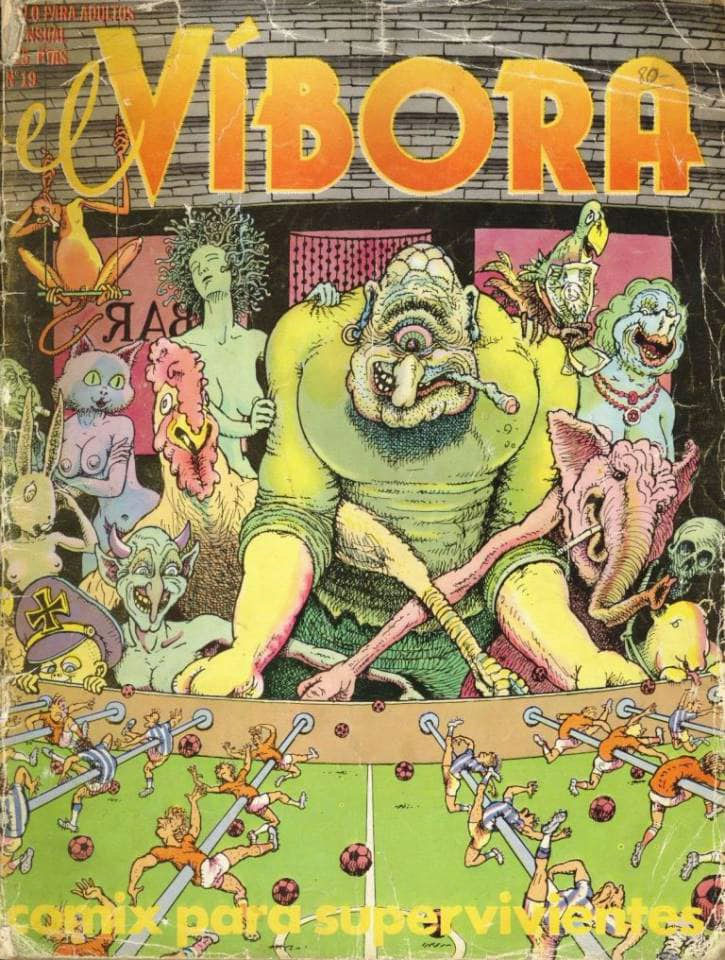
Cover for El Víbora (19 June 1981).
Move to France
In 1979, Gilbert Shelton and his wife Lora Fountain left San Francisco. Using the money from a never-produced film deal with Universal for a 'Fabulous Furry Freak Brothers' movie they traveled through Europe, which, in turn inspired some of the Freak Brothers' similar travel adventures. Between 1980 and 1981, the Sheltons lived in La Floresta, Barcelona, just over the Tibidabo hill. In Spain, his comics ran in the alternative magazines El Víbora and Makoki. One of his more notable contributions ran in the 23 February 1983 issue of El Víbora, which was devoted to the failed military coup in Spain of 1981, when colonel Antonio Tejero walked in the Spanish parliament trying to take over, but waited for recruits who never arrived. In the story, Shelton spoofs this event.
In 1984, Shelton and his wife inherited an apartment in Paris, not far from the Père Lachaise cemetery, and decided to settle there for good. Many journalists have pointed out the coincidental parallels between Gilbert Shelton and Robert Crumb's careers, particularly that Shelton once applied for a job at American Greetings, where Crumb worked, and that less than a decade later, Shelton moved to France, while Crumb and his family did the same in 1992.
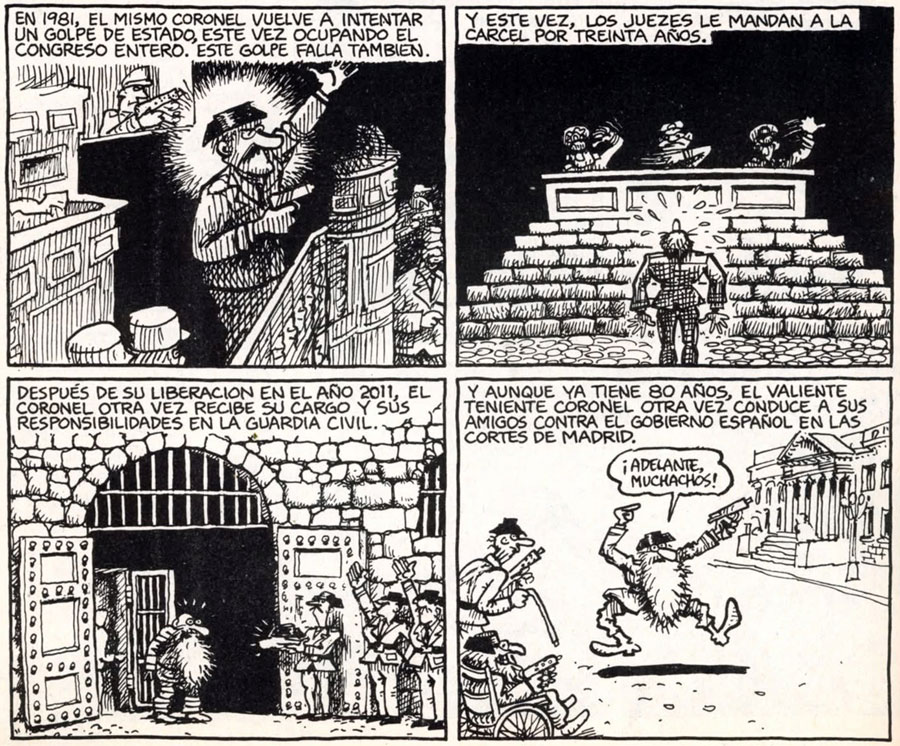
'Golpe de Estado en España' (El Víbora #19, 1981).
Not Quite Dead
Based in France, Gilbert Shelton continued to work as a cartoonist, with his most notable new creation being the gag comic 'Not Quite Dead' (1988-2010), about an unlucky amateur rock band. In 1988, Shelton drew the characters for the first time on the cover of Rip Off Comix issue #19, but it wasn't until issue #25 (Winter 1989) that their first gag was printed. After a hiatus, Shelton teamed up with the French cartoonist Pic to turn it into an ongoing series. Between 1993 and 1996, Rip Off Press released six issues in the United States. In France, 'Not Quite Dead' was serialized in the magazine Flag, with four book collections published by Tête Rock Underground (1996, 1998, 2006, 2009). Between 2005 and 2010, Knockabout released the series in the United Kingdom it ran in Knockabout Comics.
As Not Quite Dead try to make their big breakthrough, they are constantly confronted with Spinal Tap-esque troubles, accidents and bad luck. The band consists of quiffed lead singer Cat Whittington, the curly-locked guitar player Elephant Fingers, the cool saxophonist Sweaty Eddie (a caricature of Paul Mavrides), while the short-sized, big-nosed suit-wearing Felonious Punk performs on keyboards, dim-witted Thor trashes away on drums and equipment manager Gnarly Charlie helps out on tambourine. The band's management is run by their agent Lorleen. Not Quite Dead plays at a lot of gigs where things go disastrously and hilariously wrong. Their antics range from half and one-page gag comics to short stories. Apart from the characters' squabbles and incompetence, 'Not Quite Dead' also offered satire of the music industry, unreceptive crowds and conservatives who want to ban "dangerous rock".
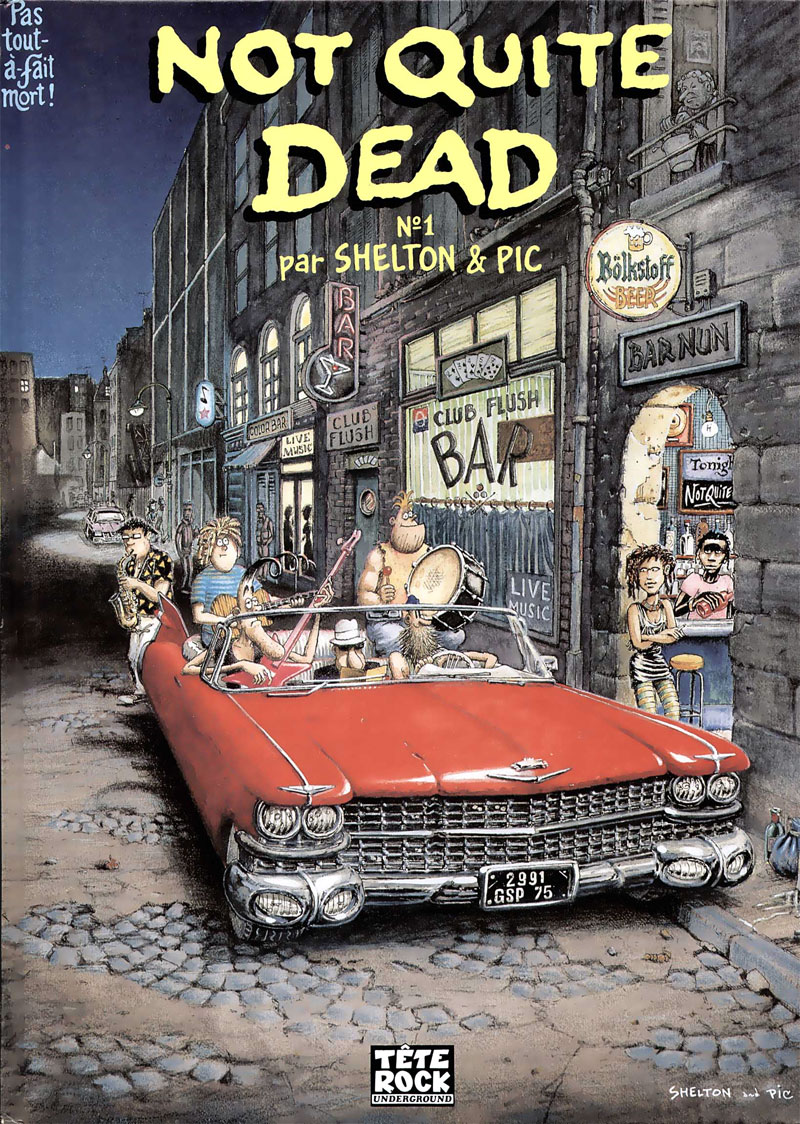
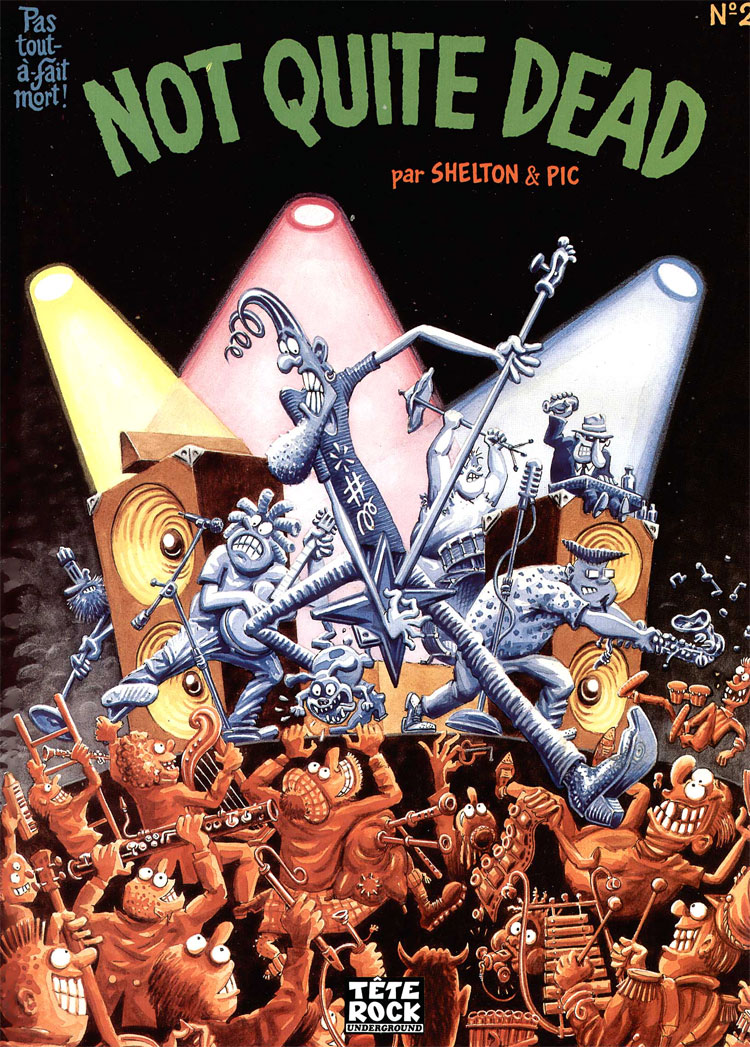
'Not Quite Dead', French editions.
Contributions
In 1971, Shelton's Monopoly-inspired board game 'Feds 'n' Heads' appeared as a supplement to the September issue of Hugh Hefner's Playboy magazine. In music, he designed the 1973 self-titled debut album by Doug Sahm and Band, as well as 'Shakedown Street' (1978) by The Grateful Dead. He also livened up the cover for 'The Best of Creative Computing, Volume 2' (1977). Shelton made a graphic contribution to Marion Vidal's 'Monsieur Schulz et ses Peanuts' (Albin Michel, 1976), an essay about Charles M. Schulz' 'Peanuts', illustrated with subversive parodies of the comic that Schulz unsuccessfully tried to sue. He was one of the artists making graphic contribution to 'Pepperland' (1980), a collective comic book celebrating the 10th anniversary of the Pepperland comic book store. In addition, he contributed to 'Les Aventures Du Latex - La Bande Dessinée Européene S'Empare Du Préservatif' (1991), a Swiss educational comic promoting condom use. He illustrated a record single for the project '20 Vraies Fausses Pochettes de Disque Par 20 Vrais Dessinateurs de BD' (1995), choosing a song by Clarence "Gatemouth" Brown. Shelton additionally drew a homage to Robert Crumb in the collective book 'A Tribute to Robert Crumb' (Éditions 52, 2013). In 2014, Shelton wrote the foreword to a Dark Horse Comics reprint of Harvey Kurtzman's 'Jungle Book'.
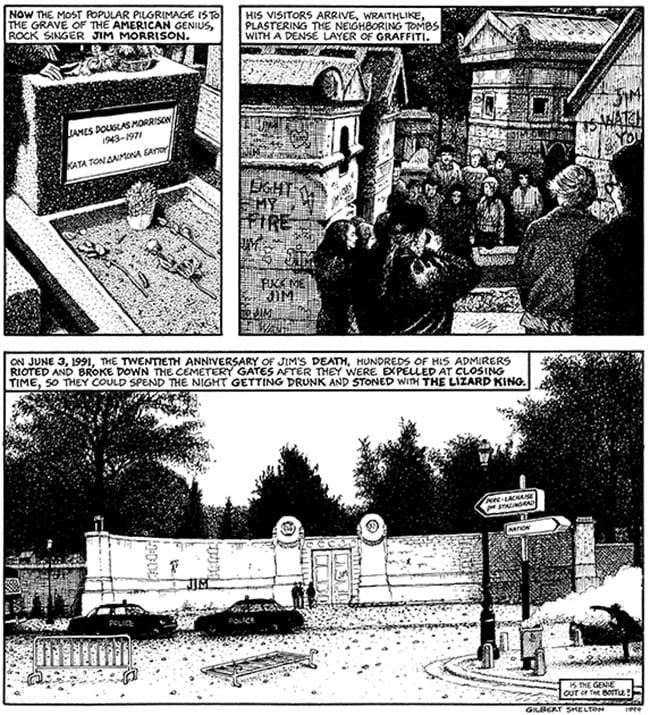
'Graveyard Ghosts' (Zap Comix #13, 1994).
In 1989, Gilbert Shelton and Paul Mavrides were interviewed for the documentary 'Comic Book Confidential'. They additionally designed the cover for 'Grateful Dead Comix' #4 (Kitchen Sink Press, 1991), a series of comics about the cult rock group The Grateful Dead. One of Shelton's most notable contributions appeared in Zap Comix #13 (1994), where his story 'Graveyard Ghosts' was an interesting break in style and tone, reflecting on his visit to Jim Morrison's grave at the Père La Chaise cemetery in Paris.
Music
From a young age, Gilbert Shelton adored R&B music, doubled by the fact that his parents didn't like it. He often secretly listened to it on his transistor radio under his bed sheets. In 1966, the single 'If I Was A Hells Angel/Southern Stock Car Man' was released on the ESP label under the group name the Gilbert Shelton Ensemble, which featured members of The Conqueroo, an Austin rock band that performed at the Vulcan Gas Company. Two years later, Gilbert Shelton designed a full-colour picture sleeve for The Conqueroo's 1968 single 'I've Got Time/1 To 3'. In France, Shelton sang and played piano as part of The Blum Brothers, a R&B group he formed with fellow cartoonist Bruno Blum.
Recognition
In 1978, Gilbert Shelton and Dave Sheridan shared an Inkpot Award. In 2011, Shelton received the LiberPress Camin Award and a year later, he was inducted into the Will Eisner Hall of Fame. Between 13 March and 8 May 2010, his comics were exhibited in the South Austin Museum of Popular Culture. Between 18 May and 3 June 2018, they were on display in the gallery of the Comic Art Factory in Brussels, Belgium. In May 2024, his art was also the subject of a retrospective exhibition at Hed Hi Studios in Charleston, South Carolina, organized by Shelton's nephew, filmmaker Gavin Shelton.
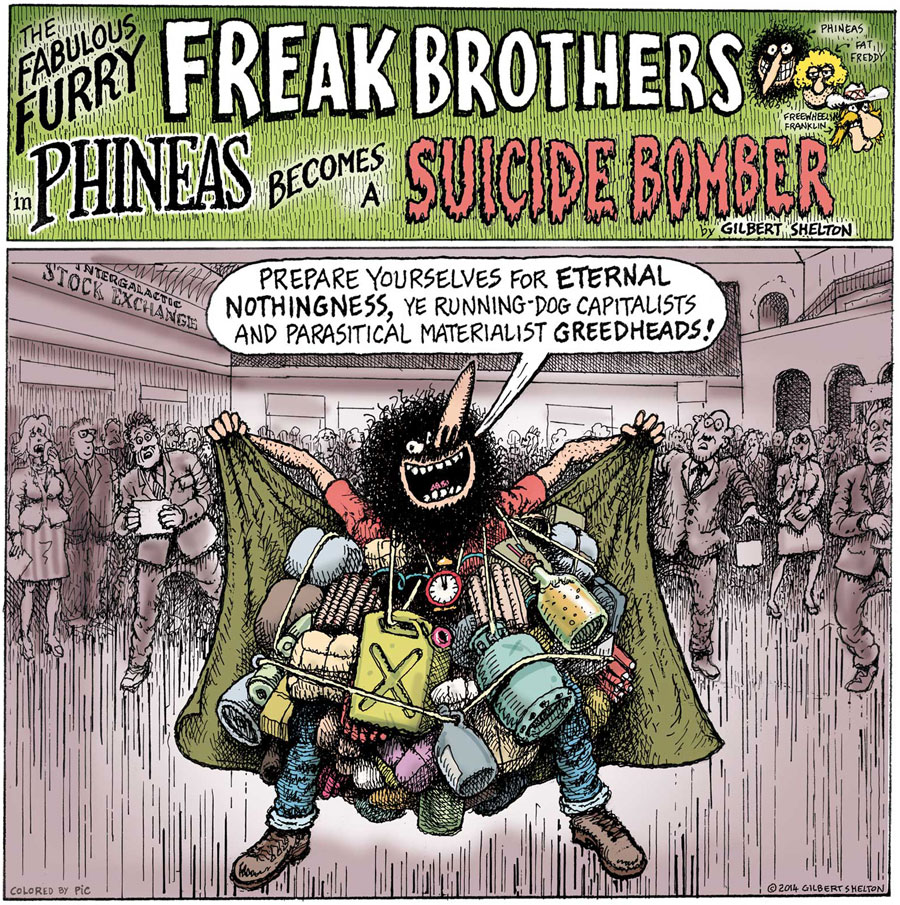
'Phineas Becomes a Suicide Bomber', new episode for 'The Complete Zap Comix' #4 (November 2014).
Legacy and influence
Gilbert Shelton remains a cult figure and one of the most beloved underground cartoonists. Still, many misconceptions exist about the artist. Since he is such an icon of the hippie era, many fans assume he is nostalgic for "the golden sixties". In reality, Shelton never felt like a true hippie, since he was already in his late twenties when the subculture emerged. He also preferred R&B and blues over rock music. Shelton has also been a sparse drug user. He was already experimenting with marijuana, LSD and peyote in the late 1950s, long before they received more mainstream attention in the mid-1960s. To obtain them, he used to travel across the Mexican border. But even when it became easier to get access to hallucinogenic drugs, he always maintained a strong workman's discipline. As co-founder of Rip Off Press, he had a lot of responsibility running a business, and he wrote and drew his comics while completely clean and sober. Shelton has never been an advocate of all drugs either, which explains why the Freak Brothers don't use heroin.
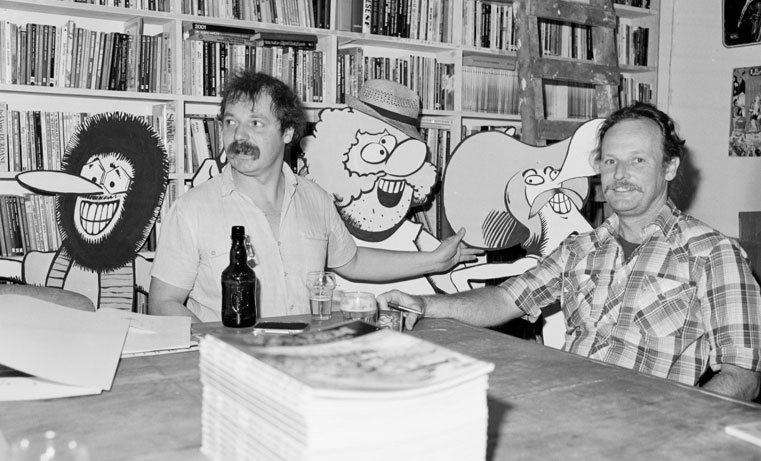
Gilbert Shelton (right) with Kees Kousemaker (left) at comic shop Lambiek in Amsterdan (1970s). Photo: Hans Frederiks.
'The Fabulous Furry Freak Brothers' can be considered the first "stoner comedy" in history, paving the way for cinematic equivalents like Cheech & Chong and Harold & Kumar. In fact, Tommy Chong actually named Shelton's comics as his direct inspiration. A song from a comic by Shelton in Bijou Funnies #1 (1968), titled 'Set My Chickens Free' has been set to music by The Hub City Movers (1969), David Carradine (1976) and Merle Haggard (1994). The song 'Pigs of Uranus' (1972) by Pink Fairies is lyrically lifted from Shelton's 1970 'Wonder Warthog and the Invasion of the Pigs from Uranus' story. In Galway, Ireland, the theme restaurant Fat Freddy's Restaurant has been named after the comic. In Italy, supporters of the football team Ternana Calcio are nicknamed "the Freak Brothers". The New Zealand band Fat Freddy's Drop was based on the comic, with musician Dallas Tamaira being a comic artist himself.
'The Fabulous Furry Freak Brothers' were spoofed by Jay Lynch as 'The Geek Brothers' in Bijou Funnies issue #8. In the United States, Gilbert Shelton was an influence on Ralph Bakshi, Larry Gonick, The Hernandez Brothers, Krystine Kryttre, Frank Stack and Arthur Suydam. In Canada, he inspired Robin Bougie. He also found followers in Belgium (Willy Linthout), France (Garf, Invader, Pixel Vengeur), Germany (Andreas Rausch, Gerhard Seyfried), The Netherlands (Jos Beekman, Flip Fermin, Frans Hasselaar, Yiri T. Kohl, Oscar De Wit) and the United Kingdom (Alan Moore, Stewart Kenneth Moore). Alan Moore once described Shelton "as near as comics have come to a natural comedic genius of the same stature as a Chaplin or a Tati." In Australia, Shelton influenced Tony Edwards, whose pig superhero 'Captain Goodvibes' is a direct tribute to Wonder Wart-Hog.
Secondary literature
For those interested in Gilbert Shelton's life and career, the book 'Freaks, Free Press and Warthogs' (Presses Universitaires de Bordeaux, 2024), by Jean-Paul Gabilliet, Pierre Ponant and Camille de Singly, is highly recommended.
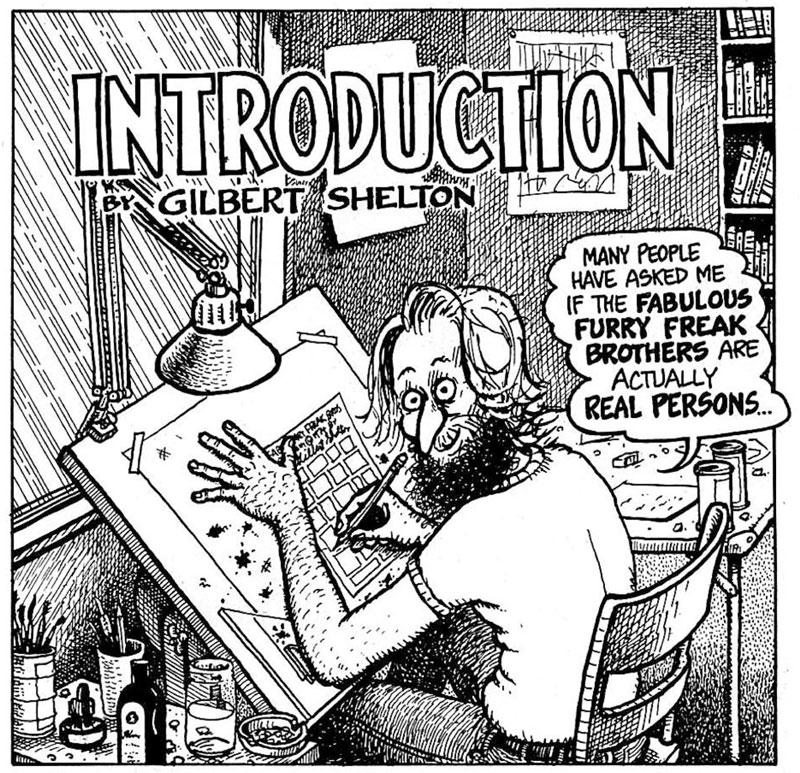
Self-portrait.